Katsushika Hokusai: A Pioneer of Impressionism Before Its Time
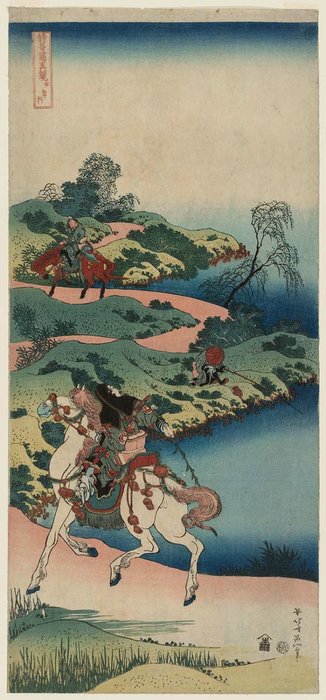
The painting “Young Man Setting Out,” attributed to Katsushika Hokusai, stands as a testament to the artist’s unparalleled ability to capture fleeting moments of beauty and emotion—a feat that foreshadowed the burgeoning movement of Impressionism decades before its formal emergence in Europe. More than just a depiction of two riders on horseback, this artwork embodies a profound exploration of Japanese landscape painting and its connection to Zen Buddhist philosophy.
- Subject Matter: The scene portrays a young man embarking on a journey across a hillside adorned with lush foliage and scattered trees—a common motif in Hokusai’s oeuvre reflecting the importance of pilgrimage and contemplation within Japanese culture.
- Style: While categorized as landscape painting, “Young Man Setting Out” transcends conventional stylistic boundaries. Its flattened perspective and emphasis on atmospheric effects – particularly the subtle gradations of color – reveal an intuitive grasp of principles that would later become hallmarks of Impressionism. Hokusai’s approach prioritizes capturing the essence of a scene rather than meticulous detail.
Technique: The Power of Prussian Blue
Hokusai's masterful use of Prussian blue—a pigment synthesized in Europe during his lifetime—is arguably the painting’s defining characteristic. This vibrant hue dominates the sky, conveying not merely color but also a sense of dynamism and depth. Unlike traditional Japanese pigments which relied on mineral oxides to achieve similar tonal ranges, Prussian blue offered an unprecedented level of saturation and luminosity. The artist skillfully blended this pigment with other colors—greens, browns, and reds—to create a harmonious palette that perfectly complements the natural surroundings.
Historical Context: Edo Period Japan and Zen Aesthetics
“Young Man Setting Out” was created during the Edo period (1603-1868), a time of relative peace and prosperity under Tokugawa rule. This era witnessed a flourishing of artistic patronage, particularly within Buddhist monasteries where Hokusai served as a prolific printmaker. Zen Buddhism profoundly influenced Japanese aesthetics, emphasizing simplicity, spontaneity, and direct perception—values that are vividly reflected in the painting’s composition and color choices. The artist deliberately avoids elaborate ornamentation, focusing instead on conveying a feeling of serene contemplation.
Symbolism: Journey Towards Enlightenment
The young man traversing the hillside symbolizes the arduous path towards enlightenment – a central concept within Zen Buddhism. The horses represent steadfastness and perseverance, mirroring the unwavering determination required to overcome obstacles and achieve spiritual realization. Furthermore, the trees serve as visual anchors, grounding the scene in the natural world and reminding viewers of the interconnectedness between humanity and nature—a recurring theme throughout Hokusai’s artistic output.
Emotional Impact: Tranquility and Wonder
Ultimately, “Young Man Setting Out” evokes a profound sense of tranquility and wonder. The painting's subdued palette combined with its dynamic composition invites contemplation and encourages viewers to appreciate the beauty of the natural world. It’s a piece that speaks to the human desire for connection—both with oneself and with something larger than oneself—a timeless message conveyed through masterful technique and imbued with the spirit of Zen Buddhism.