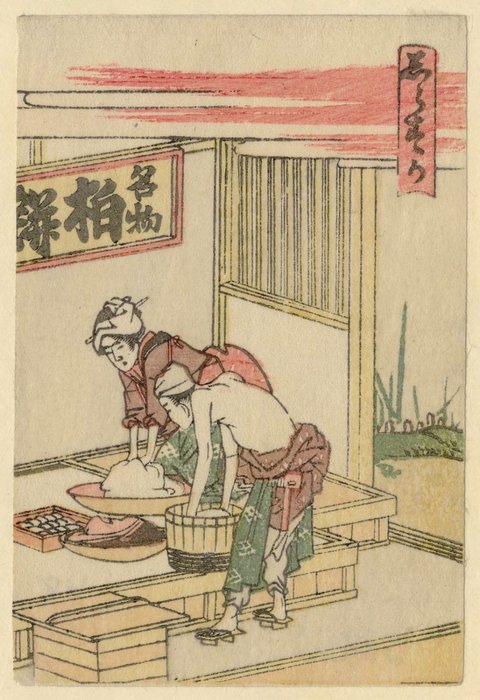
Shirasuka – A Landscape Reverie by Katsushika Hokusai
Katsushika Hokusai’s “Shirasuka,” part of his monumental series “Thirty-Six Views of Mount Fuji,” transcends mere depiction; it embodies a profound meditation on nature and the ephemeral beauty of existence. Executed in vibrant Prussian blue pigment, this woodblock print captures a serene vista overlooking Shizuoka Prefecture—specifically, the region surrounding Shirasuka Station.
- Composition: The scene unfolds horizontally across the sheet, dominated by Mount Fuji’s majestic presence rising above a dense grove of bamboo. Foreground elements include a small pond reflecting the mountain's grandeur and a meticulously rendered embankment adorned with flowering shrubs.
- Technique: Hokusai’s mastery lies in his masterful application of Prussian blue—a pigment imported from Europe during the Edo period—which achieved an unparalleled luminosity and depth. The printmaker skillfully utilized Ukiyo-e techniques, including meticulous carving of woodblocks and precise layering of ink to achieve remarkable tonal gradation and textural detail.
- Historical Context: Created in 1804 during the reign of Emperor Go-Showan, “Shirasuka” reflects the burgeoning interest in landscape painting within Japan’s artistic milieu. The series was conceived as a response to the growing popularity of scenic excursions among the samurai class and aristocratic families—a phenomenon known as *tokaidō* travel boom.
- Symbolism: Mount Fuji, revered as sacred by Buddhists and embodying stability and permanence, serves as a counterpoint to the fleeting beauty of the bamboo grove and pond. The artist’s deliberate framing emphasizes the grandeur of nature while simultaneously hinting at its impermanence—a central theme in Zen Buddhism.
The Influence of Impressionism: A Parallel Vision
Interestingly, “Shirasuka” foreshadowed developments in Western art decades later. The bold use of color and the flattened perspective—characteristics prominent in Impressionist paintings like Claude Monet’s Water Lilies—demonstrate Hokusai's intuitive grasp of artistic principles that would soon revolutionize European painting. This shared aesthetic sensibility underscores the universality of human perception and appreciation for natural beauty.
Beyond Aesthetics: Capturing a Moment in Time
"Shirasuka" isn’t simply a beautiful image; it’s a snapshot of a specific place and time—a testament to Hokusai's ability to distill complex emotions into visual form. The print invites contemplation on themes of solitude, tranquility, and the sublime—qualities that continue to resonate with audiences today. Its enduring appeal lies in its capacity to transport viewers back to Edo Japan and evoke a sense of wonder at the majesty of the natural world.
Reproductions & Inspiration: Bringing Hokusai's Vision Home
High-quality reproductions of “Shirasuka” offer an opportunity to experience the brilliance of Hokusai’s artistry firsthand. Whether adorning a gallery wall or serving as a centerpiece in a minimalist interior design scheme, this iconic print embodies timeless elegance and artistic innovation—a legacy that continues to inspire artists and collectors alike.