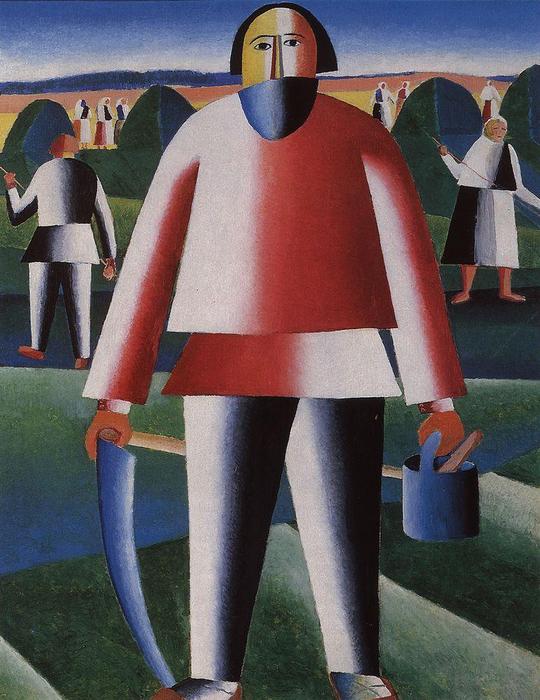
A Symphony of Red Amidst Rural Labor
In the vast landscape of twentieth-century abstraction, few works command attention with such visceral intensity as Kazimir Malevich’s “Haymaking,” completed in 1929. This monumental oil on canvas is far more than a mere depiction of agricultural toil; it is a profound philosophical manifesto rendered in pigment. At first glance, the viewer is met with a striking, almost rhythmic arrangement of color and form that captures a group of laborers engaged in the timeless task of harvesting. Yet, beneath this surface lies the radical heart of Neo-Suprematism, a movement designed to strip away the superficial layers of reality to reveal a fundamental, spiritual truth through pure geometric precision.
The painting’s visual impact is anchored by its masterful use of color, specifically a bold, commanding red that pulses through the composition. This hue does not merely serve a decorative purpose; it acts as a symbol of vitality, energy, and the transformative power of human labor. Malevich employs a technique characterized by flattened planes and simplified geometric shapes—circles and squares—arranged in an asymmetrical grid that defies traditional perspective. By reducing the figures of men, women, and children to essential forms, he transcends the subjective experience of a single moment, inviting the observer into a universal dialogue about existence and movement.
The Intersection of Tradition and Radical Innovation
To understand the soul of “Haymaking,” one must look toward the artist’s roots. Born in the Kyiv Oblast of Ukraine, Malevich’s early exposure to the rich, folk-infused landscapes of his homeland subtly informs the composition's rhythmic vitality. While he famously moved away from representational art, the essence of the Ukrainian landscape remains a ghostly presence within the work’s structural bones. This piece represents a pivotal moment in his Peasant Cycle, where the grit of rural life meets the high intellect of the avant-garde. It is a fascinating tension between the heavy, physical reality of haymaking and the weightless, spiritual aspirations of Suprematist thought.
Created during the turbulent years following the Russian Revolution, the painting reflects a broader era of searching for spiritual renewal. As the world around him shifted toward new political and social structures, Malevich sought a visual language stripped of superfluous detail—a language capable of conveying the ideals of a new age through pure abstraction. For the modern collector or interior designer, this work offers a unique opportunity to introduce a piece that is both historically significant and aesthetically commanding. Its vibrant palette and structured geometry make it an ideal focal point for spaces that demand a sense of strength, dynamism, and intellectual depth.
An Emotional Resonance for the Modern Space
Beyond its historical importance, “Haymaking” possesses an undeniable emotional resonance. There is a palpable sense of rhythm and teamwork within the scene; the figures, though abstracted, convey a collective energy that feels both ancient and modern. The painting does not ask you to recognize a specific person or place, but rather to feel the pulse of life itself. It captures the very essence of hard work—not as a burden, but as a vital, energetic force that shapes the world.
For those seeking to curate an environment filled with inspiration, a high-quality reproduction of this masterpiece serves as more than just decoration. It is an invitation to contemplate the beauty of simplicity and the power of the essential. Whether placed in a contemporary gallery setting or a sophisticated residential study, “Haymaking” brings with it a legacy of revolution, a mastery of color, and a timeless connection to the fundamental rhythms of human existence.