A Symphony of Form and Spirit
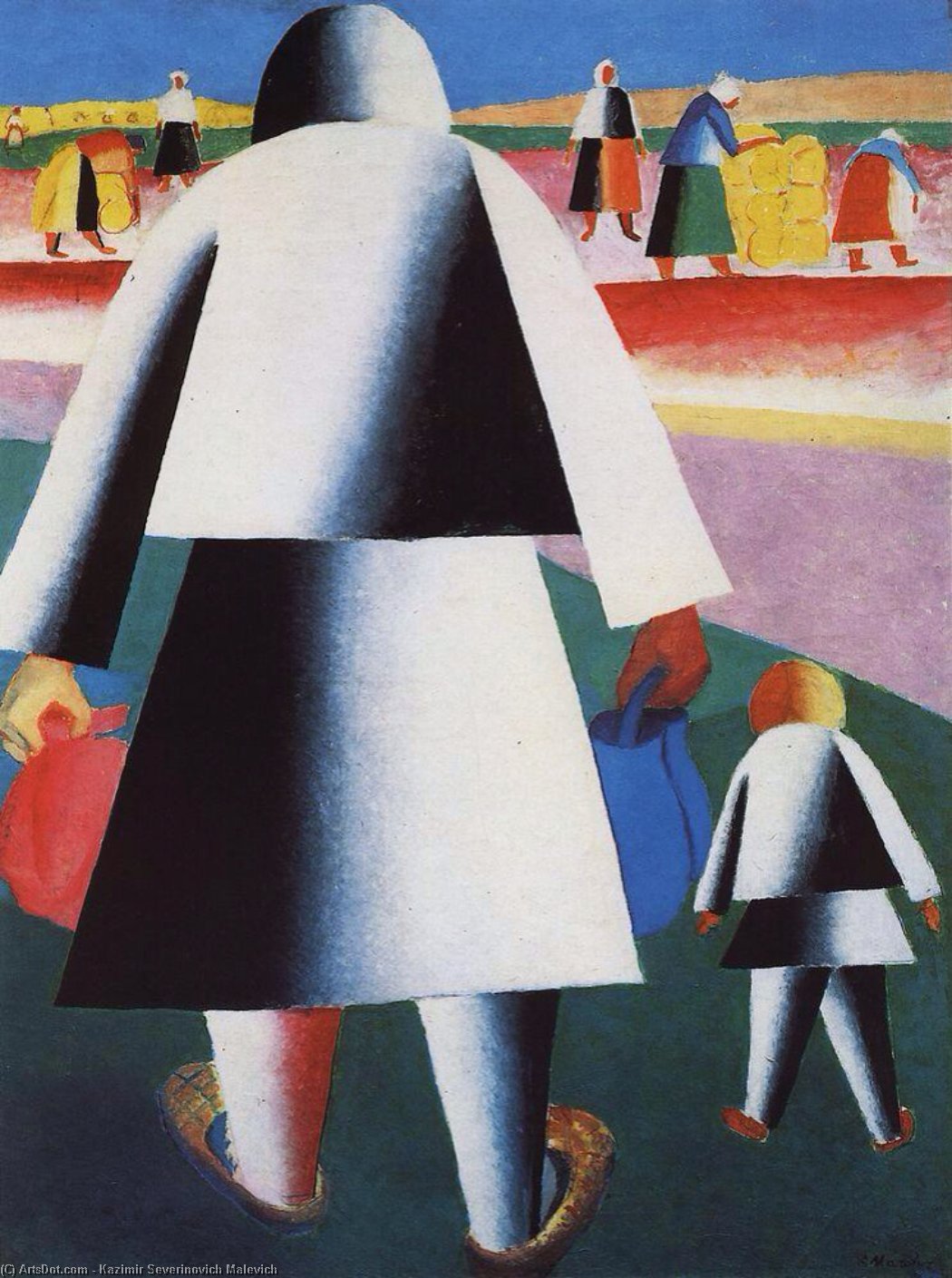
In the vast landscape of the twentieth-century avant-garde, few works capture the tension between the tangible world and the infinite realm of abstraction as poignantly as Kazimir Malevich’s “Marpha and Van’ka.” Painted in 1929, this masterpiece serves as a profound window into the artist's evolving consciousness. At first glance, the viewer is greeted by a scene that feels intimately human—a man traversing a path with two children, accompanied by the quiet presence of a dog and the bustling energy of figures in the background. Yet, beneath this surface-level narrative of a family stroll lies the heartbeat of Geometric Supremacy. Malevich does not merely depict a moment in time; he seeks to distill the very essence of existence into a language of pure form and color, inviting the observer to look beyond the physical and into the spiritual.
The painting is a masterclass in the balance between representational memory and radical innovation. While the composition retains echoes of everyday life—the weight of bags on shoulders, the movement of travelers—it is infused with the revolutionary spirit of the Russian avant-garde. Malevich, having journeyed through the expressive realms of Impressionism, Fauvism, and Cubism, arrived at a point where he believed art could transcend the "burden" of objects. In “Marpha and Van’ka,” we see this transition in motion. The figures are not mere portraits but are integrated into a dynamic arrangement of shapes that suggest a deeper, cosmic order. For the collector or interior designer, this piece offers a rare duality: it possesses the warmth of a human story while maintaining the sophisticated, intellectual rigor of high abstraction.
The Vibrancy of Color and Geometric Soul
To behold this work is to experience a deliberate explosion of vitality. Eschewing the monochromatic austerity often associated with pure Suprematism, Malevich employs a palette that breathes with life. Deep blues, energetic reds, lush greens, and sun-drenched yellows dance across the canvas, interspersed with crisp whites that provide structural clarity. This use of color is far from decorative; it is an emotional tool designed to evoke optimism and a sense of universal truth. The interplay of these hues creates a rhythmic movement that guides the eye through the composition, mirroring the physical journey of the figures within the frame.
The technique reflects Malevich’s profound belief that color and geometry are the primary vehicles for conveying emotion. By stripping away unnecessary illusionistic detail, he allows the weight of each shape to resonate. For those looking to adorn a contemporary space, this painting provides an unparalleled focal point. Its ability to command attention through bold, geometric interplay makes it an ideal centerpiece for modern, minimalist, or eclectic interiors. It is not simply a decoration; it is an invitation to contemplation, a piece that transforms a room into a gallery of thought and a sanctuary of color.
A Legacy for the Modern Collector
Owning a reproduction of “Marpha and Van’ka” is more than an aesthetic choice; it is an engagement with art history's most radical era. Malevich’s journey from the folk-inspired landscapes of his Ukrainian youth to the pinnacle of abstract thought represents one of the most significant shifts in human perception. This painting stands as a testament to that metamorphosis. It captures the precise moment where the weight of the world meets the lightness of pure idea.
For the discerning art lover, this work offers a continuous dialogue between the past and the present. Its themes of movement, family, and the search for order remain eternally relevant in our fast-paced, modern existence. Whether placed in a professional studio, a sophisticated living area, or a curated collection, this hand-painted tribute to Malevich’s genius brings with it an aura of intellectual depth and a timeless, vibrant energy that transcends the boundaries of time and medium.