The Radical Essence of Pure Form
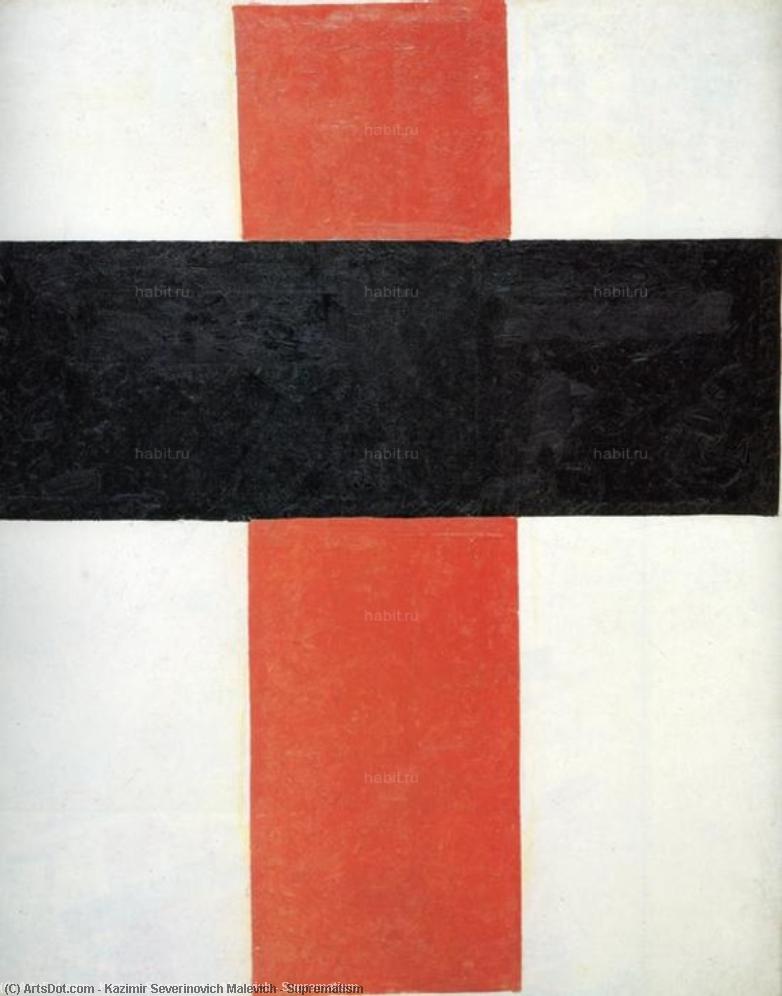
In the annals of twentieth-century modernism, few works possess the seismic power of Kazimir Malevich’s “Suprematism,” painted in 1928. This is not merely a painting; it is a manifesto rendered in pigment, a bold declaration that fundamentally dismantled the long-standing traditions of representational art. At its core, the work presents a striking red square overlaid with a black cross, a composition so stripped of superfluous detail that it confronts the viewer with an almost unsettling immediacy. To gaze upon this piece is to witness the moment where art ceased to be a mirror held up to nature and instead became a window into a new, non-objective reality. For the discerning collector or interior designer, this work offers more than just a visual focal point; it provides a profound intellectual anchor that commands attention through its uncompromising simplicity.
The technique employed by Malevich reflects his revolutionary philosophy of the supremacy of pure feeling. Eschewing the preparatory sketches and complex underpaintings common in classical traditions, Malevich applied pigment directly onto the canvas to achieve a surface texture that is both tactile and visually arresting. This raw, direct method ensures that the vibrant red and deep black do not merely sit upon the surface but seem to vibrate with an inherent energy. The stark contrast between the bold primary colors creates a dynamic tension, making the piece an ideal centerpiece for contemporary spaces that value high-contrast aesthetics and minimalist elegance.
A Spiritual Geometry: Symbolism and Meaning
Beyond its striking visual impact, “Suprematism” carries a weight of profound symbolic significance. Malevich did not view these geometric shapes as mere mathematical abstractions; rather, he imbued them with a spiritual dimension. In his visionary framework, the square served as a representation of “the world,” while the black cross symbolized “God.” Through this juxtaposition, the painting seeks to achieve a harmonious unity—a quest for transcendence that bypasses the need for religious iconography or narrative storytelling. It is an attempt to communicate directly with the viewer’s subconscious, using the universal language of geometry to evoke emotions that words often fail to capture.
This movement, born from Malevich's encounters with the Parisian avant-garde and his deep roots in Ukrainian folk traditions, sought to liberate art from the "burden" of depicting reality. By stripping away the recognizable, Malevich invites the observer into a meditative state, where the focus shifts from what is being depicted to how color and form interact within the space. For those looking to curate an environment of contemplation and intellectual depth, this artwork serves as a timeless bridge between the physical world and the realm of pure thought.
Legacy and Interior Inspiration
The legacy of Malevich’s Suprematism continues to ripple through modern design, influencing everything from architectural minimalism to graphic abstraction. Owning a high-quality reproduction of this masterpiece allows one to bring this historical revolution into a modern domestic or professional setting. The painting's ability to function as both a historical artifact and a contemporary aesthetic statement makes it an invaluable asset for any curated collection.
When integrating such a powerful piece into an interior design scheme, consider the following:
- Minimalist Sanctuaries: Pair the work with neutral palettes—whites, greys, or soft beiges—to allow the vibrant red square to act as the room's primary energetic pulse.
- Architectural Contrast: In spaces featuring industrial materials like concrete or steel, the geometric precision of "Suprematism" complements the structural honesty of the environment.
- Statement Lighting: Utilize directional lighting to highlight the tactile quality of the paint, emphasizing the depth and texture that define Malevich's unique approach to the canvas.
Ultimately, “Suprematism” is an invitation to experience art in its most distilled form. It remains a testament to the power of reduction, proving that when everything unnecessary is stripped away, what remains is an eternal, unshakeable truth.