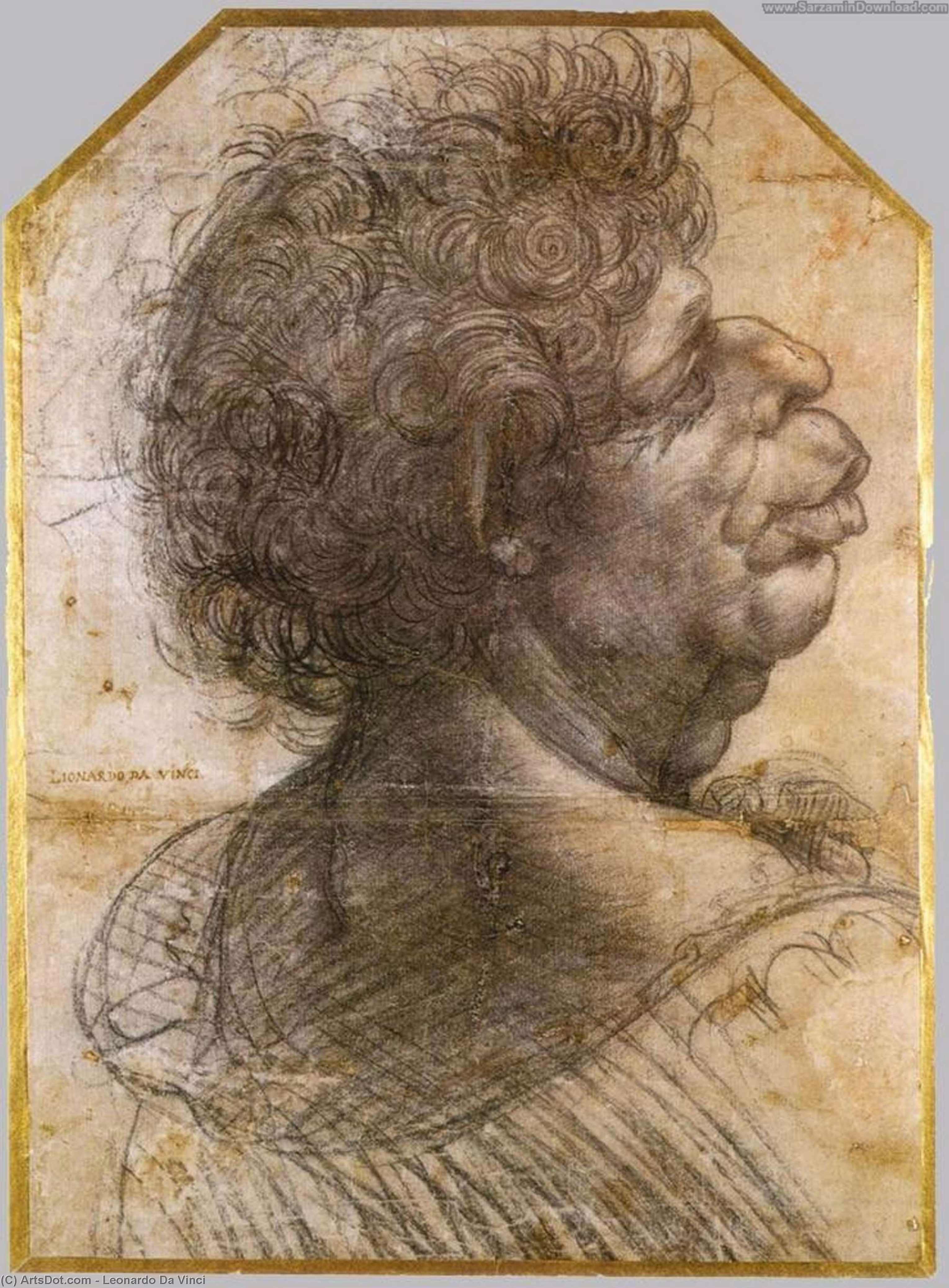
Grotesque Head
Leonardo da Vinci, one of the most renowned artists of the High Renaissance, left an indelible mark on the world of art with his captivating and thought-provoking works. Among these, the "Grotesque Head" stands out as a masterpiece that continues to intrigue art enthusiasts and scholars alike.
Artistic Context
The "Grotesque Head," created around 1500, is a chalk drawing measuring 390 x 280 cm, housed in Christ Church, Oxford, United Kingdom. This piece exemplifies Da Vinci's fascination with human anatomy and his ability to capture the essence of emotion through facial expressions. It represents a pivotal moment in Renaissance art—a departure from idealized portraits toward explorations of psychological complexity.
Composition and Technique
The painting features a man with a distorted face, prominently displayed against a blurred background. The use of chalk allows for a range of tonal values, creating depth and dimensionality in the subject's features. Da Vinci’s mastery of chiaroscuro is evident in the way light and shadow sculpt the face, drawing the viewer’s attention to the intense expression. This technique—the dramatic interplay between light and dark—was revolutionary at the time and remains a cornerstone of artistic excellence. The artist meticulously rendered every detail, capturing not just physical appearance but also inner turmoil.
Symbolism and Interpretation
The "Grotesque Head" can be seen as a representation of the artist's exploration into the human psyche. The exaggerated features may symbolize the inner turmoil or emotional state of the subject, reflecting Da Vinci’s interest in psychology and human behavior. It’s considered to be an attempt to portray not just what is visible but also what lies beneath—a daring ambition for its era. Some scholars interpret it as a commentary on mortality and the fragility of human existence.
Artistic Legacy
Leonardo Da Vinci's influence on Western art is profound, as detailed in the
Discovering the Artworks of Christ Church, Oxford, United Kingdom document. His works, including the "Grotesque Head," have inspired generations of artists and continue to be celebrated for their innovative techniques and emotional depth. The drawing’s unsettling realism continues to fascinate viewers today, prompting contemplation on themes of vulnerability and psychological complexity.
Reproductions and Preservation
For those interested in owning a piece of art history, ArtsDot.com offers high-quality, handmade oil painting reproductions of the "Grotesque Head." These reproductions are crafted with meticulous attention to detail, ensuring that the essence of Da Vinci's original work is preserved. They allow collectors and enthusiasts alike to experience the grandeur of Renaissance artistry in their own homes.
Conclusion
The "Grotesque Head" by Leonardo Da Vinci is a testament to his artistic genius and his ability to capture the complexities of human emotion. This piece, along with other works by Da Vinci, can be found in the collection at
Christ Church (Oxford, United Kingdom). For art enthusiasts seeking to delve deeper into the history of painting, the
History of Painting on Wikipedia provides a comprehensive overview.
The "Grotesque Head" by Leonardo Da Vinci is a masterpiece that continues to captivate audiences with its unique blend of realism and artistic expression.
Photo Description: The image is a painting of a man with a grotesque face, possibly by Leonardo Da Vinci. The man's head is prominently displayed in the center of the picture, with his features appearing distorted or exaggerated. The background of the painting appears to be blurry and out of focus, giving the image an artistic and dramatic quality. The overall composition of the painting suggests a sense of intensity and emotion, as if capturing a moment of deep thought or contemplation.
Size: 390 x 280 cm
Date: 1500