The Genesis of Precision: Leonardo da Vinci's Early Exploration
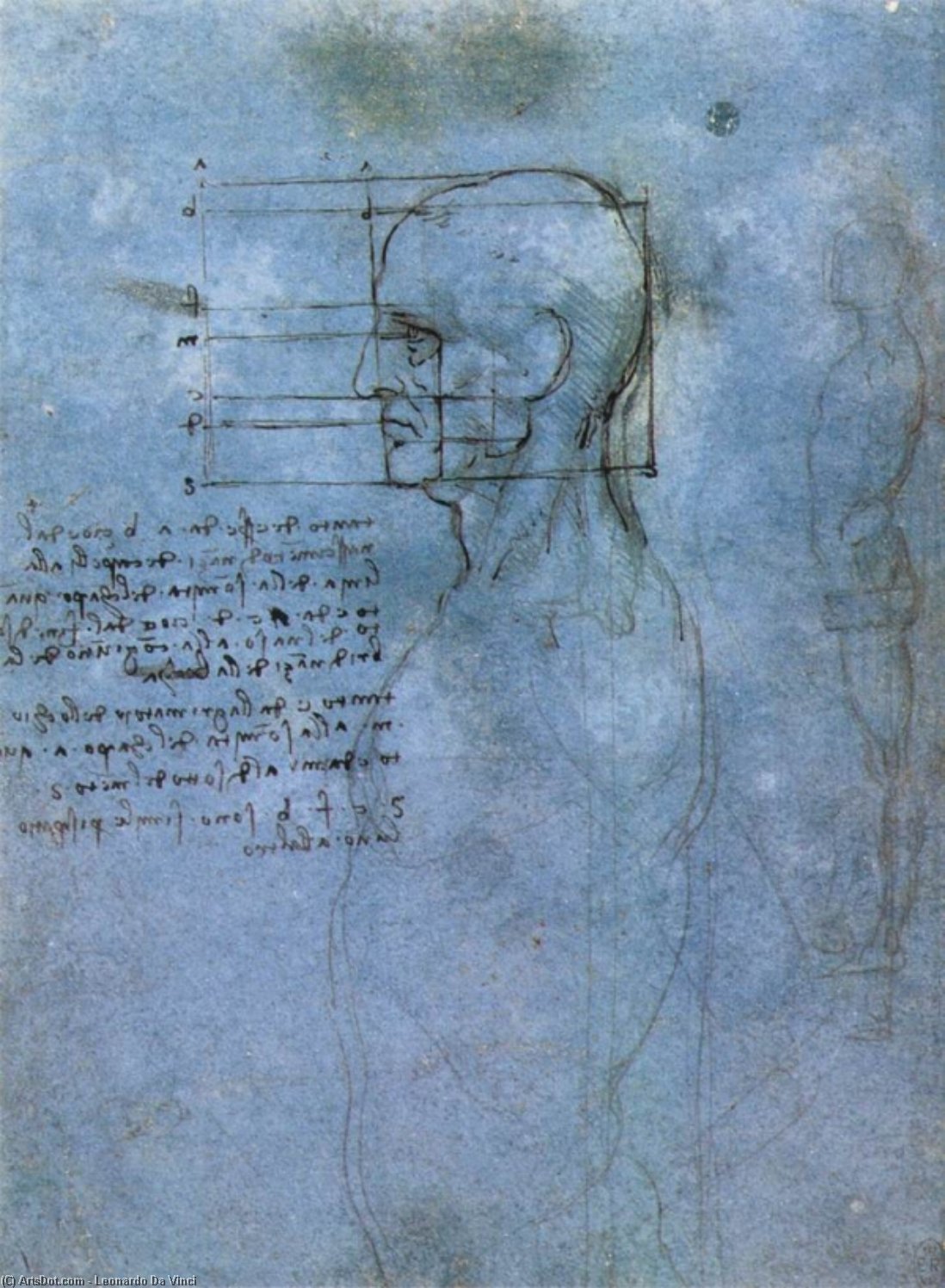
Leonardo da Vinci’s Study of Proportion, a deceptively simple drawing executed in silverpoint around 1490, represents far more than just an early sketch. It’s a foundational moment in the artist's relentless pursuit of understanding the human form and its relationship to the universe – a testament to his unique blend of artistic observation and scientific inquiry. Born out of wedlock near Vinci, Leonardo’s education was unconventional, shaped by apprenticeship under the renowned sculptor Andrea del Verrocchio rather than formal schooling. This early exposure instilled in him a meticulous attention to detail and a fascination with mechanics, which would later inform his groundbreaking anatomical studies. The drawing itself emerged during a period when artists were increasingly seeking to move beyond stylized representations towards a more realistic depiction of the human body – a shift powerfully driven by the rediscovery of classical ideals and fueled by burgeoning scientific thought.
The work’s genesis lies in the writings of Vitruvius, a Roman architect and engineer whose treatise *De Architectura* (circa 80 BC) outlined principles for harmonious design. Vitruvius proposed that the human body was inherently governed by mathematical ratios – a concept Leonardo embraced with characteristic zeal. The drawing isn't merely an illustration of these proportions; it’s a deliberate attempt to codify them, meticulously documenting measurements and relationships between various body parts. Notice how the figure is presented within both a circle and a square—symbols representing the heavens and earth respectively—reflecting the Renaissance fascination with universal harmony and the interconnectedness of all things.
The Alchemy of Silverpoint: Technique and Detail
What immediately distinguishes this study is its technique – silverpoint drawing. Unlike paint, which relies on pigment suspended in a medium, silverpoint utilizes a wire or rod dipped in molten silver to directly mark the surface of prepared gesso or Chinese white ground. This method offers an unparalleled level of detail and tonal subtlety. The resulting lines possess a remarkable sharpness and luminosity, capturing the delicate nuances of muscle structure and bone form with astonishing precision. Leonardo’s mastery of this technique is evident in the incredibly fine gradations of shading achieved through controlled pressure and layering – a testament to his patience and observational skills.
The drawing's composition is remarkably restrained, yet profoundly informative. The figure, rendered in profile, is presented with a clarity that invites close examination. Observe how Leonardo has carefully delineated the musculature of the arms and torso, noting the subtle shifts in tone to suggest volume and depth. He doesn’t simply depict the body; he dissects it, revealing its underlying structure through meticulous measurement and observation. The notes scribbled around the drawing – a mix of mathematical ratios and anatomical observations – further underscore Leonardo's commitment to understanding the mechanics of human form.
A Legacy of Proportion: Influence and Inspiration
Leonardo’s Study of Proportion wasn't a solitary endeavor; it was part of a broader movement towards anatomical realism in art. His work directly influenced subsequent generations of artists, providing a framework for creating more lifelike and dynamic figures. The meticulous measurements he documented – the length of the face being one-tenth of the total height, for example – became invaluable references for artists seeking to achieve greater accuracy in their depictions of the human form.
Furthermore, Leonardo’s approach foreshadowed advancements in anatomy and physiology. His detailed observations on muscle structure, skeletal design, and bodily movement anticipated later scientific discoveries, laying the groundwork for a deeper understanding of human anatomy during his time. The influence extends far beyond the Renaissance; artists throughout history have drawn inspiration from this study, recognizing its enduring value as a model for anatomical accuracy and compositional balance. It’s a remarkable example of how artistic exploration can intersect with scientific inquiry, resulting in a work that continues to resonate centuries later. For those interested in exploring more of Da Vinci's works, visit Study of Horses or Profile of a Warrior in Helmet at ArtsDot.com.
This reproduction captures the essence of this seminal work, faithfully recreating Leonardo’s meticulous detail and evocative shading. It's an exceptional addition to any art collection or a striking piece for interior design – a tangible connection to one of history’s greatest artistic minds.