Leonardo da Vinci: Life and Legacy
Leonardo di ser Piero da Vinci (1452–1519) stands as an unparalleled figure in the annals of Renaissance art and science—a testament to human potential and intellectual curiosity. Born out of wedlock in Vinci, Italy, his early education fostered a remarkable blend of artistic talent and scientific inquiry, shaping him into one of the most multifaceted geniuses of his era.
His apprenticeship with Andrea del Verrocchio instilled foundational skills in painting, sculpting, and engineering—a crucible where observation and experimentation converged. This formative period propelled him toward groundbreaking innovations that would redefine artistic expression and propel advancements across disciplines.
First Milanese Period (1482–1499)
Leonardo’s arrival in Milan under Ludovico Sforza marked a pivotal juncture, transforming him from an artisan into a court artist and innovator. During this time, he conceived ambitious projects—military fortifications, elaborate stage sets, and monumental sculptures—demonstrating his mastery of both artistic vision and practical engineering.
Perhaps his most enduring achievement was The Last Supper, a fresco that captured the solemnity and drama of Christ’s final meal with his disciples. Its masterful use of sfumato—a technique characterized by subtle gradations of tone—created an ethereal atmosphere and conveyed profound emotion.
Manuscript Page on the Sforza Monument
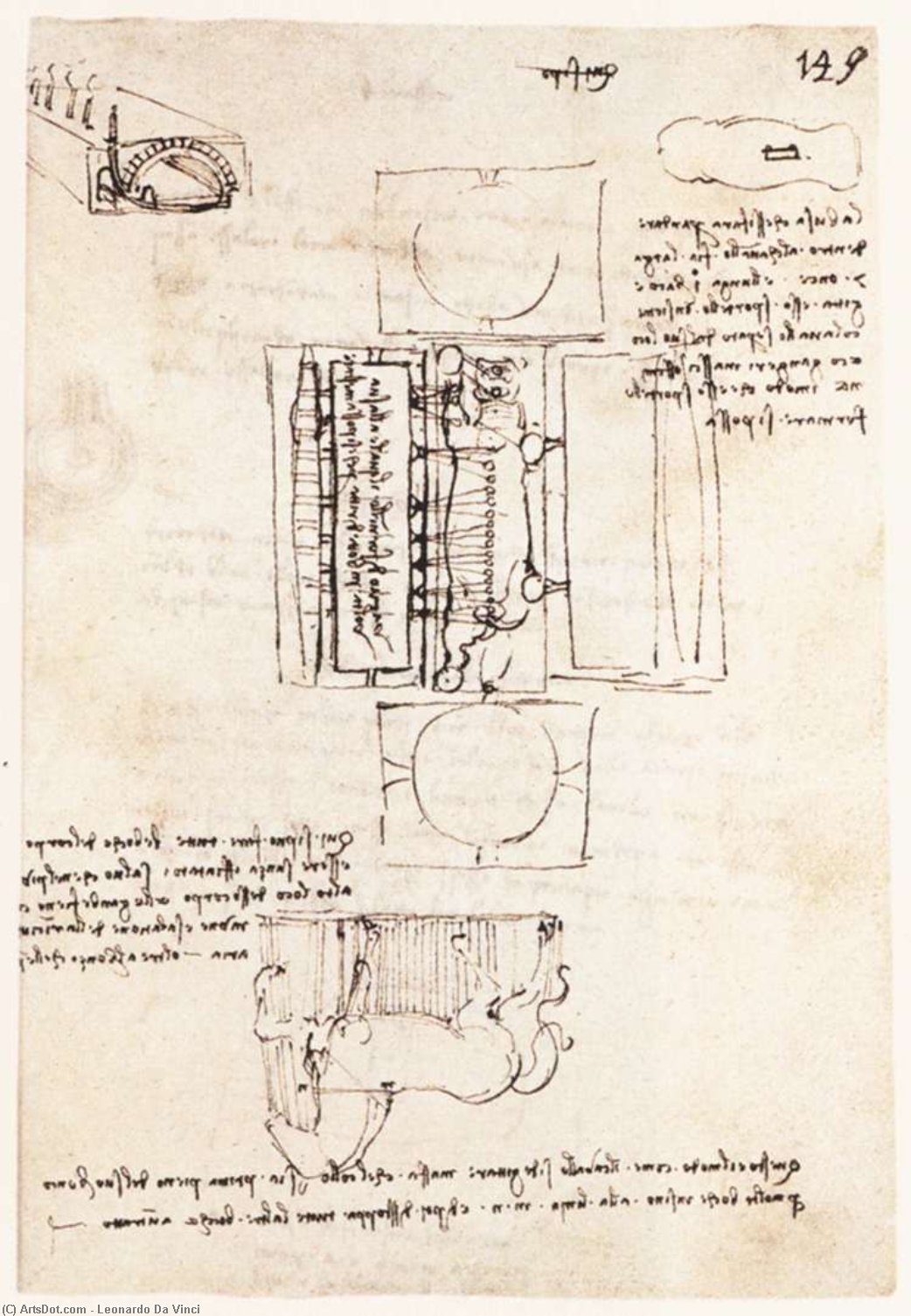
Among Leonardo's vast notebooks, “Manuscript page on the Sforza monument” holds particular fascination. Dated 1493, this meticulously rendered drawing exemplifies Da Vinci’s characteristic approach—a seamless fusion of theoretical knowledge and artistic execution. It depicts a detailed schematic representation of a machine designed to cast a colossal equestrian statue commemorating Ludovico Sforza.
The page showcases multiple circles, representing various components of the device, alongside diagrams illustrating the principles of casting bronze. A clock positioned prominently suggests that time was paramount in Da Vinci’s calculations—a reflection of his unwavering commitment to precision and observation.
“Manuscript page on the Sforza monument” transcends mere technical illustration; it embodies Leonardo's humanist spirit, demonstrating his conviction that art could illuminate scientific understanding. It remains a cornerstone of his legacy, inspiring artists and engineers alike with its audacious ambition and unparalleled artistry.
For more information on Leonardo Da Vinci’s works and other artists, visit ArtsDot.