A Window into Renaissance Anatomy: Leonardo da Vinci’s Anatomical Study
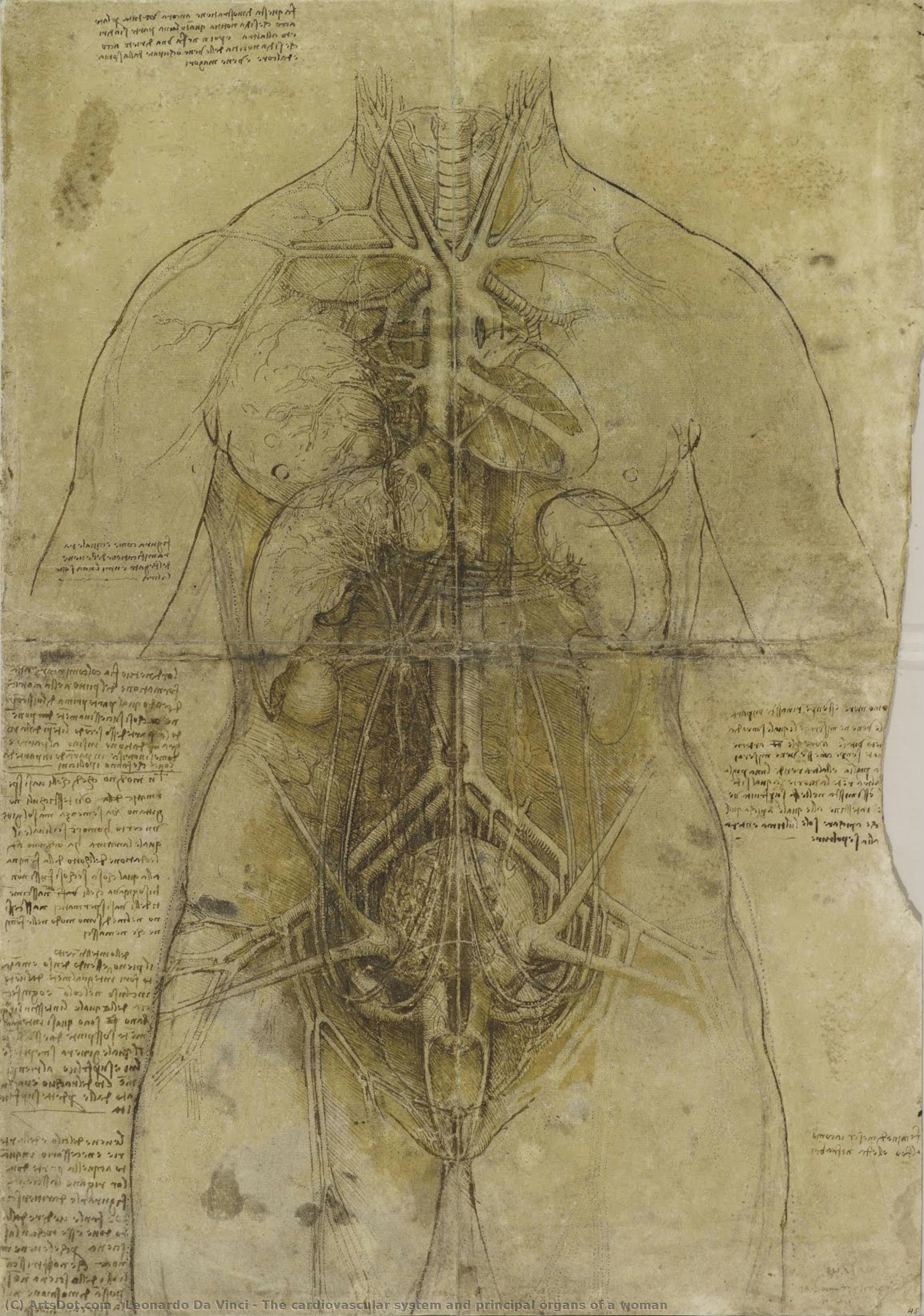
Leonardo da Vinci's “The Cardiovascular System and Principal Organs of a Woman,” executed in 1509, transcends mere anatomical illustration; it embodies the spirit of humanist inquiry that defined the High Renaissance. Created during a period marked by burgeoning scientific curiosity alongside artistic brilliance, this drawing stands as a testament to Leonardo’s unparalleled ability to synthesize observation with intellectual contemplation.
- Subject Matter: The artwork meticulously depicts the human torso—specifically focusing on the circulatory system and vital organs like the heart, lungs, stomach, liver, kidneys, and intestines. Unlike conventional anatomical drawings of the time which predominantly depicted male subjects, Da Vinci’s choice to portray a female form represents a significant departure from established artistic conventions and underscores his fascination with understanding the human body's intricacies.
- Style & Technique: Leonardo employed a masterful blend of disegno—precise drawing—and sfumato—a technique pioneered by him—to achieve remarkable realism. The subtle gradations of tone create an illusion of depth and volume, capturing the delicate musculature and contours of the torso with breathtaking accuracy. This meticulous attention to detail reflects Da Vinci’s unwavering commitment to scientific observation informing artistic expression.
Historical Context: Da Vinci undertook this ambitious project shortly after his groundbreaking dissection of an elderly man in Florence's hospital—a pivotal moment that fueled his anatomical understanding. Driven by a desire to advance knowledge beyond the limitations of Galenic humoral theory, he sought to integrate ancient wisdom with empirical observation. The drawing served as a precursor to his planned treatise on anatomy, highlighting his ambition to disseminate scientific discoveries and reshape perceptions of human physiology.
- Symbolism: Beyond its anatomical precision, the image carries symbolic weight. Da Vinci’s depiction of the uterus—a sphere representing perfection and fertility—suggests a contemplation of female reproductive health and aligns with Renaissance ideals concerning beauty and vitality. It speaks to the broader humanist preoccupation with understanding the human condition and celebrating the natural world.
- Emotional Impact: Viewing this drawing evokes admiration for Da Vinci’s artistic genius and intellectual rigor. The sheer scale of the artwork—spanning a considerable portion of its frame—commands attention, inviting contemplation on the complexities of human anatomy and the transformative power of scientific inquiry. It serves as an enduring reminder of Leonardo's legacy as one of history’s greatest thinkers and artists.
“The Cardiovascular System and Principal Organs of a Woman” is more than just a drawing; it’s a window into the mind of Leonardo da Vinci—a visionary who dared to challenge accepted dogma and elevate art and science in pursuit of profound understanding. Its enduring beauty lies not only in its technical mastery but also in its symbolic resonance, continuing to inspire awe and wonder centuries after its creation.