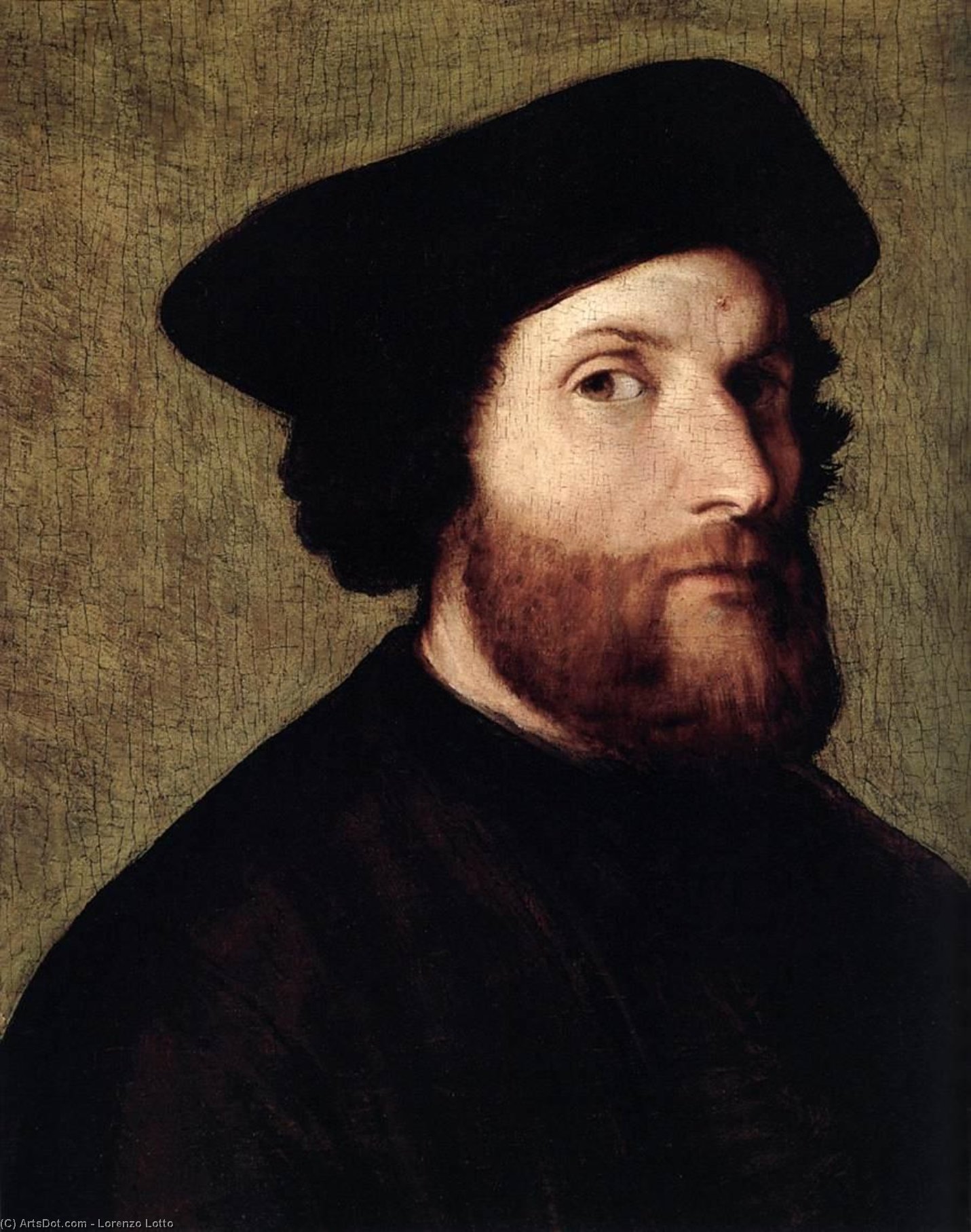
Lorenco Loto (1480-1556): Otkrijte jedinstveni renesansni stil ovog venecijanskog majstora, poznatog po emotivnim portretima i mističnoj religioznoj umetnosti. Istražite njegovu ponovo otkrivenu ostavštinu!
Откријте европску уметност у Музеју Тиссен-Борнемизза! Погледајте шест векова ремекдела, укључујући Ботицелија и Ван Гока у дивном мадридском амбијенту.
Музеј Тиссен-Борнемизза, Мадрид, Шпанска уметност, Европска уметност, Ботицелио, Каравађо, Моне, Ван Гок, Пикасо, Ренасанца, Барок
Национални музеј Тиссен-Борнемизза
Шпанија
Мануел Лопес-Пикасо
Мадрид
Музеј Тиссен-Борнемизза
Ренасанца
1.3
A Glimpse into the Soul: Lorenzo Lotto's Self-Portrait
To stand before this self-portrait by Lorenzo Lotto is to encounter not merely a likeness, but a profound meditation on the act of being seen. Painted in 1540, this work captures the artist at a moment of poised introspection. The subject gazes out from the canvas with an arresting directness, his hand gently supporting his chin—a gesture that speaks volumes more than any grand pronouncement could. Dressed in the sober elegance of a suit and tie beneath a dark hat, Lotto presents himself as both intellectual and worldly. His beard and mustache frame a countenance marked by experience, inviting the viewer into a quiet, knowing dialogue across the centuries.
The Wanderer's Eye: Context and Technique
Lorenzo Lotto’s life was one of movement; he was the quintessential Venetian wanderer whose artistic journey spanned numerous Italian cities. This itinerant existence imbued his art with a restless energy and an acute sensitivity to human emotion, distinguishing him from artists rooted in single academic traditions. Technically, the painting showcases a mastery characteristic of the High Renaissance period, yet it possesses a distinct Lottoan immediacy. Observe the subtle rendering of the fabric against the depth suggested by the background wall; these details reveal a painter deeply concerned with capturing tangible reality while simultaneously hinting at an inner, emotional landscape. The technique is remarkably polished for its age, allowing light to play across the planes of his face and hands with delicate precision.
Symbolism of Self-Reflection
The self-portrait genre has always been a crucible for artistic identity, and Lotto handles this theme with remarkable nuance. The act of holding the chin is inherently symbolic—it suggests contemplation, perhaps even a moment of creative blockage or profound realization. It asks us, the viewers, to consider our own moments of pause. His attire speaks to his engagement with contemporary society, yet his gaze seems fixed on something beyond the immediate viewer, suggesting that the true subject is not the man himself, but the complex interplay between self and observer. It is a portrait layered with unspoken narratives.
Bringing Renaissance Depth Home
For those who wish to incorporate such historical depth into a modern interior, this piece offers unparalleled gravitas. A reproduction of Lotto's Self-Portrait allows one to possess a tangible connection to the intellectual ferment of the Italian Renaissance. It functions beautifully as a focal point in a study, drawing room, or gallery space, lending an air of cultivated history and thoughtful contemplation. Owning this work is not simply acquiring art; it is curating a moment of timeless reflection, echoing the quiet dignity captured by the master himself.