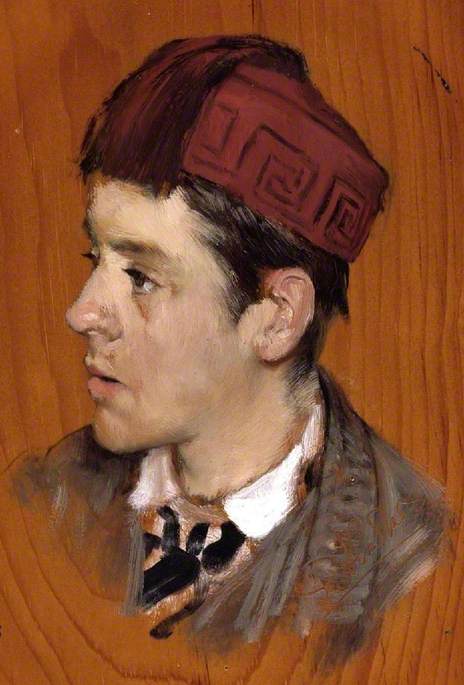
A Moment Frozen in Time: Sir Herbert Thompson, Bt. by Lawrence Alma-Tadema
Lawrence Alma-Tadema’s 1877 portrait of Sir Herbert Thompson, Bt., is more than a simple likeness; it's a meticulously crafted tableau vivant – a frozen moment imbued with the quiet dignity and subtle melancholy characteristic of the artist’s most celebrated works. The painting captures a young man in profile, seated before a richly appointed wooden panel, his gaze directed slightly downward, suggesting introspection rather than outward engagement. It’s a study in restrained elegance, reflecting the prevailing aesthetic sensibilities of Victorian England while simultaneously hinting at the anxieties and complexities beneath its polished surface.
Tadema was a master of recreating the atmosphere of antiquity, particularly Roman life, and this portrait is no exception. The background panel isn't merely a backdrop; it’s an integral part of the composition, meticulously rendered to evoke the feeling of a luxurious study or salon. The texture of the wood – rough-hewn yet polished – grounds the scene in a tangible reality, contrasting subtly with the idealized features of the subject. The muted earth tones—browns, reds, and hints of green—create an intimate, almost somber atmosphere, punctuated by the warm glow of unseen light.
The Anatomy of Observation: Technique and Style
Alma-Tadema’s technique is characterized by a remarkable attention to detail and a commitment to realism. He employed a layered approach to painting, building up his compositions with numerous thin glazes of oil paint – a method known as *alla prima*—to achieve the luminous quality and subtle gradations of tone that define his style. The visible brushstrokes, particularly in the rendering of the skin tones and the wooden panel, contribute to the sense of immediacy and authenticity. The artist’s use of impasto—thickly applied paint—adds a tactile dimension to the work, inviting the viewer to almost feel the texture beneath their fingertips.
The portrait's composition is carefully balanced, with the subject occupying a central position within the frame. Tadema skillfully uses lines – both straight and curved – to define the contours of Thompson’s face, clothing, and the wooden panel. These lines guide the viewer’s eye through the scene, creating a sense of depth and spatial awareness. The shallow perspective further emphasizes the immediacy of the portrait, drawing us into the subject's private world.
A Portrait of Character: Symbolism and Context
Sir Herbert Thompson, Bt., was a prominent civil servant in British India, holding positions of considerable responsibility and influence. The slight frown etched upon his brow—a subtle yet powerful detail—suggests a contemplative nature, perhaps burdened by the weight of duty or wrestling with internal complexities. The posture itself – seated formally, but not overtly imposing – speaks to a man of quiet dignity and restrained self-assurance.
Painted in 1877, the portrait reflects the broader cultural context of Victorian England—an era defined by rapid industrialization, social change, and a renewed interest in classical antiquity. Alma-Tadema’s work was deeply influenced by archaeological discoveries and historical research, which fueled a fascination with ancient Rome and its opulent lifestyle. The painting can be seen as an attempt to capture the essence of this idealized past, filtered through the lens of Victorian aesthetics.
A Legacy of Light and Atmosphere
While Alma-Tadema’s style didn't always enjoy widespread popularity during his lifetime, it has since been recognized for its exquisite beauty and technical mastery. His ability to evoke atmosphere and capture fleeting moments of human emotion continues to resonate with viewers today. Reproductions of “Sir Herbert Thompson, Bt.” offer a remarkable opportunity to experience the artist’s vision firsthand, bringing a touch of Victorian elegance and quiet contemplation to any space.