The Subject: A Man of Faith and Influence
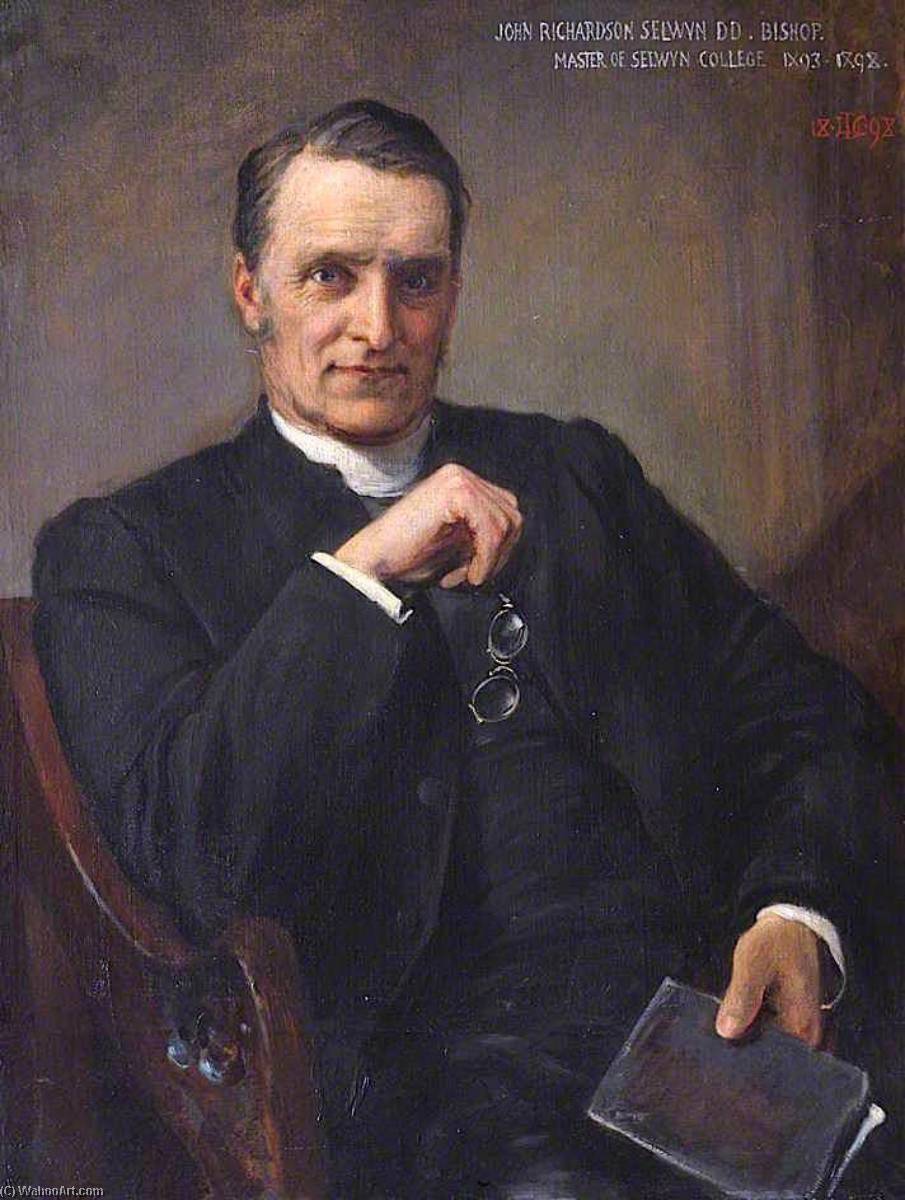
Lowes Cato Dickinson’s 1898 oil painting captures John Richardson Selwyn, a figure deeply rooted in both the ecclesiastical and social landscapes of late Victorian England. Selwyn wasn't merely a Bishop; he was a man of considerable influence – the second Bishop of Melanesia, a pivotal role in establishing an Anglican presence within the diverse islands of the Pacific. His appointment marked a significant step in missionary efforts, reflecting the era’s complex engagement with colonialism and its accompanying responsibilities. Beyond his religious duties, Selwyn held positions of leadership within the Working Men's College, a pioneering institution dedicated to providing educational opportunities for artisans – a testament to his commitment to social reform and accessible learning.
The portrait itself presents Selwyn as an elder statesman, radiating an aura of quiet authority and thoughtful contemplation. His posture, seated with hands crossed in a gesture of deliberate repose, speaks volumes about his character—a blend of solemnity and inner strength. The inclusion of spectacles suggests not only his intellectual pursuits but also a dedication to careful observation and reasoned judgment – qualities highly valued within the context of his role as Bishop.
The Style: Realism Infused with Victorian Detail
Dickinson’s style leans heavily into the tenets of academic realism, prevalent during the late 19th century. He meticulously renders Selwyn's features – the lines etched by age and experience around his eyes, the subtle curve of his mustache, the dignified set of his jaw—with a remarkable degree of accuracy. However, Dickinson doesn’t simply aim for photographic likeness; he imbues the portrait with a distinctly Victorian sensibility. The rich palette, dominated by deep browns, blues, and golds, evokes a sense of gravitas and tradition. The careful attention to detail – the texture of his clothing, the sheen of his spectacles, the subtle play of light on his face—demonstrates Dickinson’s mastery of technique and his ability to capture not just appearance but also character.
Furthermore, the composition itself is carefully orchestrated. The arrangement of objects within the scene – the chair, the book, the two clocks – serves to anchor Selwyn in a specific environment, suggesting an intellectual and scholarly atmosphere. These elements aren’t merely decorative; they contribute to the overall narrative, hinting at his multifaceted life as a religious leader, educator, and thoughtful observer.
Technique & Historical Context
Dickinson's technique is characterized by a smooth, blended brushstroke, creating an illusion of depth and volume. He skillfully employs chiaroscuro – the dramatic contrast between light and shadow – to sculpt Selwyn’s form and emphasize his features. This technique was particularly favored by Victorian portrait painters, allowing them to convey both physical likeness and psychological character. The painting's creation coincided with a period of significant social and political change in Britain—the rise of industrialization, the expansion of the British Empire, and growing concerns about poverty and inequality. These broader societal shifts undoubtedly informed Dickinson’s approach to portraiture, encouraging him to capture not just outward appearances but also the inner lives and complex roles of his subjects.
Notably, Dickinson frequently worked with photographs in his portraits, often using them as a basis for his paintings. This practice reflects the increasing availability of photographic technology during this era and demonstrates Dickinson’s willingness to embrace new artistic tools while retaining his own distinctive style. The inclusion of the clocks adds another layer of historical context, referencing the burgeoning interest in timekeeping and its impact on Victorian society.
Symbolism & Emotional Impact
Beyond the literal depiction of Selwyn, the portrait is rich in symbolic meaning. His seated posture and crossed hands convey a sense of contemplation and inner peace—a reflection of his spiritual life and leadership role. The spectacles symbolize his intellectual pursuits and his commitment to reasoned judgment. The book suggests a lifelong engagement with knowledge and learning. Overall, Dickinson’s painting offers a powerful glimpse into the character of a man who dedicated his life to both faith and service, embodying the values and aspirations of Victorian England.
Reproductions of this compelling portrait capture not only its visual beauty but also the profound sense of dignity and wisdom it conveys. It stands as a testament to Dickinson’s skill as an artist and a poignant reminder of a significant figure in Victorian history.