Otkrijte svet Marka Šagala (1887-1985), ruskog umetnika čija dela odišu snovima i folklorom! Poznat po živopisnim slikama, jevrejskoj tematici i prelepim vitražima. Istražite njegovu istorijsku važnost i nasleđe!
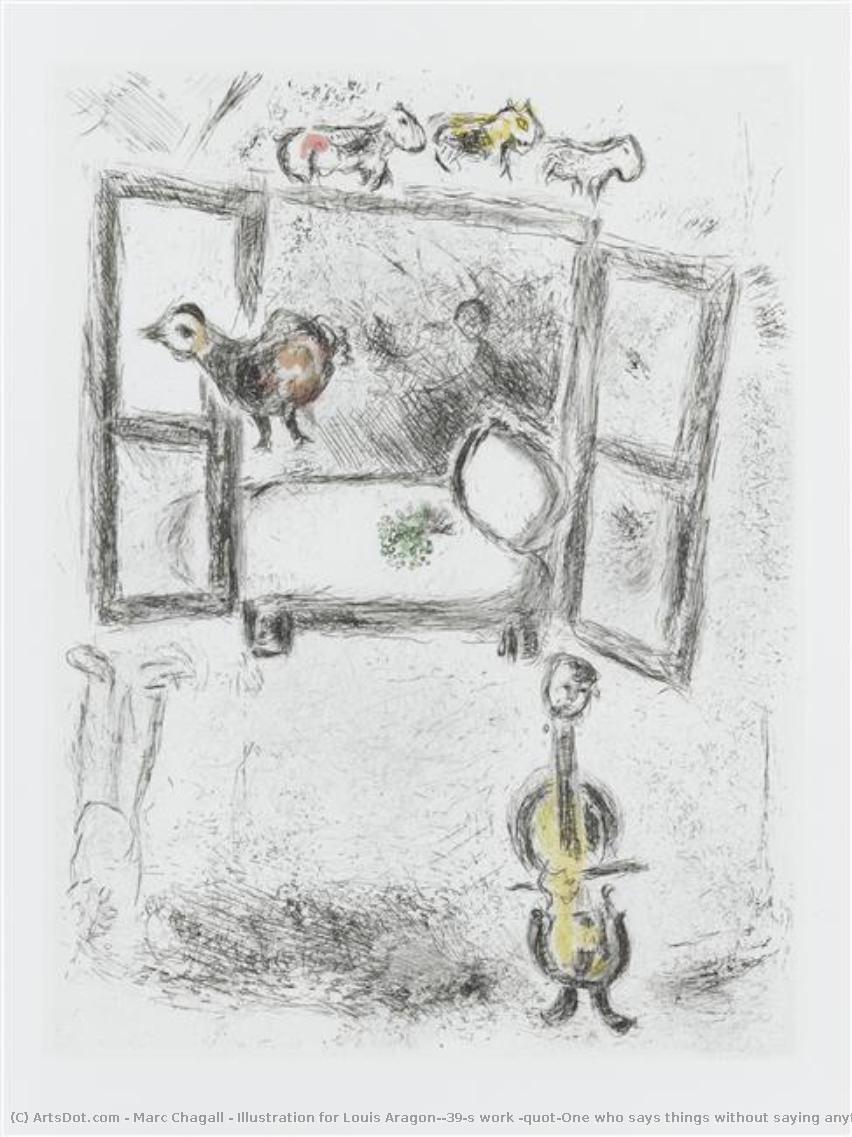
Illustration for Louis Aragon's work “One who says things without saying anything” – A Surreal Window into Chagall’s Imagination
Marc Chagall’s 1976 lithograph, "Illustration for Louis Aragon's work ‘One who Says Things Without Saying Anything,’” stands as a testament to the artist’s enduring fascination with dreamlike imagery and symbolic storytelling. More than just a visual depiction, it embodies Chagall’s profound engagement with poetic expression and his unwavering belief in the transformative power of artistic vision—a conviction rooted deeply within his formative years spent in Vitebsk, Belarus. This small but impactful piece exemplifies the artist's signature blend of Cubism, Expressionism, and Symbolism, resulting in a captivating artwork that continues to resonate with audiences today.
Composition & Visual Narrative
The artwork’s central focus is undeniably a window—a recurring motif throughout Chagall’s oeuvre—which serves as both structural anchor and metaphorical gateway. Framed against a muted gray backdrop, the window overlooks an interior space populated by fantastical animals: birds soaring gracefully alongside dogs and cats, creating a dynamic interplay of forms and textures. Figures inhabit this realm, positioned within and beyond the frame, contributing to a sense of spatial ambiguity and movement that defies conventional perspective. Chagall deliberately eschews realism, prioritizing emotional resonance over accurate representation; instead, he invites viewers into a world governed by imagination and imbued with lyrical beauty.
Color Palette & Lithographic Technique
Despite its evocative subject matter, “One who Says Things Without Saying Anything” employs a remarkably restrained color palette dominated by shades of gray, black, white, and subtle browns. This tonal approach—characteristic of Chagall’s lithograph technique—highlights textural variations and emphasizes the artist's masterful manipulation of ink density. Lithography, unlike painting or watercolor, relies on transferring pigment from a stone or plate to paper through pressure, resulting in an image that possesses a distinctive matte surface and subtle graininess. This deliberate choice underscores Chagall’s commitment to conveying mood and atmosphere rather than achieving photographic accuracy.
Symbolism & Emotional Resonance
The artwork's symbolism is multilayered and open to interpretation—a hallmark of Chagall’s artistic practice. The animals depicted represent not merely creatures inhabiting a fantastical landscape but also potent symbols embodying human emotions and aspirations. Similarly, the window itself symbolizes a portal between realities—a visual metaphor for introspection and contemplation—reflecting Chagall's preoccupation with themes of memory, spirituality, and the elusive nature of truth. Viewing this piece evokes feelings of wonder, melancholy, and quiet contemplation, capturing the artist’s ability to distill complex ideas into emotionally charged imagery.
Historical Context & Artistic Influences
Chagall’s artistic journey was profoundly shaped by the turbulent socio-political landscape of his time—particularly the rise of Surrealism in Europe during the 1920s and 30s. Embracing the principles of automatism and dreamlike association championed by André Breton, Chagall sought to liberate art from rational constraints and tap into the subconscious mind. Influenced by Cubist fragmentation and Expressionist emotional intensity, he fused these stylistic elements into his own unique visual language—a distinctive blend that distinguishes him as one of the most celebrated artists of the 20th century.