A Vision of Rococo Splendor
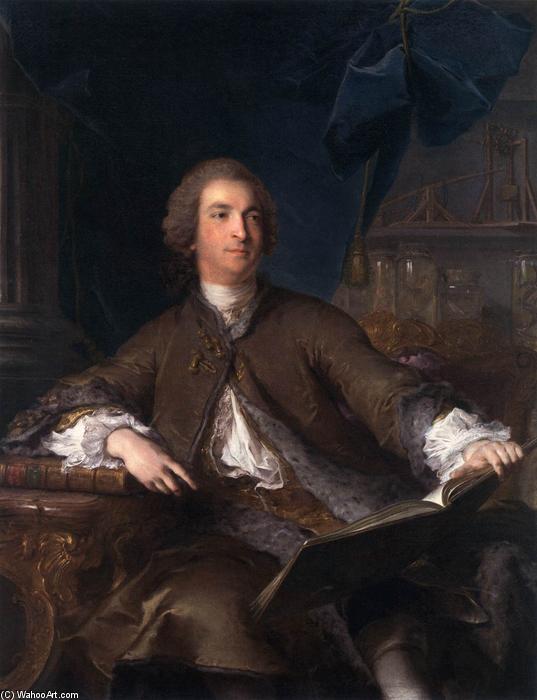
In the grand tapestry of eighteenth-century French portraiture, few works capture the delicate equilibrium between intellectual depth and aristocratic grace as masterfully as Jean-Marc Nattier’s 1745 masterpiece, Joseph Bonnier de la Mosson. This painting is far more than a mere likeness of a nobleman; it is an evocative window into the soul of the Rococo era, a period defined by its pursuit of elegance, refinement, and the subtle celebration of status. As one gazes upon the sitter, there is an immediate sense of being transported to a world of quiet luxury and scholarly repose, where every brushstroke serves to elevate the subject's perceived character.
The portrait presents Joseph Bonnier de la Mosson, a man whose very presence commands a composed, self-assured dignity. Seated with an air of effortless sophistication, he is enveloped in a setting that speaks of both comfort and culture. Nattier utilizes a palette of luminous, muted tones—warm, earthy browns harmonizing beautifully with cool, serene blues—to create a visual atmosphere that is both intimate and grand. The subject’s gaze, directed slightly upward, suggests a mind engaged with lofty thoughts, perhaps reflecting on the very texts he holds. This subtle gesture invites the viewer to participate in his moment of quiet contemplation, fostering an emotional connection that transcends the centuries.
The Artistry of Detail and Symbolism
Nattier’s technical prowess is on full display through his exquisite handling of texture and light. The artist employs chiaroscuro with remarkable sensitivity, using the interplay of shadow and soft illumination to sculpt the contours of de la Mosson’s face and the heavy folds of his attire. The tactile quality of the painting is breathtaking; one can almost feel the velvety weight of the brown suit and the crisp, delicate intricacy of the white lace collar. This meticulous attention to detail is a hallmark of the Rococo style, where ornamentation is never gratuitous but serves to enhance the overall sense of luxury.
Beyond the surface beauty, the composition is rich with symbolic layers designed to communicate the sitter's social and intellectual standing. The presence of scattered books and the open volume in his hands are deliberate iconographic choices, signaling de la Mosson’s erudition and his place within the enlightened circles of French society. Even the serene blue drapery in the background acts as a theatrical backdrop, adding depth and a sense of staged importance to the scene. Most poignant is the inclusion of a clock in the upper corner—a subtle memento mori that reminds us of the fleeting nature of time, contrasting the permanence of intellectual legacy with the inevitable passage of life. For the discerning collector or interior designer, this painting offers a profound narrative depth that adds both historical weight and aesthetic sophistication to any curated space.