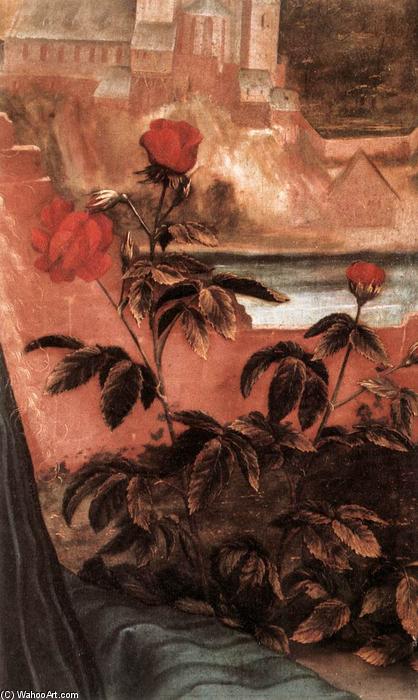
The Raw Heart of Faith: Unveiling Grünewald's "Nativity"
Matthias Grünewald’s “Nativity (detail) (13)” isn’t merely a depiction of the biblical scene; it’s an immersion into the turbulent, deeply felt spirituality that defined Northern Renaissance art. Completed in 1515 and currently residing within the hallowed halls of the Musée d'Unterlinden in Colmar, France, this oil-on-canvas panel transcends simple representation to become a visceral expression of faith, sorrow, and profound human connection. Grünewald, a figure often overshadowed by his more flamboyant contemporaries like Dürer, carved out a unique space for himself—one where emotional intensity and stark realism reigned supreme, eschewing the idealized beauty favored in Italy.

(Image of Matthias Grünewald's self portrait)
A Symphony of Red and Shadow – Technique and Composition
The immediate impact of “Nativity” is dominated by a startling palette—a vibrant, almost aggressive use of red. These aren’t the gentle hues of a pastoral scene; they are the reds of blood, roses, and perhaps even the embers of sacrifice. This boldness is masterfully contrasted with deep shadows that engulf much of the composition, creating an atmosphere of both intimacy and foreboding. Grünewald's technique is characterized by meticulous detail—the individual petals of the red roses, rendered with astonishing realism, are juxtaposed against the rough texture of the canvas itself. The figures themselves are not idealized; they possess a tangible physicality, conveying a sense of vulnerability and earthly suffering. The composition is deliberately unbalanced, drawing the eye to the central focus – the radiant Christ Child nestled amongst his mother Mary and Saint Joseph—while the surrounding figures fade into the background, emphasizing the intimate nature of this sacred moment.
Symbolism Woven Deep: Interpreting the Details
Every element within “Nativity” is laden with symbolic weight. The prominent red roses, a traditional symbol of Mary’s purity and suffering, are not simply decorative; they represent her maternal grief and the sacrifice inherent in motherhood. The stark contrast between light and shadow isn't merely an aesthetic choice but a visual representation of the struggle between good and evil, hope and despair. Note the carefully positioned halos—a subtle yet powerful reminder of divine grace. The inclusion of Saint Joseph, often overlooked in depictions of the Nativity, underscores his role as protector and guardian of the family. Even the muted landscape behind the figures hints at a world transformed by the arrival of Christ – a world imbued with spiritual significance.
A Window into a Troubled Era – Historical Context
To fully appreciate “Nativity,” it’s crucial to understand the historical context in which it was created. Grünewald lived during a period of profound religious and social upheaval, marked by the rise of humanism, the Reformation's nascent stirrings, and widespread disease. His art reflects this turbulence—a sense of unease and spiritual questioning permeates his work. The Isenheim Altarpiece, to which “Nativity” belongs, was commissioned for a hospital dedicated to St. Anthony, where patients suffered from ergotism – a debilitating illness characterized by hallucinations, convulsions, and gangrene. The altarpiece’s imagery served as both a source of comfort and a reminder of the suffering inherent in human existence. Grünewald's ability to convey such raw emotion within this context is a testament to his extraordinary artistic talent.
Bringing Grünewald Home: Reproductions and Artistic Inspiration
Reproductions of “Nativity (detail) (13)” offer a remarkable opportunity to experience the power and intensity of Grünewald’s vision. When selecting a reproduction, consider the quality of the print and the accuracy of the colors—a faithful representation is essential to capturing the essence of this iconic work. Beyond its aesthetic appeal, “Nativity” serves as a potent reminder of the enduring themes of faith, sacrifice, and human compassion. It’s a piece that invites contemplation, sparking dialogue about our own beliefs and values – a timeless masterpiece for any space seeking depth and emotional resonance.