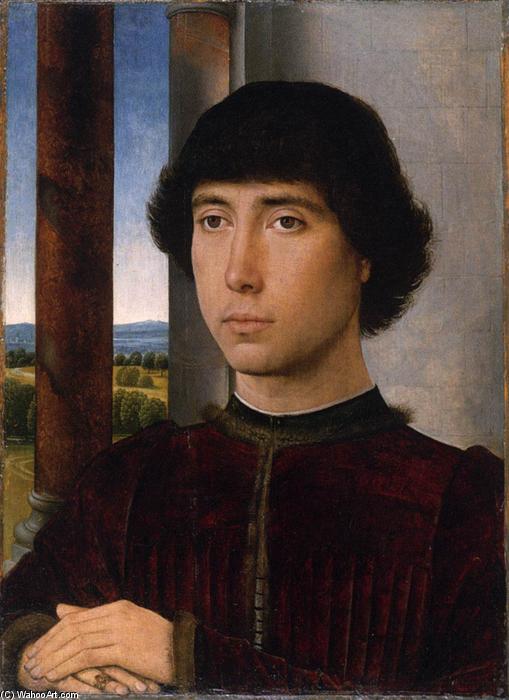
A Window into Bruges’ Golden Age
In the quiet, contemplative stillness of Hans Memling's "Portrait of a Man at a Loggia," created around 1480, we find more than a mere likeness of a bygone era; we encounter a profound window into the soul of the Northern Renaissance. This exquisite masterpiece serves as a testament to the zenith of Early Netherlandish painting, a period defined by an almost supernatural realism and a deep, spiritual introspection. The sitter, a dignified gentleman, is positioned within the elegant architectural embrace of a loggia—an open-air gallery of columns and arches that was a hallmark of the affluent Flemish residences in Bruges. As he gazes outward, his eyes establish a direct, haunting connection with the viewer, inviting us to step across the centuries and participate in his moment of serene reflection.
The composition is masterfully orchestrated to balance intimacy with grandeur. While the man’s presence is immediate and palpable, the architectural elements of the loggia provide a sense of depth and atmospheric context, suggesting a world that is both structured and expansive. There is a deliberate tension here between the physical reality of the man—rendered with such precision that one can almost feel the weight of his garments—and the spiritual aura he radiates. This duality was central to the artistic fervor of Bruges during its golden age, where the material wealth of international trade met a fervent, pious devotion to moral virtue.
The Mastery of Light and Oil
To behold this work is to witness the transformative power of the oil painting technique, a medium that Memling utilized with unparalleled virtuosity. Unlike the flatter, more opaque qualities of tempera, the oil pigments allowed Memling to achieve a luminous depth and a subtle gradation of tones that breathe life into the canvas. One can observe the meticulous modeling of the man's features, where light and shadow dance across his skin to create a striking illusion of three-dimensionality. The artist’s touch is particularly evident in the textures of the drapery; the rich, heavy folds of his attire are rendered with such tactile accuracy that they possess a palpable weight and sheen.
Memling’s lineage is clearly visible in his sculptural approach to painting, an influence inherited from the titan of Flemish art, Rogier van der Weyden. However, Memling infused this structural precision with a unique softness and a luminous clarity that became his signature. The way light filters through the loggia, catching the edges of the stone columns and illuminating the fine details of the sitter's clothing, demonstrates a sophisticated understanding of optics. For the collector or the lover of fine art, this technical brilliance offers a sensory experience that remains as captivating today as it was in the fifteenth century.
An Enduring Legacy for the Modern Interior
Beyond its historical and technical significance, "Portrait of a Man at a Loggia" possesses an emotional resonance that transcends time. It is a piece that commands attention through its quietude rather than through clamor. For the discerning interior designer or art enthusiast, this work offers a sophisticated anchor for a room, providing a sense of timelessness, stability, and intellectual depth. The palette—rich with deep reds, muted earth tones, and the cool shadows of the stone architecture—complements both classical and contemporary settings, lending an air of cultured elegance to any space.
Integrating a high-quality reproduction of this masterpiece into a home or gallery is an act of bringing history to life. It serves as a constant reminder of the beauty found in introspection and the enduring strength of human dignity. Whether placed in a sunlit study or a grand salon, the portrait continues to perform its original function: inviting the observer to pause, to breathe, and to engage in a moment of profound, silent contemplation.