A Vision of Purity: The Luminous Grace of Moroni’s Masterpiece
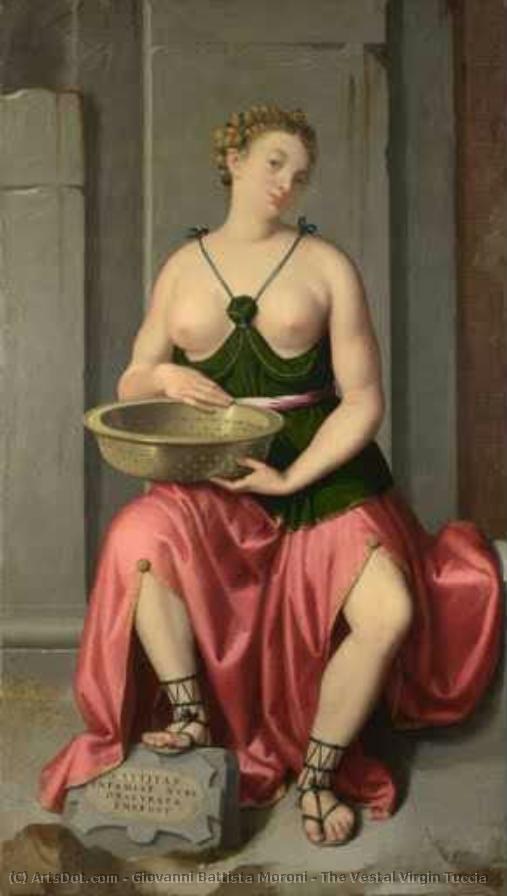
In the quiet stillness of Giovanni Battista Moroni’s "The Vestal Virgin Tuccia," one encounters more than a mere portrait; one enters a realm of profound spiritual and psychological depth. Completed around 1555, this extraordinary work stands as a jewel of the Mannerist period, capturing a moment of serene devotion that transcends the boundaries of time. The painting presents a woman of singular poise, seated with a contemplative grace that invites the viewer into her private world of sanctity. Clad in a striking ensemble where the deep, passionate reds of her dress meet the cool, verdant tones of a green gown, she holds a simple bowl—a vessel that serves as the silent protagonist of her legendary story. The interplay of light and shadow across the heavy folds of her garments creates a tactile reality, making the fabric feel almost tangible to the touch, while her steady gaze anchors the composition with an unwavering sense of peace.
The technical mastery displayed in this work reveals Moroni’s profound connection to the great Venetian masters. Having been shaped by the influence of Titian, Moroni employs a sophisticated technique of layering translucent oil glazes upon the canvas. This method allows light to penetrate the upper layers of paint, reflecting back from the base to create an inner luminosity that seems to emanate from the subject herself. Every detail, from the delicate texture of her skin to the subtle reflections on the bowl, is rendered with a meticulous realism that defines his unique approach to Mannerism. Unlike the more exaggerated distortions found in other works of this era, Moroni’s style favors an elegant naturalism, where the drama is found not in grand gestures, but in the quiet, nuanced shifts of light and the subtle emotional resonance of a single, focused expression.
Symbolism and the Echoes of Antiquity
Beyond its aesthetic splendor, "The Vestal Virgin Tuccia" is steeped in the rich allegorical traditions of the Renaissance. The subject refers to the historical Tuccia, an ancient Roman priestess whose legendary chastity was proven when she successfully carried water from the Tiber to her temple in a perforated basket without losing a single drop. In this painting, the bowl she holds becomes a powerful symbol of integrity and the triumph of virtue over accusation. For the discerning collector or interior designer, this piece offers a narrative of resilience and purity that is both intellectually stimulating and visually captivating. The composition, set against the soft suggestion of an open doorway, hints at a threshold between the earthly and the divine, making it an ideal focal point for spaces designed to inspire reflection and quiet sophistication.
For those seeking to elevate a curated collection or a refined living space, a high-quality reproduction of this masterpiece brings with it the prestige of the Italian Renaissance. The painting’s balanced color palette—dominated by rich primary tones and grounded by earthy textures—allows it to integrate seamlessly into diverse interior styles, from classical European estates to modern, minimalist galleries. It is not merely a decorative element but an invitation to engage with history, a window into a period where art served as the ultimate bridge between the human soul and the eternal.