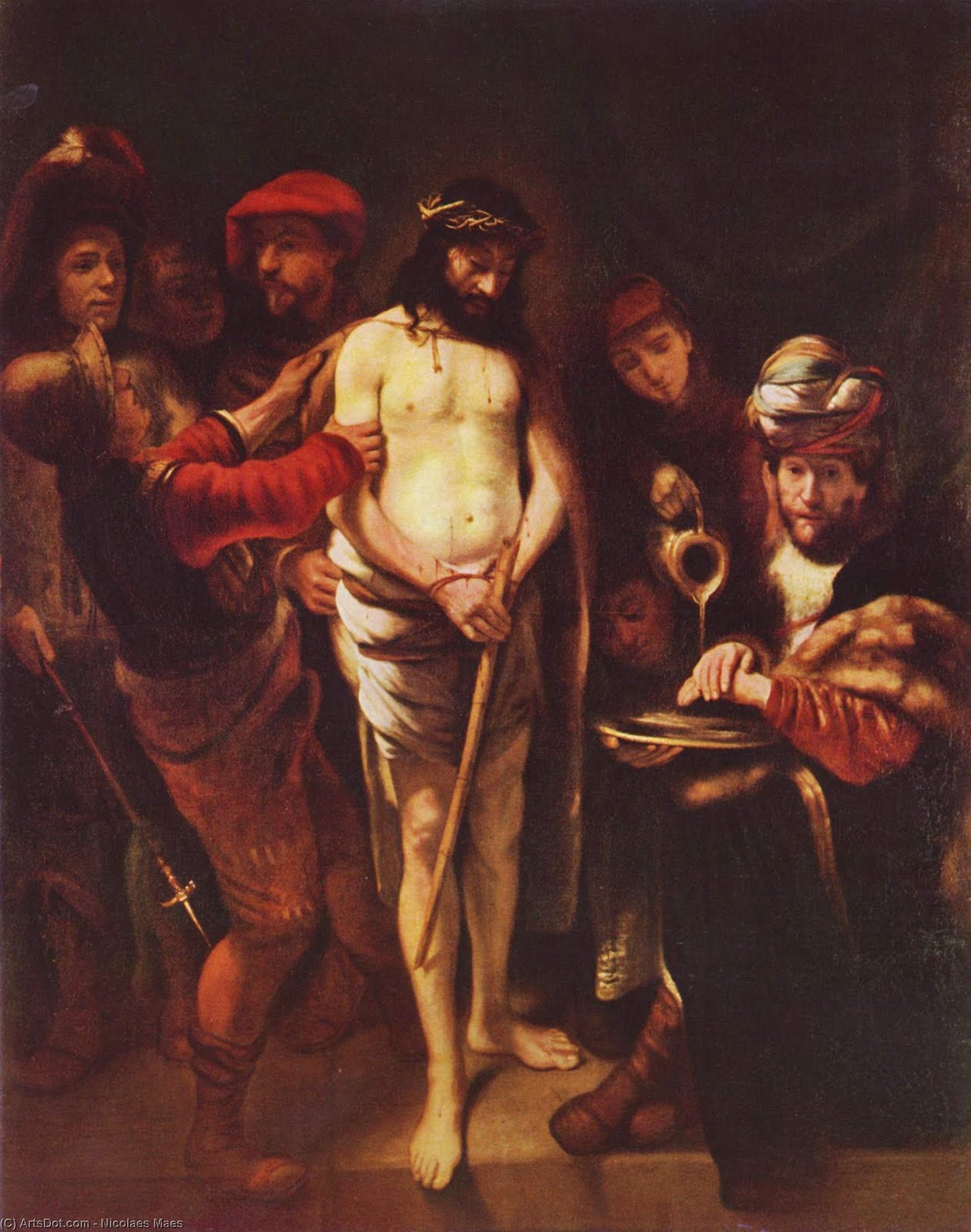
The Weight of Judgment: Nicolaes Maes’s ‘Christ Before Pilate’
Nicolaes Maes's “Christ Before Pilate,” painted in 1649-50, isn’t merely a depiction of a biblical scene; it’s a masterclass in conveying psychological drama and the unsettling ambiguity of power. The painting immediately commands attention with its monumental scale – measuring an impressive 216 x 174 cm – drawing the viewer into a meticulously rendered tableau of apprehension and moral conflict. Maes, deeply influenced by Rembrandt's pioneering use of *chiaroscuro*, employs a dramatic interplay of light and shadow to sculpt the figures, creating a palpable sense of unease that permeates the entire composition. The muted palette, dominated by deep blues, browns, and ochres, contributes to this atmosphere of somber contemplation, while strategically placed highlights draw focus to key elements – Christ’s outstretched hands, Pilate's hesitant gaze, and the faces of the onlookers, each reflecting a complex blend of fear, curiosity, and indifference.
- Rembrandt’s Shadow: Maes’s apprenticeship under Rembrandt is undeniably evident. The masterful use of light to define form and create depth echoes Rembrandt's signature style, yet “Christ Before Pilate” possesses a distinctly more intimate and emotionally charged quality than many of the artist’s larger historical scenes.
- The Human Scale: Unlike the grand, theatrical compositions favored by some of his contemporaries, Maes presents this pivotal moment in Christian history with an almost unsettling sense of immediacy. The figures are rendered with remarkable realism, their faces etched with emotion and vulnerability – a deliberate choice that forces the viewer to confront the human cost of judgment.
- Compositional Tension: The arrangement of figures is carefully orchestrated to heighten the drama. Christ, positioned centrally, becomes the focal point of attention, while Pilate’s posture—a mixture of reluctance and resignation—suggests a profound internal struggle. The surrounding crowd, rendered in varying degrees of detail, represents the collective conscience of Jerusalem, caught between loyalty to Roman authority and compassion for the accused.
A Window into 17th-Century Dutch Society
“Christ Before Pilate” offers a fascinating glimpse into the social and religious landscape of 17th-century Holland. The painting reflects the burgeoning interest in biblical narratives within a society grappling with questions of morality, justice, and faith. The inclusion of details like the bowl and cup – symbols of earthly sustenance and ritual – subtly underscores the contrast between the spiritual significance of Christ’s sacrifice and the mundane realities of daily life. Furthermore, the presence of several onlookers—a soldier, a scribe, and a group of citizens—reflects the diverse social strata of Jerusalem at the time, highlighting the universal nature of human judgment and its potential for both righteousness and injustice.
Historical Context: Painted during a period of intense religious debate and political upheaval in Europe, “Christ Before Pilate” speaks to broader anxieties about authority, faith, and the role of the individual. The painting’s enduring appeal lies in its ability to resonate with viewers across centuries, prompting reflection on timeless questions of morality and responsibility.
Symbolism and Emotional Resonance
Beyond its historical context, “Christ Before Pilate” is rich in symbolic meaning. Christ's outstretched hands represent humility, sacrifice, and the acceptance of his fate. Pilate’s hesitant gaze embodies doubt, uncertainty, and the burden of leadership—a recognition that even those entrusted with power are not immune to moral dilemmas. The faces of the onlookers convey a spectrum of emotions – fear, indifference, curiosity, and perhaps even a flicker of hope – reflecting the complex human response to injustice. The painting’s overall effect is profoundly moving, evoking a sense of empathy for both Christ and Pilate, and prompting viewers to contemplate their own roles in the ongoing drama of human judgment.
Bringing ‘Christ Before Pilate’ into Your Space
Reproductions of Nicolaes Maes's “Christ Before Pilate” offer a remarkable opportunity to bring this powerful work of art into your home or office. Available in a range of sizes and framing options, our high-quality reproductions faithfully capture the painting’s dramatic intensity and nuanced details. Whether you are an art collector, an interior designer seeking to create a contemplative atmosphere, or simply someone who appreciates the beauty and emotional depth of classic art, a reproduction of “Christ Before Pilate” is sure to be a treasured addition to your collection. Consider pairing it with complementary colors and textures to enhance its impact – deep blues and browns will evoke the painting’s somber mood, while warm earth tones can create a sense of grounding and stability.