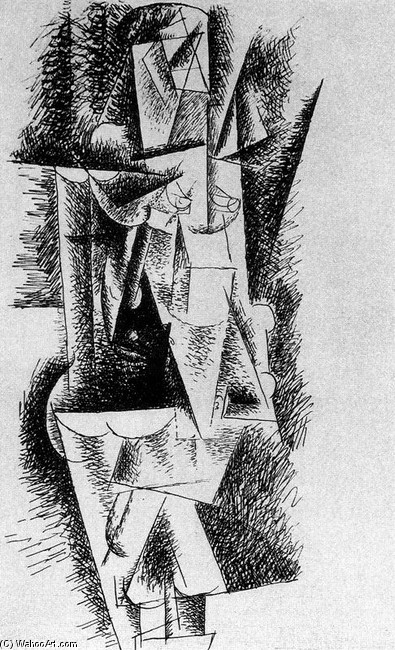
A striking Cubist exploration of form, this monochromatic charcoal masterpiece by Pablo Picasso deconstructs the female nude through geometric abstraction, inviting you to experience the essence of modern art history.
A Fragmented Portrait of Humanity: Analyzing Picasso’s Mujer desnuda de pie 3
Pablo Picasso's “Mujer desnuda de pie 3” stands as a testament to the artist’s unwavering commitment to Cubist principles, transforming a seemingly simple subject – a nude female figure – into an exploration of form and perception that transcends mere representation. Executed with meticulous charcoal strokes on paper, this monochrome masterpiece embodies the spirit of artistic innovation that defined Picasso's oeuvre during his formative years.
- Subject Matter & Context: The artwork depicts a woman standing in repose, a motif recurrent throughout Picasso’s oeuvre and reflecting broader anxieties about femininity and vulnerability prevalent in early 20th-century European art. However, unlike traditional depictions of the nude female form, Picasso abandons perspective and anatomical accuracy, prioritizing instead geometric abstraction to convey an emotional resonance far deeper than visual fidelity.
- Style & Technique: Picasso’s signature Cubist style is immediately apparent in the fractured composition. Planes intersect at sharp angles, creating a dynamic interplay of shapes that disrupts conventional spatial illusion. The artist employs hatching and cross-hatching techniques with remarkable precision, layering tonal variations to sculpt volume and texture—a deliberate rejection of Renaissance ideals of idealized beauty.
- Color Palette & Composition: Strikingly devoid of color, the grayscale palette amplifies the artwork’s dramatic impact. The dark tones dominate, emphasizing the figure's solidity while simultaneously conveying a sense of solemn contemplation. The vertical orientation reinforces the woman’s posture and contributes to the overall feeling of stillness amidst complexity.
- Symbolic Resonance: While Picasso himself resisted interpretations of his art as laden with symbolism, the fragmented form undeniably speaks to the multifaceted nature of human experience. It suggests a dismantling of preconceived notions about identity and perception—a visual metaphor for confronting ambiguity and embracing multiple viewpoints.
- Emotional Impact: “Mujer desnuda de pie 3” evokes a profound sense of introspection, inviting viewers to contemplate themes of vulnerability and resilience. The stark monochrome aesthetic underscores the artist’s desire to strip away superficial appearances, revealing an underlying emotional core that resonates with timeless artistic concerns.
Exploring Picasso's Charcoal Technique
Picasso’s masterful use of charcoal demonstrates his dedication to capturing subtle nuances of form and texture. The artist meticulously builds up tonal gradations through overlapping strokes, creating a palpable sense of depth and materiality. This technique—characteristic of Cubist drawings—highlights the importance of gesture and expressive mark-making in conveying emotion and intellectual contemplation.
Comparative Analysis: Picasso’s Influence on Modern Art
“Mujer desnuda de pie 3” exemplifies Picasso's pivotal role in shaping the trajectory of modern art. His rejection of academic conventions paved the way for subsequent artists to experiment with abstraction and explore alternative modes of representation—influences that can be seen throughout the works of Surrealists, Futurists, and Abstract Expressionists.