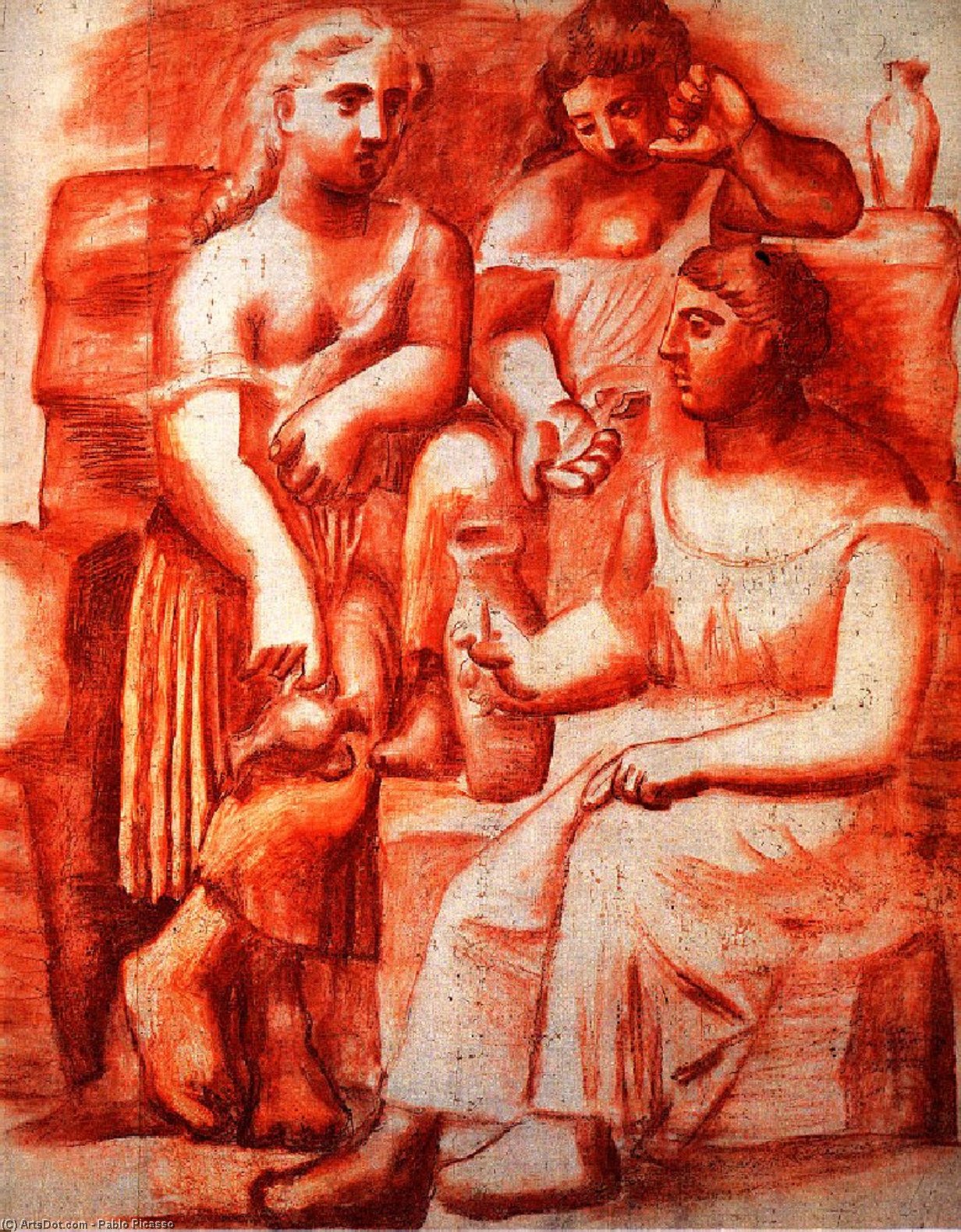
Three Women at a Fountain: A Glimpse into Picasso's Naive Art Exploration
Pablo Picasso, a titan of 20th-century art, continually pushed boundaries and explored diverse artistic styles throughout his prolific career. "Three Women at a Fountain," created in 1921, exemplifies his foray into Naive Art (also known as Primitivism), offering a captivating glimpse into a more simplified and expressive approach to representation. Measuring 200 x 161 cm and rendered in oil on canvas, this piece transcends mere depiction; it embodies a moment of tranquil social interaction imbued with Picasso's signature artistic flair.
Artistic Style: Embracing Naive Art & Primitivism
Naive Art, or Primitivism, is characterized by its deliberate rejection of formal academic training and a focus on simplicity and directness. Artists working in this style often employ bold colors, flattened perspectives, and simplified forms, reminiscent of folk art or the artistic expressions of non-Western cultures. Picasso's adoption of this style in "Three Women at a Fountain" reflects his ongoing experimentation with new modes of expression, seeking to liberate himself from the constraints of traditional representation and tap into a more instinctive form of creativity. It’s important to note that while embracing Naive Art elements, Picasso’s work retains a sophisticated understanding of composition and color theory honed through years of artistic development.
Composition & Symbolism: A Serene Gathering
The painting depicts three women seated around a fountain, each positioned with distinct postures suggesting movement and interaction. The arrangement isn't rigidly structured; rather, it conveys a sense of relaxed informality. Two dogs add a playful element to the scene, further enhancing the atmosphere of casual companionship. Bottles strategically placed near the top right corner and bottom left side contribute depth and context, grounding the figures within a recognizable environment. While seemingly straightforward, the fountain itself can be interpreted as a symbol of life, renewal, and communal gathering – themes often explored in classical mythology and art. The women's expressions are subtle yet engaging, inviting viewers to imagine their conversation and shared experiences.
Historical Context & Picasso’s Legacy
"Three Women at a Fountain" was created during a period of significant artistic evolution for Picasso. While he is famously known as a pioneer of Cubism alongside Georges Braque, this work demonstrates his willingness to explore other avenues of expression. The painting reflects the broader cultural fascination with "primitive" art forms prevalent in Europe during the early 20th century, which influenced many artists seeking new sources of inspiration beyond Western artistic traditions. Picasso’s influence extends far beyond Cubism; his innovative approaches paved the way for movements like Orphism, abstract art, and Purism. His ability to constantly reinvent himself solidified his position as one of the most influential figures in modern art history.