A Gaze into Eternity: Unveiling the Majesty of Paolo Uccello’s ‘Head of Prophet’
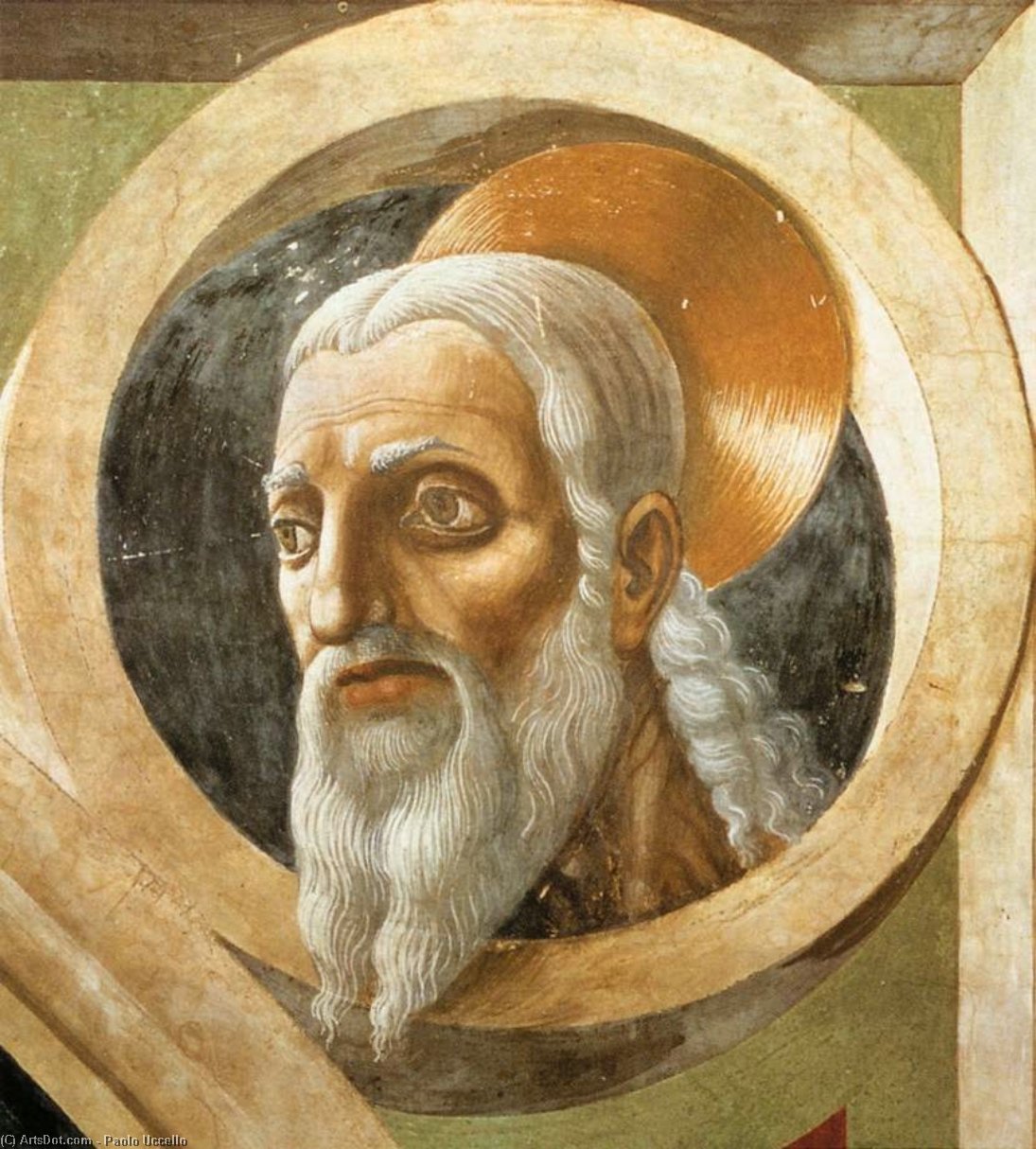
Paolo Uccello's “Head of Prophet,” painted in 1443, is not merely a portrait; it’s a meticulously crafted window into the spiritual and intellectual landscape of early Renaissance Florence. This intimate depiction, rendered with a startlingly modern sensibility for its time, transcends simple representation to become a profound meditation on wisdom, faith, and the very nature of visual space. The painting immediately commands attention through its stark simplicity – a close-up of an elderly man, his face framed by a halo that subtly suggests both divinity and the passage of time. Uccello’s genius lies not in flamboyant detail but in the masterful manipulation of line and form to create a sense of intense presence and quiet reverence.
The composition itself is strikingly deliberate. The circular frame, reminiscent of illuminated manuscripts or devotional panels, isolates the subject, drawing our focus entirely onto his face. This framing technique, coupled with the shallow perspective – a characteristic Uccello would later refine in works like ‘Clock with Heads of Prophets’ – creates an immediate sense of intimacy and draws us into a private encounter. The use of linear perspective is particularly noteworthy; it's not merely applied to create depth but seems to actively shape the viewer’s gaze, guiding our attention across the contours of his face and emphasizing the solemnity of his expression.
The Painter’s Mathematics: Technique and Materials
Uccello’s technique is a testament to his dedication to understanding the principles of visual space. Executed in oil on panel, the painting exhibits a remarkable smoothness in areas like the skin and halo, achieved through meticulous layering and blending – a hallmark of Renaissance oil painting. However, closer inspection reveals a deliberate roughness in the beard and surrounding background, suggesting the artist’s hand actively shaping the texture and adding depth to the image. These subtle variations speak volumes about his process: a careful balance between idealized representation and tangible materiality.
The palette is restrained, dominated by earthy tones – ochres, siennas, and umbers – that evoke a sense of age and solemnity. The use of light is equally deliberate, casting soft shadows that sculpt the face and halo, lending it three-dimensionality without resorting to dramatic chiaroscuro. This controlled lighting further enhances the figure’s presence, making him appear almost luminous against the dark backdrop.
Symbolism and Spiritual Resonance
The “Head of Prophet” is unequivocally a religious depiction, likely representing Saint Simeon, a revered figure known for his prophetic visions and devotion. The halo, a universal symbol of holiness and divine grace, immediately establishes this context. However, Uccello’s portrayal goes beyond simple iconography. The subject's aged appearance – the deep wrinkles etched into his face, the long white beard – are not merely indicators of age but potent symbols of wisdom, experience, and the accumulated knowledge of a life dedicated to faith. He embodies a quiet authority, suggesting that true understanding comes not from youthful exuberance but from years spent contemplating the mysteries of the divine.
Furthermore, the painting’s focus on the face – a deliberate choice in an era dominated by portraiture of the whole body – elevates the individual to a level of profound significance. It's as if Uccello is inviting us to contemplate not just the figure’s outward appearance but also the inner life and spiritual journey represented within his gaze.
A Legacy of Innovation: Paolo Uccello and His Place in Art History
Paolo Uccello stands as a pivotal, yet often misunderstood, figure in Renaissance art. While he is best known for his ambitious and occasionally eccentric works like ‘Clock with Heads of Prophets,’ this “Head of Prophet” offers a more intimate glimpse into his artistic vision. His pioneering work on perspective – a concept still debated among scholars – fundamentally altered the way artists represented space and depth. Uccello’s legacy lies not just in his technical innovations but also in his willingness to experiment, to push the boundaries of convention, and to imbue his art with a profound sense of intellectual curiosity. Reproductions of this captivating portrait offer a unique opportunity to connect with one of the most inventive minds of the Early Renaissance.