Paul Cezan (1839-1906): Pionerski postimpresionista koji je spajao impresionizam i kubizam! Istražite geometrijske oblike, mrtve prirode i njegov uticaj na modernu umetnost. Otkrijte 'Kupateljke' i slike Mont Sainte-Victoire.
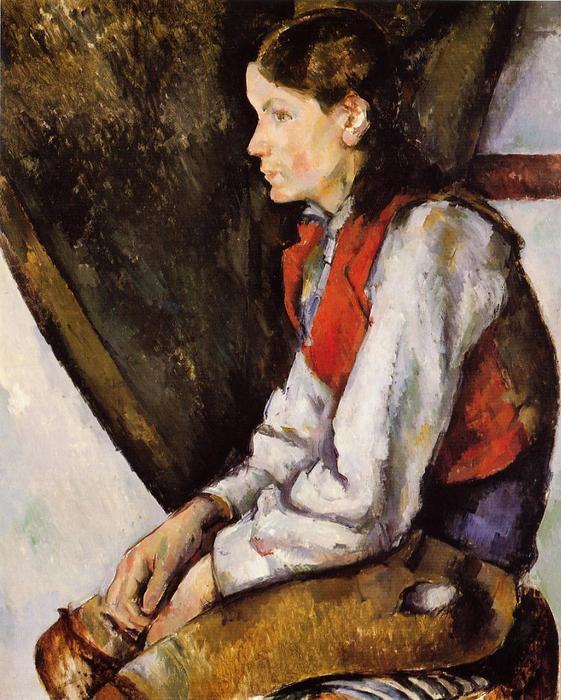
A Revolutionary Portrait: Decoding Cézanne’s ‘Boy in the Red Vest’
Paul Cézanne's *The Boy in the Red Vest* (Le Garçon au gilet rouge) isn’t merely a depiction of youthful innocence; it’s a cornerstone of modern art, representing a decisive break from Impressionism and establishing Cézanne as one of the progenitors of Cubism. Painted around 1882 during his formative years in Aix-en-Provence, this deceptively simple composition belies a complex exploration of form and perspective that continues to fascinate scholars and artists alike. Venturing beyond mere visual representation, Cézanne sought to capture not just what he saw but how he *felt* about seeing it—a characteristic ambition that would define his entire artistic career.
The Style & Technique: Pioneering Geometric Abstraction
Cézanne’s approach departed dramatically from Impressionism's focus on fleeting light and color, prioritizing solidity and structure. He employed a technique known as “alla prima,” applying paint directly onto the canvas without preliminary sketches, resulting in textured surfaces that convey palpable physicality. The painting utilizes thick impasto—heavy application of pigment—creating ridges and valleys that sculpt the form of the boy and subtly suggest the contours of the surrounding landscape. Notice how Cézanne dismantles traditional perspective, flattening the space and presenting multiple viewpoints simultaneously. This deliberate fragmentation anticipates Cubism’s radical simplification of forms, foreshadowing a revolution in artistic representation. The use of muted earthy tones—primarily ochre and umber—further enhances the painting's contemplative mood.
Historical Context: Impressionism's Legacy & Cézanne's Artistic Quest
Cézanne emerged from the shadow of Impressionism, influenced by artists like Monet and Renoir who championed capturing atmospheric effects. However, Cézanne rejected Impressionism’s ephemeral beauty, arguing that it failed to convey the essence of reality. He was driven by a profound conviction that art should strive for permanence—a belief rooted in his fascination with sculpture and his desire to depict objects as they truly exist, independent of optical perception. This intellectual pursuit fueled his experimentation with form and color, pushing him toward increasingly abstract representations. The painting’s creation coincided with Cézanne's growing disillusionment with the artistic conventions of his time—a sentiment echoed in his famously terse pronouncements about “making it over.”
Symbolism & Emotional Resonance: Beyond Surface Appearance
While seemingly straightforward, *The Boy in the Red Vest* is laden with symbolic significance. The red waistcoat itself serves as a focal point, drawing the eye and injecting vibrancy into the muted palette. Color, according to Cézanne, possessed emotional power—a conviction he rigorously tested throughout his artistic life. The boy’s gaze directs outwards, suggesting contemplation and introspection; he embodies a quiet dignity that transcends mere portraiture. Furthermore, the inclusion of the boat – likely Cézanne's studio – subtly reinforces the artist’s connection to nature and his desire to capture its enduring presence within the confines of the canvas. Ultimately, the painting evokes feelings of serenity and melancholy—a testament to Cézanne’s ability to distill profound emotion into a deceptively simple visual form.
A Lasting Influence: Shaping Modern Art's Future
Cézanne’s influence extended far beyond his own lifetime, inspiring generations of artists who embraced abstraction and geometric simplification. Picasso famously declared that Cézanne “destroyed perspective.” Matisse acknowledged Cézanne as "the father of us all." His groundbreaking technique paved the way for Cubism and Surrealism, fundamentally reshaping artistic conventions and establishing Cézanne’s place among the titans of modern art. Reproductions of *The Boy in the Red Vest* continue to captivate audiences today, offering a glimpse into the mind of an artist who dared to challenge convention and forge his own path toward artistic innovation.