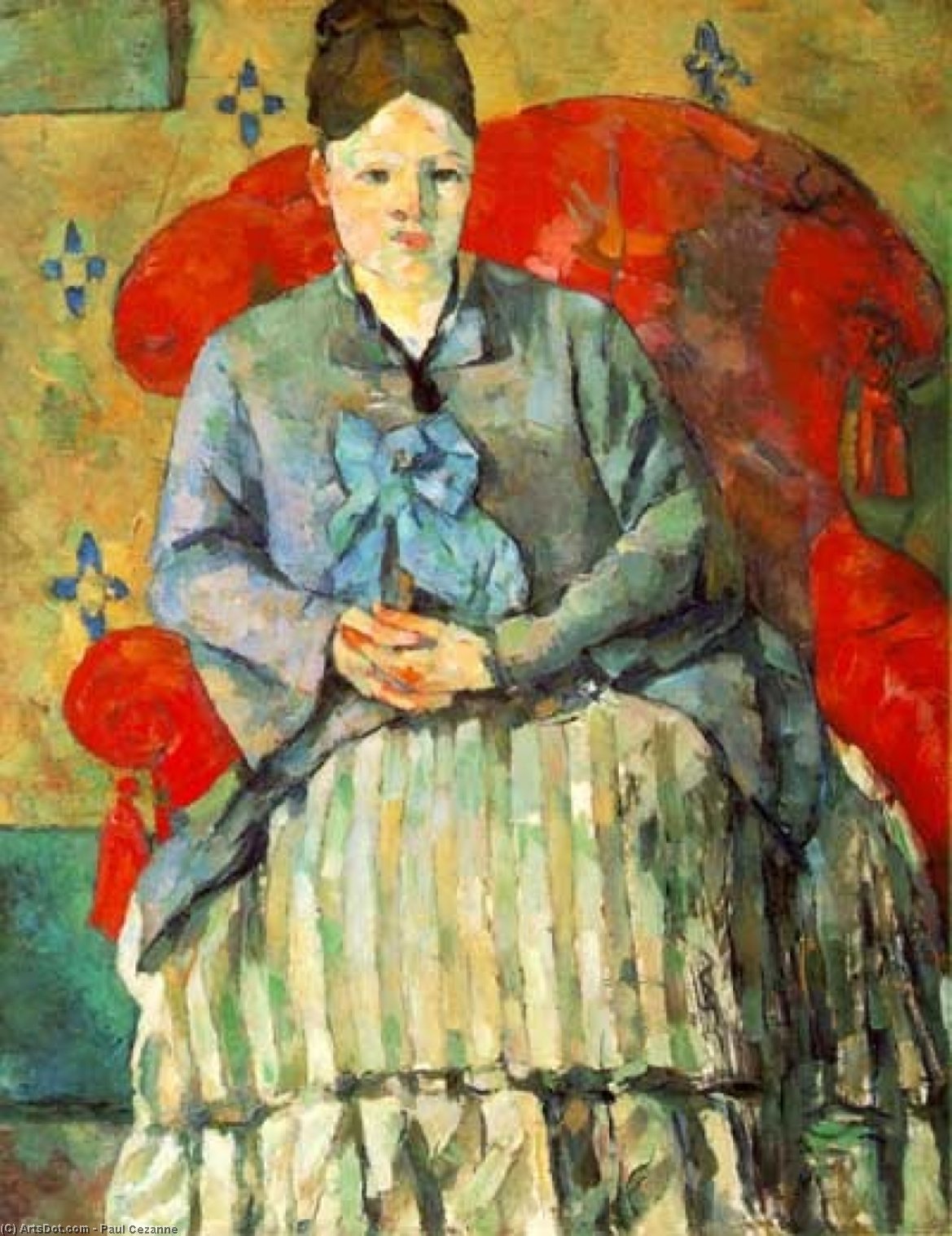
The Enigmatic Figure of Hortense Fiquet
Paul Cézanne’s Hortense Fiquet in a Striped Skirt, painted in 1877, isn't merely a portrait; it’s a carefully constructed tableau brimming with subtle symbolism and the nascent energy of Post-Impressionism. This captivating work, now residing within the esteemed collection of the Museum of Fine Arts in Boston, offers a glimpse into Cézanne’s evolving artistic vision – a vision that moved beyond simple representation to explore the very essence of form, color, and light. The subject herself, Hortense Fiquet, was more than just a model; she was a muse, a lover, and a significant influence on the artist's development, adding layers of personal narrative to the painting’s visual language.
Cézanne chose to depict her seated in a simple red armchair, a deliberate selection that anchors the composition while simultaneously suggesting a quiet intimacy. Her hands folded demurely in her lap, and her gaze directed towards the viewer, create an immediate connection – a sense of shared observation. The dominant element, undeniably, is the striped skirt, rendered with meticulous detail and a surprising vibrancy against the muted background. This bold pattern isn’t just decorative; it draws the eye, creating a visual rhythm that guides the viewer through the scene.
A Symphony of Color and Form
Cézanne's masterful technique is immediately apparent in the painting’s structure. He employs a revolutionary approach to perspective, breaking away from traditional linear representation. Instead of striving for photographic accuracy, he uses flattened planes of color and subtly shifting angles to create an illusion of depth and volume. The red armchair isn’t simply placed behind her; it seems to press forward, almost merging with the surrounding space. This technique, a hallmark of Cézanne's style, anticipates the developments of Cubism by deconstructing objects into their fundamental geometric components.
The color palette is equally significant. Cézanne utilizes a restrained range of earthy tones – ochres, browns, and greens – punctuated by the striking contrast of the red chair and the blue bow in Hortense’s hair. He masterfully blends these colors, creating subtle gradations and shimmering effects that imbue the painting with a remarkable sense of luminosity. Notice how he uses small brushstrokes to build up layers of color, capturing the texture of the fabric and the play of light on its surface.
Post-Impressionism: A Departure from Reality
Hortense Fiquet in a Striped Skirt stands as a pivotal work within the Post-Impressionist movement. Emerging as a reaction against the fleeting impressions of Impressionism, Post-Impressionists sought to explore subjective experience and emotional truth. Cézanne wasn’t interested in capturing a momentary snapshot; he aimed to distill the essence of his subject – Hortense Fiquet – into a timeless representation. His focus shifted from merely depicting what was seen to conveying how it *felt*.
The painting's context is crucial to understanding its significance. Cézanne’s relationship with Hortense Fiquet was complex and often fraught with emotional intensity, adding another layer of meaning to the portrait. The inclusion of seemingly minor details – the clock on the wall, the two vases – subtly enrich the scene, suggesting a domestic setting and hinting at the passage of time. These elements aren't merely decorative; they contribute to the painting’s overall atmosphere and narrative depth.
A Legacy of Innovation
Paul Cézanne’s Hortense Fiquet in a Striped Skirt is more than just a beautiful portrait; it’s a groundbreaking work that fundamentally altered the course of art history. It represents a decisive break from traditional artistic conventions and paved the way for the revolutionary developments of modernism. The painting's influence can be seen in the works of artists such as Picasso, Matisse, and Braque, who built upon Cézanne’s innovations to create entirely new visual languages. Reproductions of this iconic work offer a unique opportunity to experience the genius of one of art history’s most influential figures.
To explore Paul Cézanne's artistic journey further, we invite you to visit Paul Cezanne: Hortense Fiquet in a Striped Skirt at ArtsDot and discover the rich details behind this captivating masterpiece. For an introduction to Post-Impressionism, refer to Post-Impressionism Art Movement Introduction.