A Quiet Resonance: The Soul of Cézanne’s Atelier
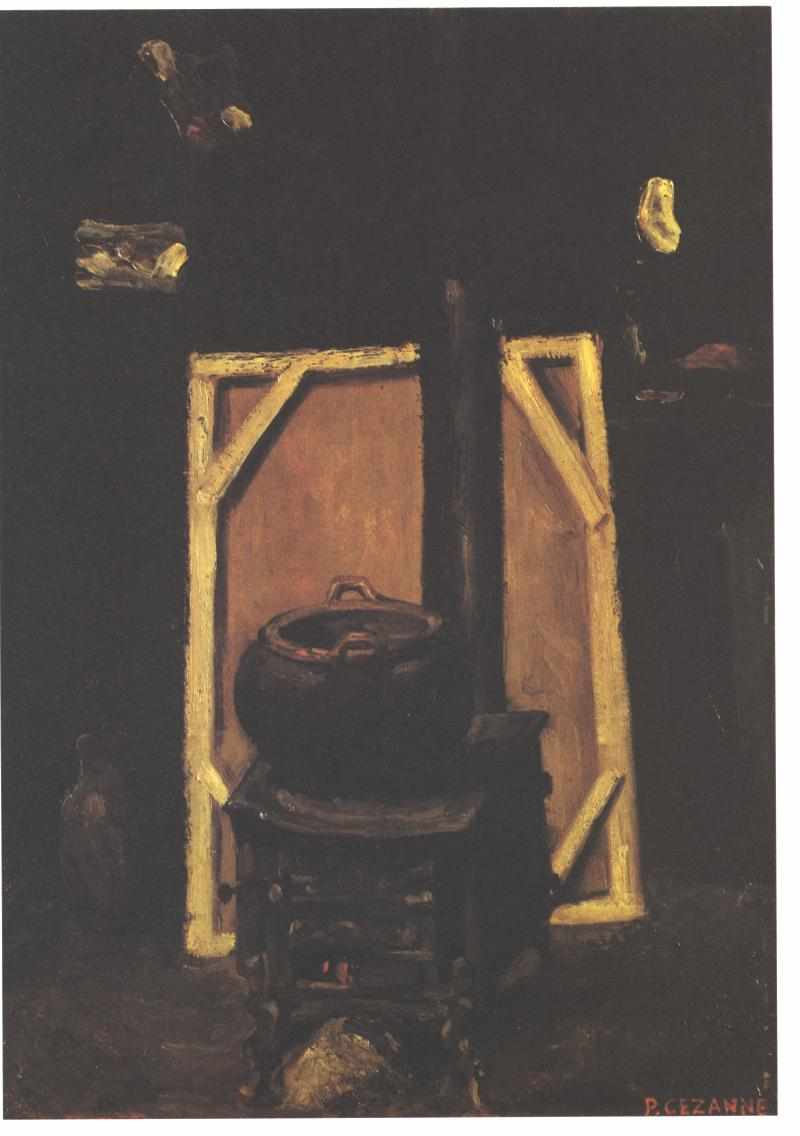
In the hushed corners of art history, few works possess the profound, meditative stillness found in Paul Cézanne's “Stove in the Atelier.” Painted around 1865, this evocative still life serves as a poignant window into the formative years of a master who would eventually dismantle traditional perspective to birth modernism. At first glance, the composition appears deceptively humble, presenting a collection of domestic objects—a dark stove, a vase of flowers, and the skeletal frame of a canvas stretcher—arranged against a somber, shadowy backdrop. Yet, beneath this surface of everyday reality lies an intense exploration of weight, volume, and the very essence of perception. For the discerning collector or interior designer, this piece offers more than mere decoration; it provides a focal point of intellectual depth and quietude, perfect for spaces that demand a sense of grounded introspection.
The technique employed in this early masterpiece reveals the seeds of what would become the Post-Impressionist revolution. Eschewing the delicate, fleeting light of his Impressionist contemporaries, the young Cézanne leaned into a more robust, impasto approach. The paint is applied with a palpable texture, where visible, rhythmic brushstrokes build a sense of physical presence. There is a deliberate, almost architectural quality to how he treats the objects; he utilizes geometric simplification—focusing on the stability of cubes and cylinders—to convey a sense of permanence. This tactile richness makes a high-quality reproduction particularly captivating, as the interplay of light across the simulated thick paint layers can bring a dynamic, sculptural energy to any wall.
Historical Echoes and Symbolic Depth
To understand “Stove in the Atelier,” one must look back to the influence of Jean-Baptiste-Siméon Chardin. Cézanne’s early work breathes the same restrained, honest air as Chardin’s legendary still lifes, prioritizing a muted palette and a frontal, unpretentious composition. This connection to the past allowed Cézanne to ground his radical innovations in a tradition of masterful observation. The stove itself, positioned prominently within the frame, acts as an anchor for the composition, symbolizing the warmth and stability of the domestic sphere, while the surrounding shadows suggest the infinite mysteries of the artist's creative process.
The emotional impact of the work is one of profound solitude and focused intention. There is no grand narrative here, only the dignity of the object and the sanctity of the studio space. For those looking to curate an environment of sophistication and calm, this painting acts as a silent companion. It does not shout for attention but rather invites the viewer to slow down, to observe the subtle gradations of dark tones, and to find beauty in the structural integrity of the mundane. Whether placed in a contemporary minimalist gallery or a classic study, Cézanne’s vision remains an enduring testament to the power of seeing the extraordinary within the ordinary.