A Window Into Provence: Paul Cézanne’s “Village Behind Trees”
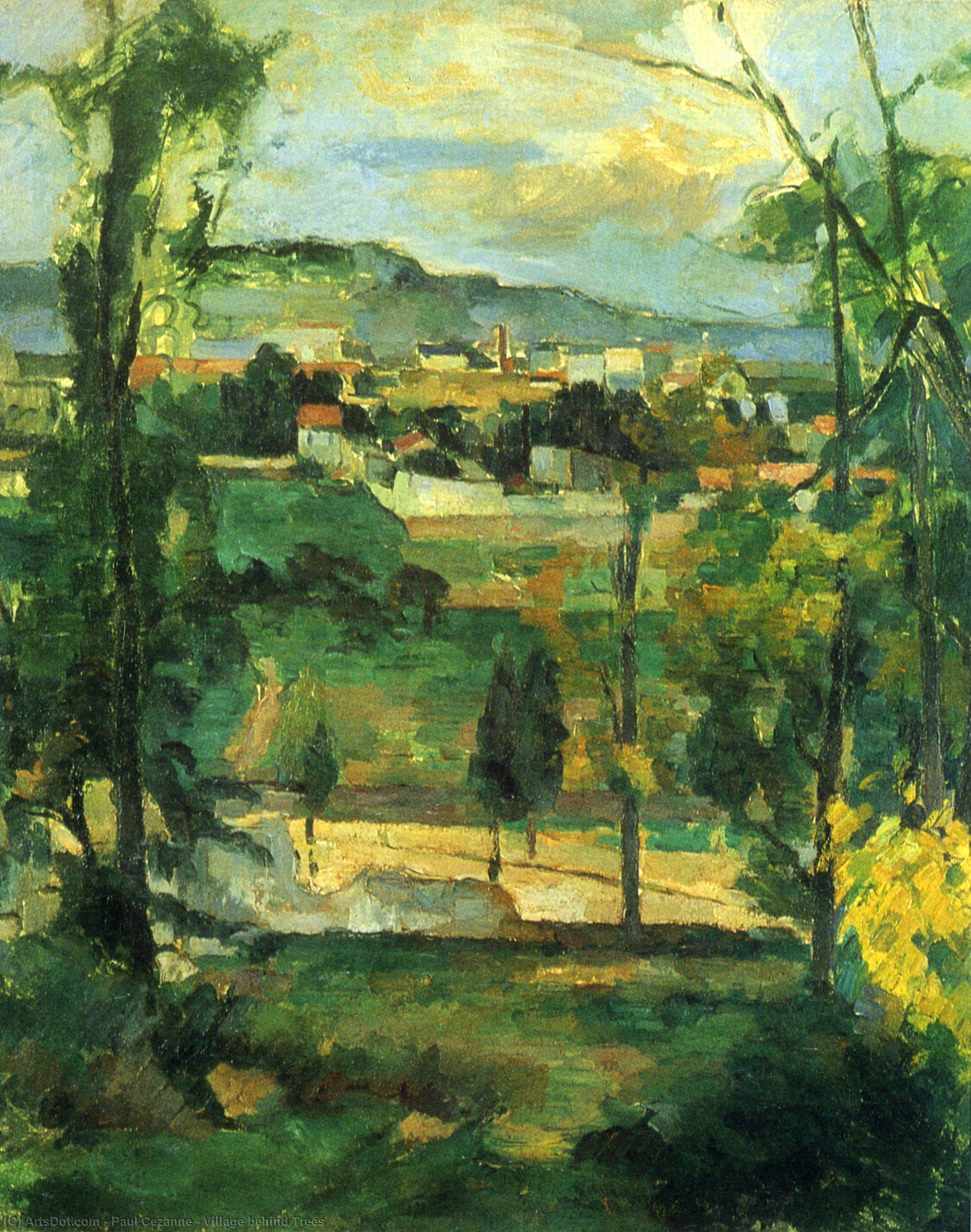
Paul Cézanne's "Village Behind Trees," painted in 1879, isn’t merely a depiction of a rural landscape; it’s a profound meditation on perception and the very nature of seeing. This oil on canvas, residing within the collection of the Smith College Museum of Art in Northampton, Massachusetts, offers a glimpse into Cézanne's revolutionary approach to art – one that deliberately challenged traditional notions of perspective and representation, ultimately laying the groundwork for modernism. The scene unfolds with a serene simplicity: a small village nestled amongst rolling hills, its houses clustered together beneath a canopy of ancient trees. Yet, within this apparent tranquility lies a complex interplay of color, form, and spatial illusion, revealing Cézanne’s meticulous study of light and structure.
The painting exemplifies Cézanne's unique style, characterized by repetitive brushstrokes and a deliberate focus on the underlying geometric forms of objects. He wasn’t interested in capturing a fleeting impression of a scene; instead, he sought to distill it into its essential elements – the planes of color, the angles of buildings, the solidity of trees. Notice how Cézanne doesn't attempt to render every detail with photographic accuracy. Instead, he employs small, broken brushstrokes—often applied in parallel directions—to build up fields of color that suggest volume and depth. This technique creates a sense of atmospheric perspective, where distant elements appear paler and less distinct, while closer objects retain their vibrancy and sharpness. The village itself is rendered with an almost sculptural quality, as if it were carved from solid blocks of earth and stone. The trees, too, are not simply painted; they’re constructed from overlapping planes of green and brown, conveying a sense of their immense age and rootedness in the landscape.
Historically, Cézanne's work was initially met with skepticism by the art world. Contemporary critics struggled to grasp his unconventional approach, often dismissing it as overly simplistic or lacking in finish. However, fellow artists like Camille Pissarro recognized his genius early on, providing crucial support during a period of artistic uncertainty. Ambroise Vollard, an influential art dealer, played a pivotal role in championing Cézanne’s work, organizing the first solo exhibition of his paintings in 1895 – an event that dramatically shifted public perception and established Cézanne's place as a major figure in late 19th-century art. It is no exaggeration to say that Cézanne’s influence on modern art is profound; Henri Matisse famously declared him “the father of us all,” acknowledging his pioneering role in dismantling traditional artistic conventions and paving the way for movements like Cubism.
The painting's emotional impact is surprisingly powerful. Despite its seemingly peaceful subject matter, "Village Behind Trees" possesses a subtle tension—a sense of stillness and contemplation. Cézanne’s deliberate use of color and form creates an atmosphere of quiet mystery, inviting the viewer to lose themselves in the scene and consider their own relationship to nature and art. The village appears almost timeless, as if it exists outside of conventional time and space. The light filtering through the trees casts long shadows across the landscape, adding depth and drama to the composition. It’s a painting that speaks not just to the eye but also to the heart, evoking feelings of nostalgia, serenity, and perhaps even a touch of melancholy.
- Key Techniques: Repetitive brushstrokes, planar forms, atmospheric perspective, broken color – Cézanne meticulously builds up surfaces using small, fragmented strokes that prioritize geometric shapes over realistic representation.
- Historical Context: Bridging Impressionism and Post-Impressionism; challenging academic conventions – Cézanne’s work represents a decisive break from the idealized landscapes of Romanticism and marks the beginning of a new artistic vocabulary.
- Influences: Cézanne drew inspiration from artists like Camille Pissarro, Georges Seurat, and Paul Gauguin, whose explorations of color and form foreshadowed his own groundbreaking innovations.
Exploring Cézanne’s Vision: A Geometric Landscape
Cézanne wasn't striving for photographic realism; rather, he sought to capture the essence of what he *saw*, prioritizing underlying structural elements over visual detail. He believed that art should reflect the way objects appear to our senses—a conviction that fueled his relentless experimentation with form and color. The artist’s meticulous attention to light and shadow contributes significantly to the painting's expressive power, creating a palpable sense of depth and dimensionality.
A Legacy Enduring: Cézanne’s Influence on Modern Art
Henri Matisse famously recognized Cézanne as “the father of us all,” acknowledging his pivotal role in dismantling traditional artistic hierarchies and ushering in the era of Cubism. Picasso and Braque embraced Cézanne's revolutionary techniques, transforming them into the cornerstone of their groundbreaking movement—a testament to Cézanne’s enduring legacy on the trajectory of art history.