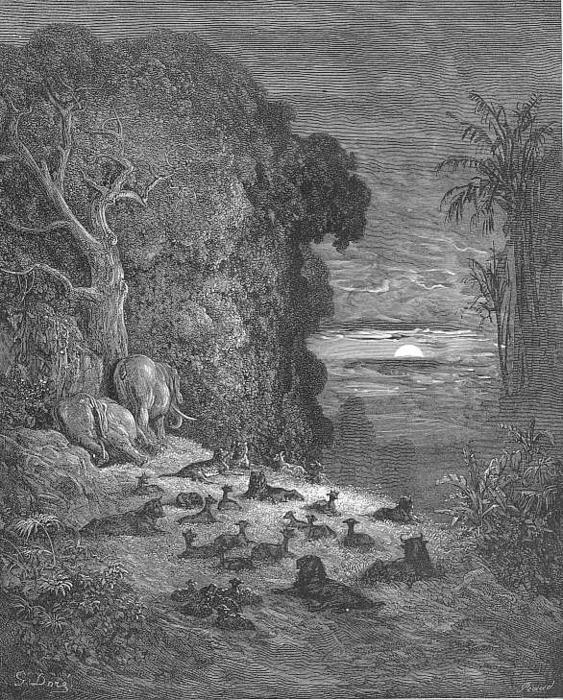
And now on earth the seventh Evening arose in Eden
Paul Gustave Doré’s “And now on earth the seventh Evening arose in Eden” is a breathtaking testament to Romanticism's ability to fuse meticulous observation with profound spiritual contemplation. Executed as a masterful wood engraving, circa 1867-1868, this artwork transports viewers back to the biblical narrative of Adam and Eve’s expulsion from Paradise – a scene rendered with unparalleled detail and imbued with an atmosphere of solemn beauty.
Doré's signature style—characterized by dramatic compositions and painstakingly crafted linework—is immediately apparent. The engraving showcases a tranquil evening landscape dominated by a colossal rock formation on the left, serving as a grounding element against which the central vista unfolds. Lush vegetation clings to the stone’s surface, subtly hinting at the vibrancy of Eden before its fall. Scattered across the foreground are animals – deer, rabbits, birds – peacefully gathered near a serene body of water reflecting the luminous orb of the moon overhead. This careful arrangement underscores Doré's dedication to capturing both the grandeur of nature and the emotional resonance of religious storytelling.
The engraving’s monochromatic palette—primarily shades of gray—amplifies its impact. Doré skillfully employs hatching and cross-hatching techniques, layering lines with varying thicknesses to convey texture and depth. The rough surface of the rock face contrasts sharply with the smooth reflection in the water, creating a visual dialogue that reinforces the artwork's thematic concerns. Furthermore, Doré’s perspective—a blend of atmospheric and linear techniques—guides the eye upwards towards the moon, emphasizing its symbolic significance as a beacon of divine light and hope amidst darkness.
Beyond its technical prowess, “And now on earth the seventh Evening arose in Eden” speaks to deeper artistic and spiritual ideas. The image embodies Romanticism’s fascination with sublime landscapes and its belief in art's capacity to convey moral truths. Doré’s meticulous rendering captures not merely a visual depiction but also an emotional experience—a poignant reminder of innocence lost and a yearning for transcendence. It remains a powerfully evocative piece, resonating with viewers centuries later as a symbol of serenity, contemplation, and the enduring beauty of creation.
- Artist: Paul Gustave Doré
- Medium: Wood engraving
- Date: Circa 1867-1868
- Style: Romantic Realism
- Historical Context: Produced during the Victorian Era, reflecting Romantic ideals of nature and spirituality.