Paul Gustave Doré: A Titan of Romantic Illustration
Paul Gustave Doré (1832-1883) stands as one monumental figure in the annals of Victorian illustration, an artist whose dramatic wood engravings indelibly shaped perceptions of literature and history. Born in Strasbourg, France, his early life was marked by a prodigious talent for drawing—a skill honed from childhood—and a personality brimming with theatrical flair, foreshadowing the profound emotional depth that would characterize his artistic output. He began his professional career remarkably young, at fifteen years old, establishing himself as a caricaturist for *Le Journal pour rire*, demonstrating an astute understanding of visual satire and mastering the craft of capturing fleeting expressions with unparalleled precision. This formative experience instilled in him a meticulous attention to detail—a hallmark that would permeate every subsequent project.
- A Master of Romantic Drama: Doré’s artistic vision was firmly rooted in the Romantic movement, an era obsessed with emotion, imagination, and grandeur. He embraced the stylistic conventions of his time – sweeping vistas, chiaroscuro lighting—to convey narratives brimming with passion and psychological complexity.
- Technique & Material: Doré’s signature medium was wood engraving, a painstaking process demanding exceptional skill and patience. Artists meticulously carved intricate lines into copper plates using specialized tools called gravers, transferring ink onto the plate and pressing it onto paper to produce stunningly detailed prints. This technique allowed for unparalleled tonal control and textural richness.
- Iconic Literary Adaptations: Doré achieved international renown through his adaptations of literary masterpieces, notably Dante’s *Inferno* and Milton's *Paradise Lost*. His depictions captured the visceral horror and sublime beauty of these narratives with breathtaking accuracy, cementing his reputation as a storyteller who could translate textual ideas into unforgettable visual experiences.
The Battle of Arsuf: A Symphony of Struggle & Despair
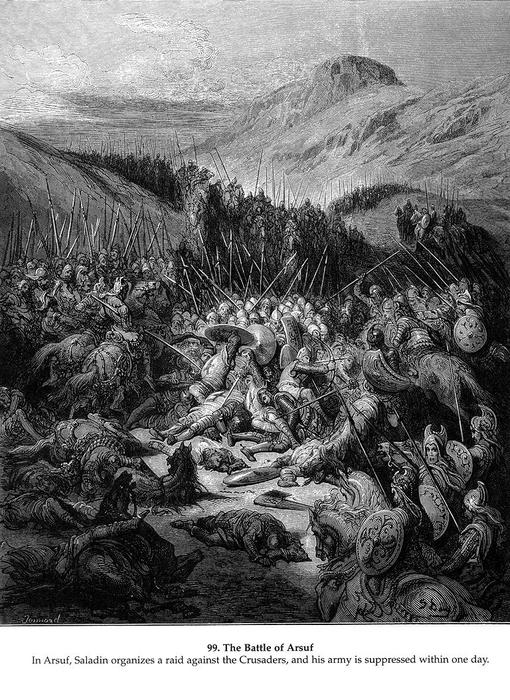
Doré’s depiction of “The Battle of Arsuf,” commemorating Richard I the Lionheart's decisive victory against Saladin in 1191, exemplifies his mastery of dramatic composition and tonal rendering. The engraving portrays a sprawling battlefield dominated by colossal figures engaged in brutal combat—crusaders battling Muslim warriors amidst a turbulent landscape. Doré skillfully employs atmospheric perspective to convey the vastness of the scene, diminishing detail in distant mountains while emphasizing the immediacy of the action at the forefront.
- Composition & Lighting: The pyramidal arrangement of figures draws the viewer’s eye upwards towards the central conflict, mirroring the grandeur and drama inherent in the historical event. Doré utilizes dramatic chiaroscuro lighting—contrasting areas of intense illumination with deep shadows—to heighten emotional impact and sculpt the forms of his subjects.
- Symbolism & Emotion: Beyond mere visual representation, Doré imbues the artwork with symbolic resonance. The depiction of suffering and heroism underscores the moral complexities of the Crusades, conveying a profound sense of human vulnerability against the backdrop of epic conflict.
Legacy & Influence
Doré’s influence extends far beyond his own lifetime, shaping artistic sensibilities for generations to come. His meticulous attention to detail and expressive use of tonal variation established new standards for illustration—inspiring countless artists who followed him. Today, reproductions of “The Battle of Arsuf” continue to captivate audiences worldwide, serving as a testament to Doré’s enduring legacy as one of the most celebrated illustrators in Victorian history. His work remains an unparalleled achievement of Romantic realism and visual storytelling.