Death of Frederick I of Germany: A Romantic Tableau of Power and Sorrow
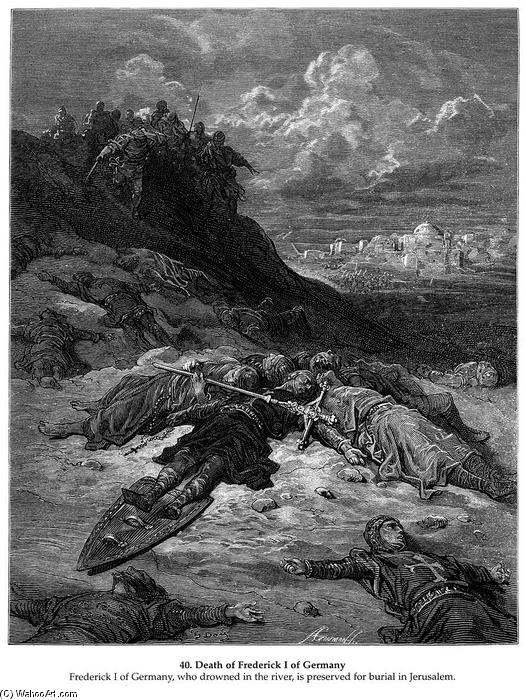
Gustave Doré’s “Death of Frederick I of Germany” isn't merely an engraving; it’s a visceral plunge into the turbulent heart of European history. Executed in 1864, this monumental print captures the chilling aftermath of the Battle of Leipzig—a decisive clash between Prussia and Austria that reshaped the political landscape of Central Europe—and portrays the emperor’s fatal demise with breathtaking dramatic intensity.
- Subject Matter: The artwork depicts Frederick I succumbing to drowning after being defeated by his enemies. This event, though seemingly simple in its narrative, encapsulates profound themes of ambition thwarted, imperial grandeur crumbling before the forces of fate, and the inescapable reality of mortality.
Doré’s masterful command of engraving—a technique favored during the Romantic era—is evident in every meticulously etched line. He employs heavy hatching and cross-hatching to achieve remarkable tonal variation, convincingly simulating textures ranging from weathered stone to damp fabric. This painstaking process lends an unparalleled sense of realism and depth to the composition.
- Style & Technique: Doré’s artistic vision aligns perfectly with the Romantic movement’s preoccupation with emotion, imagination, and the sublime—a desire to confront viewers with uncomfortable truths about human existence. This engraving transcends mere historical record; it aspires to evoke a profound emotional response, reminding us that even emperors are subject to the immutable laws of nature and the inevitability of death.
The scene unfolds on a slightly elevated plane, offering a panoramic view of the battlefield strewn with corpses and littered with weaponry. A prominent rocky outcrop dominates the left side, serving as a dramatic framing device that draws the eye towards the central tableau—the emperor’s lifeless body surrounded by grieving attendants. Atmospheric perspective subtly softens the distant cityscape, reinforcing the scale of the historical drama.
- Composition & Perspective: The composition is dominated by a large rocky outcrop on the left side, framing the central scene of the dead emperor and his attendants. There’s a distant city visible in the background, adding to the scale of the event.
Doré's deliberate use of light and shadow amplifies these emotions, creating a palpable sense of tragedy and conveying the inescapable passage of time.
- Symbolism: The fallen armor and weapons symbolize shattered power and military defeat. More powerfully, however, are the somber expressions on the faces of those present—a testament to human vulnerability in the face of overwhelming adversity.
“Death of Frederick I” remains a compelling piece of art history, offering an unforgettable glimpse into a pivotal period in European history while simultaneously demonstrating Doré’s unparalleled skill as an engraver and storyteller. Its enduring power lies in its ability to transport the viewer back to Leipzig 1864—a scene etched forever in stone and ink, imbued with both grandeur and sorrow.