A Window Into Victorian Poverty: Examining Doré’s “Spanish Beggars From Burgos”
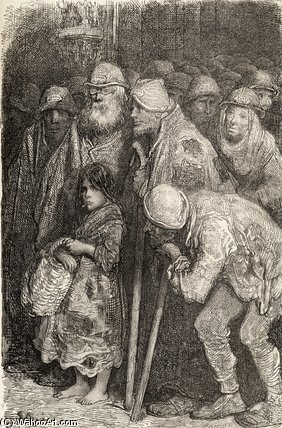
Paul Gustave Doré's "Spanish Beggars From Burgos," etched onto metal and transferred to paper with meticulous ink, stands as a haunting testament to the social realities of 19th-century Europe. More than just an illustration—though undeniably masterful in its execution—it’s a profound meditation on vulnerability, despair, and the enduring power of visual storytelling. Created during Doré's prolific period, this engraving captures a scene from Cervantes’ *Don Quixote*, specifically depicting the impoverished inhabitants of Burgos, Spain, as portrayed by Miguel de Cervantes himself. The artist skillfully translated Cervantes’ narrative into a powerfully emotive image that transcends literary text alone.
- Style and Technique: Doré's approach embodies the Romantic spirit’s fascination with dramatic realism. He employed the engraving technique—a process of etching lines onto a metal plate—allowing for unparalleled detail and tonal gradation. This method, perfected by artists like Rembrandt before him, ensured that every nuance of texture and shadow was faithfully reproduced on paper, resulting in an image brimming with palpable atmosphere. The artist’s dedication to capturing the essence of Cervantes' vision is evident in his masterful manipulation of light and dark—a hallmark of Romantic art.
- Composition & Detail: The composition is deliberately claustrophobic, compressing the figures into a densely populated space. Doré’s masterful use of cross-hatching—creating tonal variations through overlapping lines—defines every contour and folds of clothing, conveying an astonishing level of realism. Notice how the artist meticulously renders the young girl's bare feet, emphasizing her fragility against the backdrop of hardship. This careful attention to detail speaks volumes about Doré’s artistic ambition – he sought not merely to depict a scene but to evoke a feeling, to transport the viewer into the impoverished world depicted.
- Historical Context: Produced in 1869, “Spanish Beggars From Burgos” reflects the anxieties surrounding social inequality prevalent during Victorian England and its influence on European artistic sensibilities. Doré’s work served as a visual commentary on poverty and suffering—themes that resonated deeply with audiences of his time. The engraving emerged from a period marked by significant societal reform movements, highlighting the artist's engagement with pressing moral concerns.
- Symbolism & Emotional Impact: Beyond mere depiction, Doré imbued the image with symbolic weight. The downcast expressions of the beggars convey profound sadness and hopelessness, mirroring the moral dilemmas explored in Cervantes’ novel. The outstretched hand symbolizes supplication and vulnerability—a poignant reminder of human compassion amidst societal neglect. This deliberate use of symbolism elevates the engraving beyond a simple visual record; it compels contemplation about justice, empathy, and the human condition.
- Influence & Legacy: Doré's engraving profoundly impacted subsequent illustrators and artists, establishing him as a cornerstone of Romantic illustration. Its enduring appeal lies in its ability to evoke empathy and provoke contemplation about the human condition—qualities that continue to inspire artistic endeavors today. His meticulous technique continues to serve as an exemplar for aspiring engravers and artists seeking to achieve comparable levels of expressive power.
Interior Design Considerations: Reproductions of Doré’s “Spanish Beggars From Burgos” can inject a dramatic element into spaces seeking sophistication. The monochrome palette lends itself beautifully to creating moody interiors, particularly when paired with textured fabrics and warm lighting. Consider framing the print in antique gold or silver – mirroring the engraving's solemn beauty and enhancing its visual impact.
movement: Romantic Realism
topics: Poverty, Beggars, Spain, Burgos, Engraving, Detail, Suffering
creative_period: Mature Period
corpus_context: Doré’s Romantic Realism, Social Critique, Victorian Morality, Biblical Narrative, Artistic Legacy