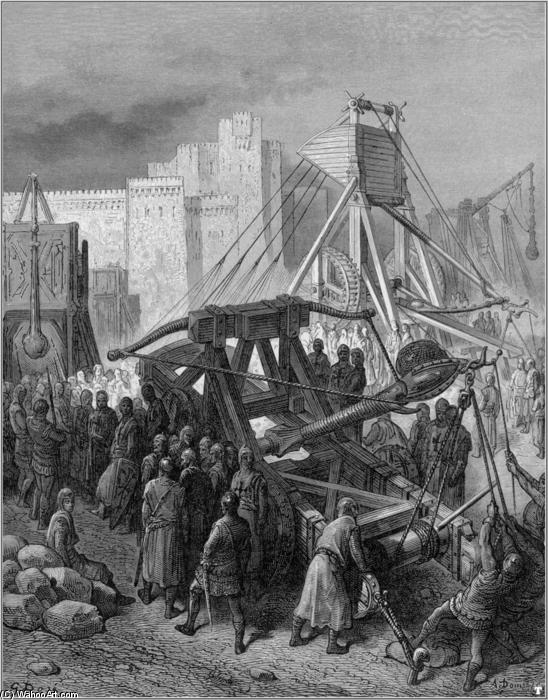
A Titan of Romantic Drama: Paul Gustave Doré’s “The Crusaders’ War Machinery”
Paul Gustave Doré (1832-1883) stands as an undisputed maestro of Romantic illustration, a figure whose artistic vision indelibly shaped the visual landscape of Victorian England and beyond. His oeuvre transcends mere depiction; it embodies a profound engagement with storytelling, psychological depth, and the sublime power of imagination—qualities exquisitely realized in “The Crusaders’ War Machinery,” a monumental wood engraving produced in 1877 for Dante’s Inferno. This artwork isn't simply a visual record of medieval siege warfare; it’s an immersive experience designed to transport the viewer into the heart of conflict and contemplation.
- Subject Matter & Historical Context: Doré meticulously captures a pivotal moment in Crusader history—the deployment of formidable siege engines against fortified castles during the Holy Wars. The engraving serves as a visual companion to Dante’s epic poem, amplifying its dramatic intensity and conveying the sheer scale of military endeavor undertaken by Christian armies seeking to reclaim Jerusalem.
- Style & Technique: Doré's distinctive style is characterized by an unwavering commitment to realism tempered with theatrical grandeur. He eschewed idealized representations in favor of gritty detail, prioritizing anatomical accuracy alongside expressive rendering. The wood engraving technique—a laborious process involving carving intricate designs onto a wooden block and applying ink—allowed for unparalleled tonal control and textural richness. Doré’s masterful manipulation of light and shadow contributes significantly to the artwork's dramatic impact.
- Composition & Visual Elements: The composition is deliberately complex, reflecting the multifaceted nature of siege warfare. Dominating the central frame is a colossal siege engine—a testament to medieval engineering prowess—its massive timbers and gears rendered with painstaking precision. Surrounding figures are arranged in layered planes, creating a palpable sense of depth and conveying the urgency of the situation. Diagonal lines accentuate movement and dynamism, while vertical lines delineate the imposing castle walls.
- Color Palette & Texture: Despite its monochrome palette—a deliberate choice reflecting Doré’s stylistic preferences—the engraving achieves remarkable tonal variation through masterful cross-hatching and shading. These techniques generate a rich surface texture that convincingly simulates the rough materiality of stone, wood, and fabric, immersing the viewer in the gritty reality of medieval siege.
- Symbolism & Emotional Resonance: Beyond its depiction of military action, “The Crusaders’ War Machinery” speaks to broader themes of ambition, faith, and human vulnerability. The sheer size of the siege engine symbolizes power and destructive potential, mirroring the anxieties surrounding warfare prevalent during Doré's time. Simultaneously, the expressions on the faces of the figures convey a mixture of determination and apprehension—reflecting the psychological toll exacted by conflict.
Doré’s “The Crusaders’ War Machinery” remains an enduring emblem of Romantic artistic achievement. Its meticulous detail, dramatic composition, and evocative tonal palette continue to inspire admiration and fascination, cementing Doré's legacy as one of the most influential illustrators in Victorian history. Reproductions of this masterpiece offer a captivating glimpse into a bygone era—a testament to Doré’s unparalleled ability to transform literature into unforgettable visual experience.
Detailed Analysis: Technique & Material Considerations
The engraving's remarkable realism stems from Doré’s masterful command of the wood engraving process. Limestone was meticulously prepared and etched with fine lines and cross-hatching—a technique demanding considerable skill and patience—to achieve exceptional tonal gradation. The resulting surface texture convincingly replicates the weathered appearance of castle walls and siege engine components, conveying a profound sense of materiality. Ink applied to the carved block produced an image imbued with depth and luminosity, capturing the dramatic interplay of light and shadow characteristic of Doré’s Romantic style.
Historical Significance & Dante's Inferno Connection
“The Crusaders’ War Machinery” wasn’t merely a standalone artwork; it served as a crucial visual accompaniment to Dante Alighieri’s “Inferno,” amplifying the poem’s thematic concerns regarding faith, morality, and the horrors of divine retribution. Doré’s depiction powerfully embodies the spirit of Romanticism—a movement preoccupied with exploring profound psychological states and confronting existential anxieties—making this engraving an invaluable window into Victorian intellectual culture.
Compositional Dynamics & Visual Narrative
The artwork's dynamic composition underscores the urgency and drama inherent in medieval siege warfare. Doré skillfully employs linear perspective to convey depth, while atmospheric perspective subtly diminishes the detail of distant elements—creating a convincing illusion of space. The careful arrangement of figures contributes to the narrative’s emotional impact, conveying both resolve and apprehension amidst the looming threat of conflict.
Doré's Legacy & Artistic Influence
Gustave Doré’s “The Crusaders’ War Machinery” stands as a cornerstone of Romantic illustration—a testament to his unwavering dedication to realism blended with theatrical grandeur. Its enduring appeal continues to inspire artists and collectors alike, securing Doré’s place among the most celebrated figures in Victorian art history.