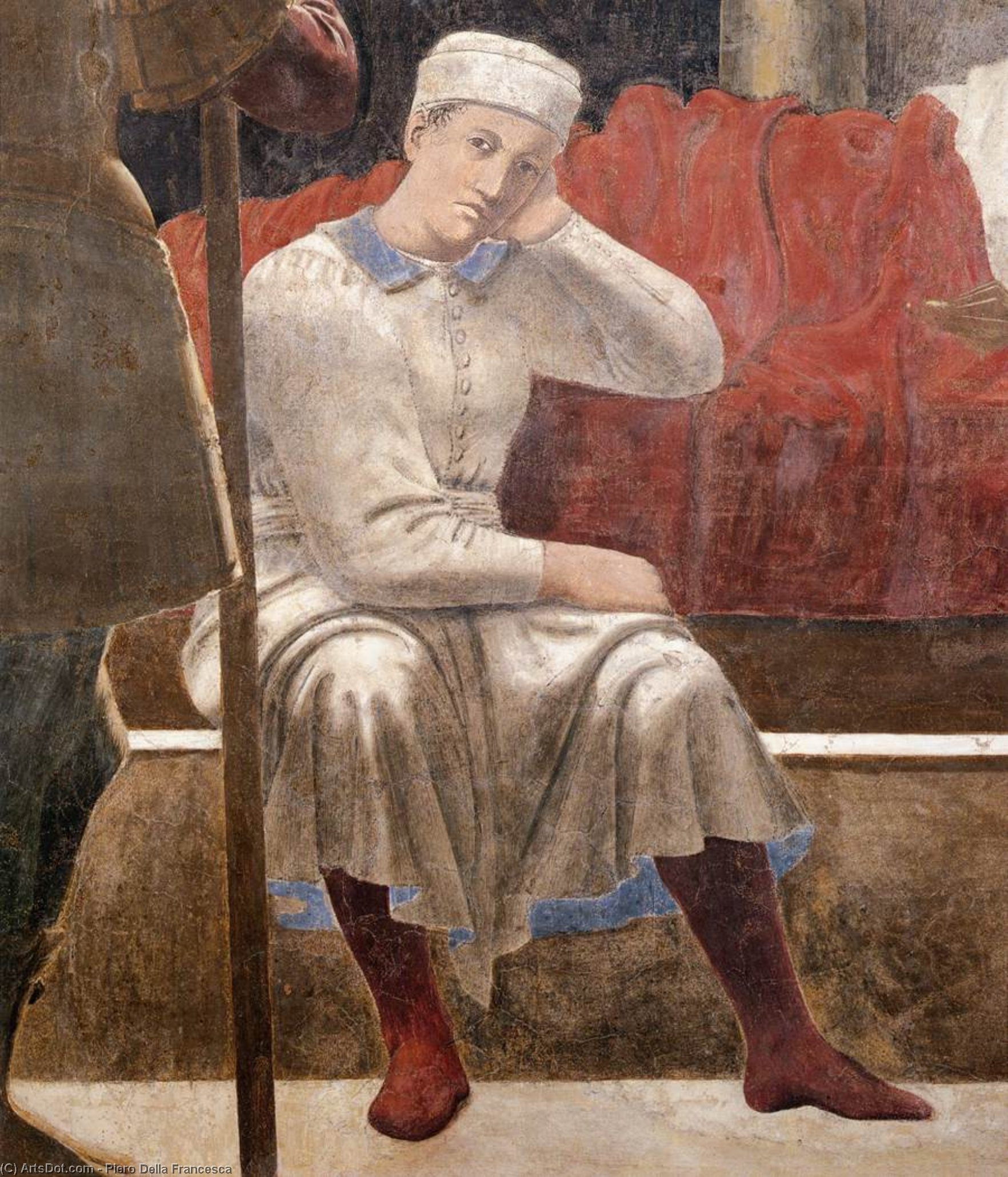
Piero della Francesca’s ‘Vision of Constantine’: A Renaissance Masterpiece of Light and Perspective
Within the venerable Basilica of San Francesco in Arezzo, Italy, resides a fresco that continues to exert a profound influence on artists and art enthusiasts alike – Piero della Francesca's '4. Vision of Constantine (detail)'. More than just a depiction of a pivotal historical moment, this work represents a pinnacle of early Renaissance artistic achievement, showcasing an unparalleled mastery of perspective, light, and the human form. It’s a painting that invites contemplation, revealing layers of meaning embedded within its meticulously constructed composition.
The fresco originates from Piero della Francesca's ambitious cycle, ‘The Legend of the True Cross’. This narrative, drawn from Jacobus de Voragine’s ‘Golden Legend’, recounts the miraculous journey of the wood from the Garden of Eden to become the instrument of Christ’s crucifixion. Piero’s skill isn’t merely in illustrating a biblical story; he elevates it through an almost clinical precision and a deeply contemplative atmosphere. The historical context is crucial – Arezzo, during the 15th century, was a vibrant center of artistic innovation, benefiting from the legacy of preceding masters while simultaneously forging its own distinctive style. The city’s rich cultural heritage, intertwined with the broader Italian Renaissance movement, provided fertile ground for Piero's development and experimentation.
The Art of Light: Chiaroscuro and Spatial Illusion
One of the most striking aspects of ‘Vision of Constantine (detail)’ is its masterful manipulation of light. Piero della Francesca was a pioneer in employing *chiaroscuro*, the dramatic contrast between light and shadow, to create an illusion of three-dimensionality on a flat surface. Notice how the light source, seemingly originating from above and slightly to the right, illuminates Constantine’s figure with an almost divine radiance. This carefully orchestrated illumination not only sculpts the forms but also directs the viewer's eye across the composition, leading them through the scene.
Furthermore, Piero’s understanding of perspective is revolutionary for his time. He employs a system of aerial perspective – diminishing detail and color intensity with distance – to convincingly portray the vastness of the tent where Constantine receives his vision. The receding lines of the tent walls converge towards a vanishing point, creating an astonishingly realistic sense of depth. This meticulous attention to spatial accuracy was groundbreaking and profoundly influenced subsequent generations of artists.
Symbolism and Narrative Depth
Beyond its technical brilliance, ‘Vision of Constantine (detail)’ is rich in symbolic meaning. The scene depicts the emperor’s dream, foretold by an angel, revealing that he will conquer his enemies by invoking the sign of the cross. The angel himself, rendered with serene dignity and a subtle halo, represents divine guidance. Constantine's posture – lying on a simple couch, seemingly vulnerable yet receiving a profound revelation – speaks to themes of humility, faith, and the transformative power of belief. The servant’s watchful gaze adds an element of human interaction and underscores the importance of earthly assistance in achieving spiritual goals.
The inclusion of the ‘in hoc signo vinces’ inscription—'In this sign you will conquer’—is a direct reference to the vision itself, solidifying its significance within the narrative. It’s a potent symbol of divine favor and military victory, reflecting the political realities of the time while simultaneously exploring profound spiritual themes.
A Timeless Masterpiece: Reproduction and Appreciation
‘4. Vision of Constantine (detail)’ stands as a testament to Piero della Francesca's artistic genius and his enduring legacy within the Renaissance. Today, through platforms like ArtsDot.com, high-quality reproductions of this remarkable fresco are readily available, allowing art enthusiasts worldwide to experience its beauty and complexity firsthand. The meticulous detail captured in these reproductions—from the subtle nuances of color to the intricate folds of Constantine’s garments—offers a compelling glimpse into Piero's artistic vision.
To truly appreciate ‘4. Vision of Constantine (detail)’ is to recognize not only a masterful work of art but also a profound meditation on faith, power, and the enduring influence of the past. For those seeking to connect with this extraordinary piece of history, Piero Della Francesca: 4. Vision of Constantine (detail) offers a captivating opportunity to immerse oneself in the world of Renaissance art.
Further exploration can be found on Wikipedia (The Legend of the True Cross), and at the Museum San Francesco in Arezzo, Italy (The Museum San Francesco in Arezzo, Italy).
Experience the beauty of Renaissance art with ArtsDot.com. For more information on ‘4. Vision of Constantine (detail)’ and other works by Piero Della Francesca, visit ArtsDot.com.