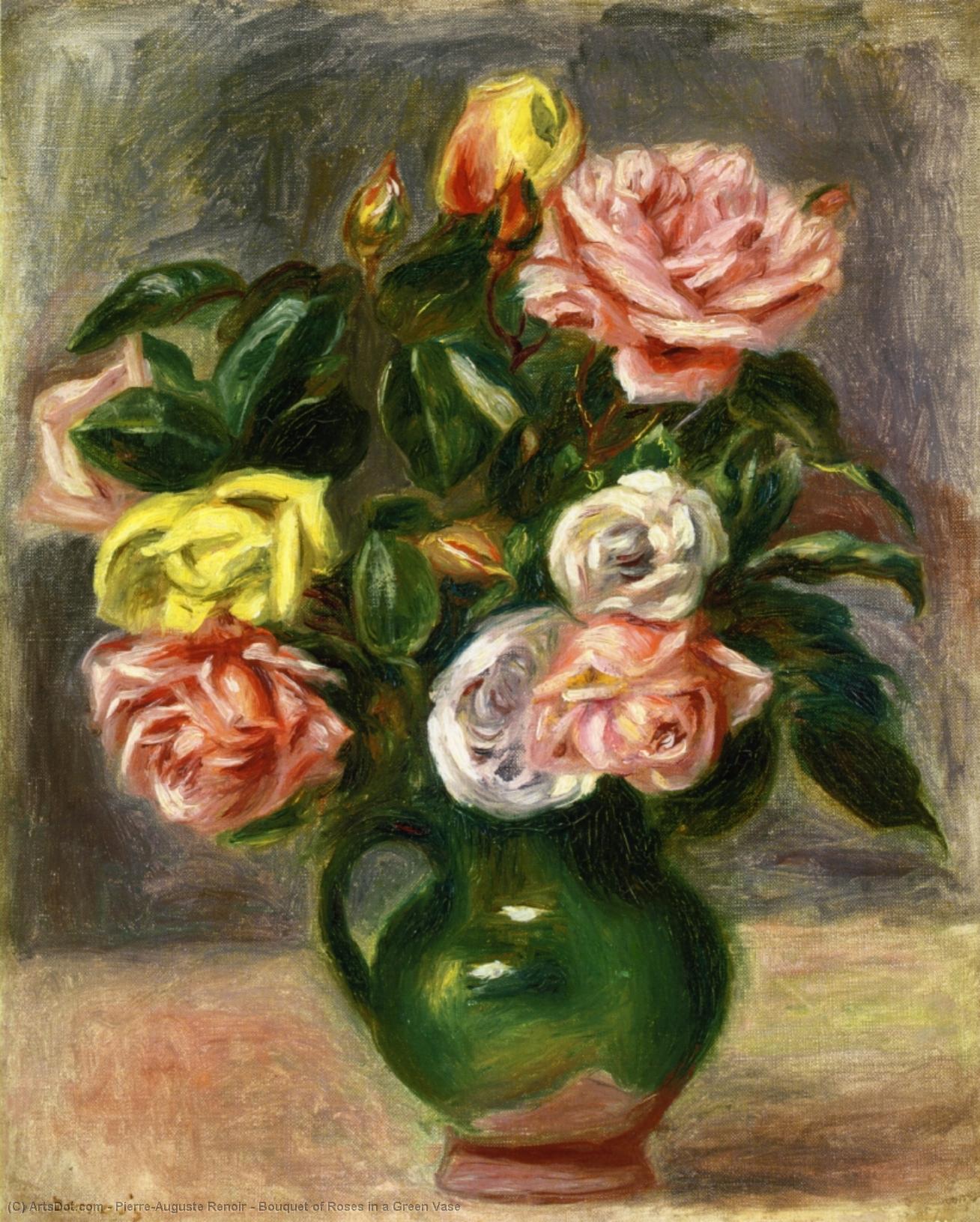
Bouquet of Roses in a Green Vase
Pierre-Auguste Renoir’s
Bouquet of Roses in a Green Vase stands as an emblem of Impressionism’s pursuit of capturing fleeting beauty and sensory experience—a mission perfectly realized by the French master. Measuring 35 x 38 cm and executed with oil on canvas, this artwork transports viewers back to the Parisian summers of Renoir's era, inviting contemplation on light, color, and the simple pleasures of observation.
The Artistic Style
Renoir’s signature style embodies the core tenets of Impressionism: a deliberate rejection of academic conventions in favor of capturing the immediacy of perception. Unlike earlier artists who meticulously rendered details with painstaking precision, Renoir prioritized conveying atmosphere—the shimmering warmth of sunlight filtering through foliage and illuminating delicate blossoms. His technique is characterized by loose, feathery brushstrokes that blend seamlessly together, creating an ethereal effect reminiscent of hazy landscapes or dappled light on water. This approach wasn’t merely stylistic; it reflected Renoir's belief that art should strive to reproduce the sensations of sight as they occur in nature—a radical departure from traditional artistic ideals.
The Composition
The painting’s composition is remarkably understated yet profoundly effective. At its heart lies a vase brimming with pink roses, positioned centrally on a tabletop surface. Renoir skillfully employs color and texture to draw attention to the flowers themselves, while simultaneously establishing a harmonious balance within the frame. The artist’s meticulous observation of botanical detail—the subtle variations in petal coloration and the velvety sheen of the blossoms—demonstrates his commitment to portraying reality with accuracy and sensitivity. Furthermore, the placement of the vase against a muted green backdrop enhances its vibrancy and emphasizes the interplay between color and form.
Artistic Influences
Renoir’s artistic vision was undeniably shaped by the pioneering efforts of fellow Impressionists like Claude Monet and Paul Cézanne. Monet's celebrated
White Poppy exemplifies Monet’s masterful manipulation of light to evoke emotion—a technique Renoir adopted wholeheartedly. Cézanne's explorations of geometric forms and spatial relationships—particularly evident in his iconic
Three Pears—provided Renoir with a conceptual framework for approaching artistic representation. These influences underscored the importance of capturing not just what is seen but also how it feels to see it.
Cultural Significance
The painting’s enduring appeal speaks to its reflection of broader cultural trends during Renoir's lifetime—namely, the burgeoning interest in plein air painting and the celebration of natural beauty as a counterbalance to industrialization. The Museum BOZAR in Brussels, Belgium, stands as a testament to this artistic heritage, embodying Art Deco elegance and housing exhibitions that showcase masterpieces from across Europe. Its very existence underscores the enduring legacy of Impressionism’s pursuit of aesthetic excellence and its profound impact on subsequent generations of artists.
ArtsDot.com offers a wide range of handmade oil painting reproductions, including works by Renoir and other famous artists. Visit their website to explore more masterpieces and own a piece of art history.