Pierre-Auguste Renoir's 'Bather Drying Her Feet,' painted in 1907, exemplifies Impressionism’s focus on light and color.
Otkrijte Pierre-Auguste Renoara, impresionističkog majstora poznatog po slikovitim portretima i prizorama pariškog života! Uživajte u njegovim radovima poput 'Plesa u Mölanu de la Galete' i otkrijte lepotu i svetlost u svakoj potezi.
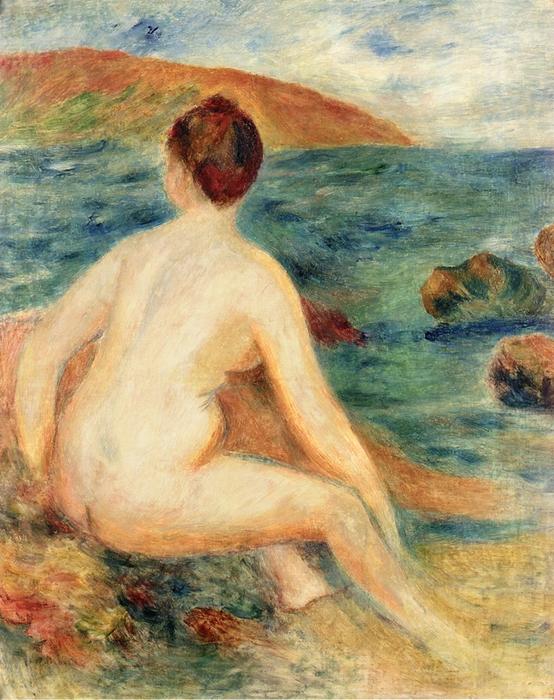
Nude Bather Seated by the Sea
Pierre-Auguste Renoir’s “Nude Bather Seated by the Sea” transcends mere depiction; it embodies the very essence of Impressionism—a celebration of light, color, and fleeting beauty. Created in 1882, this oil on canvas masterpiece resides in the Sterling and Francine Clark Art Institute, where its serene atmosphere continues to captivate viewers. Measuring 81.6 x 65.4 centimeters (32.1 in × 25.7 in), the painting exemplifies Renoir’s masterful command of artistic technique and his profound understanding of human form intertwined with the natural world.
The Composition: An Idyllic Encounter
The scene unfolds on a sun-drenched shore, dominated by rocks scattered along the waterline—a deliberate choice reflecting Renoir's fascination with capturing landscapes bathed in radiant light. At the heart of the composition sits a woman seated gracefully by the sea, her back turned towards the observer. This posture invites contemplation and emphasizes the stillness of the moment, mirroring the Impressionist preoccupation with portraying transient sensations rather than static representations. The subtle interplay between figure and environment underscores Renoir’s ability to convey emotion through visual cues—a testament to his artistic vision.
Artistic Techniques: Light as Divine Inspiration
Renoir's signature Impressionist technique is vividly apparent in “Nude Bather Seated by the Sea.” He employs loose, visible brushstrokes—characteristic of his style—to capture the shimmering luminescence of sunlight on skin and water surfaces. The artist skillfully utilizes chiaroscuro—the dramatic contrast between light and shadow—to sculpt form and imbue the painting with depth and dimensionality. Furthermore, sfumato—a technique involving subtle gradations of tone—creates a hazy atmosphere that softens edges and enhances the overall impression of ethereal beauty. These techniques weren’t merely stylistic choices; they represented Renoir's belief in light as a symbol of divinity and spiritual enlightenment – a conviction deeply rooted in his artistic sensibilities.
Historical Context: Proto-Cubism's Influence
“Nude Bather Seated by the Sea” stands within a broader artistic movement—the Proto-Cubist phase—which emerged from 1906 to 1910. Artists like Paul Cézanne and Georges Braque were experimenting with new approaches to representation, moving away from traditional perspective and embracing geometric forms as precursors to Cubism’s radical transformation of visual space. Renoir's work foreshadowed these developments, demonstrating a willingness to challenge conventions and explore innovative artistic expressions—a spirit that would resonate throughout the subsequent decades of art history.
Relevance Today: An Enduring Legacy
Even now, “Nude Bather Seated by the Sea” continues to inspire artists and captivate audiences with its timeless elegance and tranquil beauty. Its masterful execution—the luminous color palette, the expressive brushstrokes, and the harmonious composition—remains a benchmark of Impressionist art. Moreover, reproductions from ArtsDot offer an opportunity to experience this iconic masterpiece firsthand, bringing a piece of artistic history into your home and enriching your appreciation for Renoir’s enduring legacy.