Otkrijte Pierre-Auguste Renoara, impresionističkog majstora poznatog po slikovitim portretima i prizorama pariškog života! Uživajte u njegovim radovima poput 'Plesa u Mölanu de la Galete' i otkrijte lepotu i svetlost u svakoj potezi.
Otkrijte remek-dela impresionizma i postimpresionizma u pariskom Musée de l'Orangerie! Dom Monetovih Nenufara, Cézannea, Matissea i drugih, u mirnom vrtu. 🌸🎨
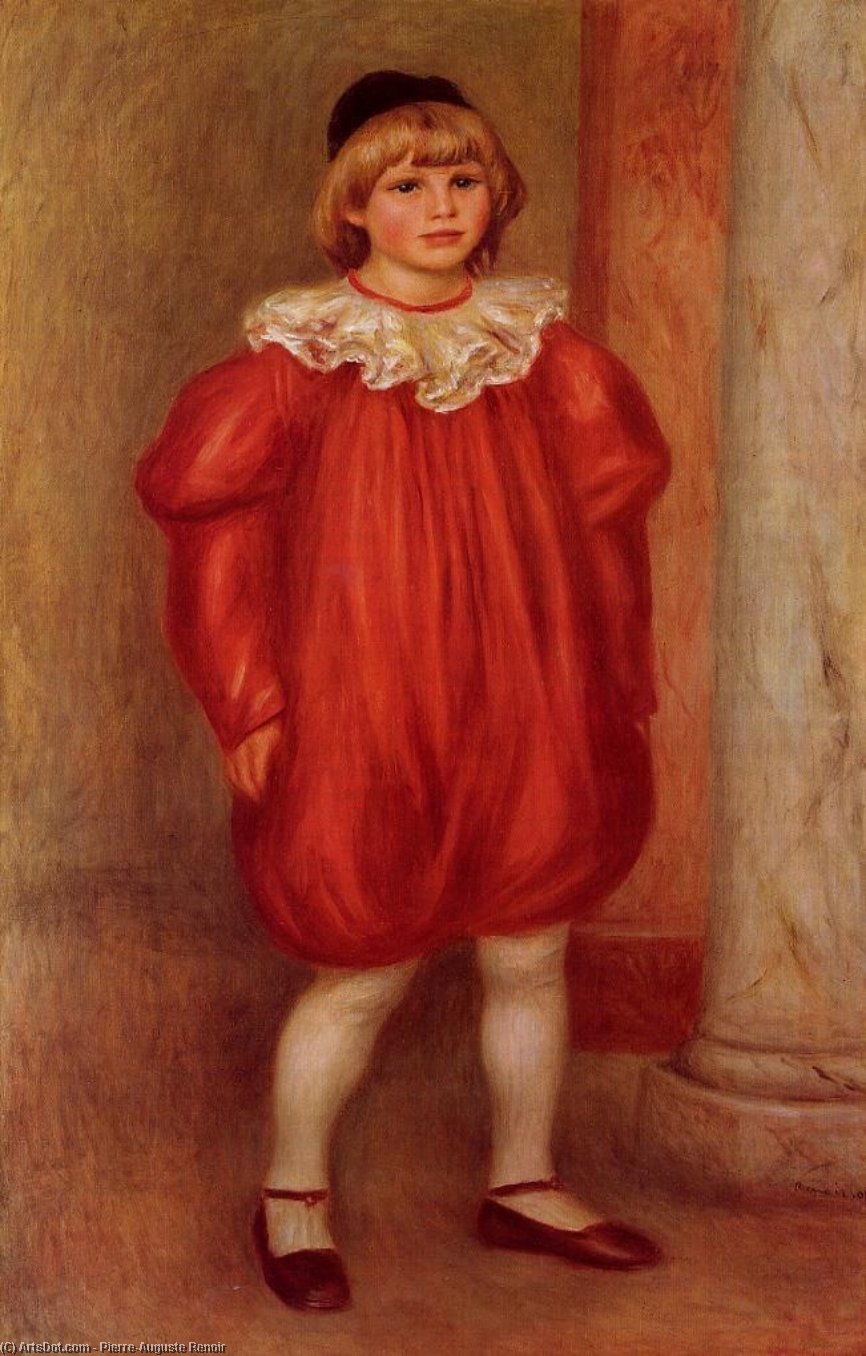
The Clown (Claude Ranoir in Clown Costume) – A Moment of Innocence Captured by Renoir
Pierre-Auguste Renoir, a luminary of Impressionism, gifted the world with canvases brimming with light and emotion. Among his enduring masterpieces is “The Clown” (also known as Claude Ranoir in Clown Costume), painted in 1909 and housed within the Musée de l'Orangerie in Paris – a sanctuary for Impressionist art itself.
- Subject Matter: The painting portrays a young boy dressed in a vibrant red dress adorned with delicate white lace trim, positioned against an ambiguous backdrop suggestive of architectural elements like columns. This deliberate choice avoids distracting from the central figure and emphasizes his serene presence.
- Style & Technique: Renoir’s masterful application of oil paint on canvas creates a rich textural surface and explodes with luminous colors—primarily reds and whites—characteristic of Impressionism. The brushstrokes are loose and visible, conveying movement and capturing fleeting impressions of light and atmosphere.
The artist's meticulous attention to detail is evident in the rendering of the boy’s costume: a jaunty hat and bow tie contribute an element of playful elegance. Renoir skillfully captures the child’s expression, conveying a palpable sense of innocence and tranquility—a testament to his ability to distill emotion onto canvas.
Historical Context & Artistic Significance
Painted during Renoir's prolific period, “The Clown” aligns perfectly with his broader artistic vision – portraying everyday life with sensitivity and beauty. Like many of his contemporaries, Renoir sought to depict the world as perceived by ordinary people, prioritizing emotional resonance over academic precision.
Renoir’s stylistic influences can be traced back to Velázquez and Goya, artists who similarly explored portraiture with psychological depth. The painting's composition echoes classical traditions while simultaneously embracing the innovative spirit of Impressionism—a harmonious blend that secures its place as a cornerstone of modern art.
Exploring Renoir’s Oeuvre & Musée de l'Orangerie
A visit to Musée de l'Orangerie offers an unparalleled opportunity to immerse oneself in the splendor of Impressionist art. Alongside Renoir’s “The Clown,” you can admire works by Henri Julien Félix Rousseau (“Le Douanier”) and Wassily Wassilyevich Kandinsky—artists who pushed the boundaries of artistic expression.
Don't miss the chance to experience the captivating beauty of Claude Renoir in Clown Costume firsthand. Its timeless charm continues to inspire collectors and interior designers alike, cementing Renoir’s legacy as one of the most beloved artists of all time.