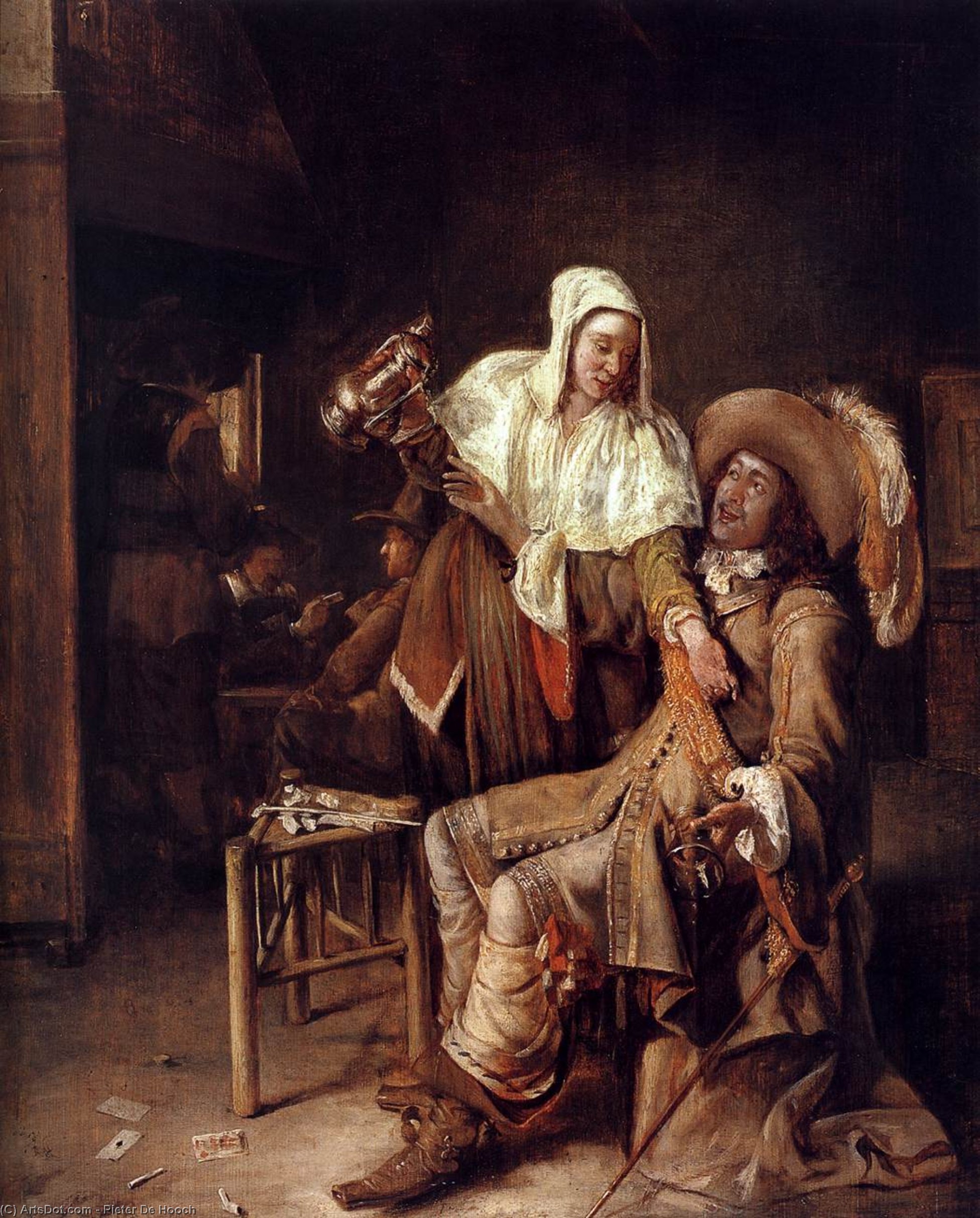
Pieter de Hooch’s "The Empty Glass," a captivating 1653 Dutch Golden Age genre painting, showcases intimate domestic life with diffused light and subtle psychological depth. Admire this masterful portrait of two figures and discover the beauty of everyday moments – own a piece of art history.
A Quiet Intimacy in the Dutch Golden Age
In the soft, diffused light of a mid-seventeenth-century interior, Pieter de Hooch captures a moment that feels both fleeting and eternal. The Empty Glass, painted around 1653, is far more than a mere depiction of domesticity; it is a masterclass in the art of atmosphere. As we gaze upon this quintessential work of the Dutch Golden Age, we find ourselves drawn into a private world where a man sits at a dining table and a woman stands nearby, their silhouettes softened by the gentle illumination filtering through an unseen doorway. There is a profound sense of conviviality here—a relaxed, shared existence that speaks to the burgeoning middle-class values of the era. The scene, housed in the prestigious Museum Boijmans Van Beuningen, invites the viewer to step out of the chaos of the modern world and into a space of quiet, contemplative grace.
The technical brilliance of De Hooch lies in his ability to render the mundane with extraordinary tactile reality. His palette, dominated by warm browns, ochres, and sun-drenched yellows, creates an earthy, grounded environment that feels remarkably lived-in. One can almost feel the weight of the fabric folds and the smooth surface of the tabletop. Through meticulous brushwork, De Hooch achieves a level of naturalism that allows light to become a character in itself. This play of light and shadow—the subtle transitions from brightness to depth—not only defines the physical space but also imbues the figures with a psychological complexity, suggesting a conversation filled with unspoken nuances and shared history.
Symbolism and the Beauty of Potential
Beyond its surface beauty, The Empty Glass carries a weight of symbolic resonance that continues to captivate scholars and art lovers alike. The titular object—the empty glass resting upon a chair—serves as a potent metaphor for the human condition. In the context of the era's fascination with symbolism, emptiness can represent receptiveness, anticipation, or even a profound openness to what is yet to come. Much like the poetic themes found in the works of Hafez, where a void signifies a readiness for divine grace, De Hooch’s glass suggests a state of potentiality. It is a vessel waiting to be filled, mirroring the very essence of the social interaction unfolding before us: a moment poised on the brink of further connection.
For the discerning collector or interior designer, this painting offers an unparalleled opportunity to introduce a sense of historical depth and emotional tranquility into a space. A high-quality reproduction of this masterpiece does not merely decorate a wall; it anchors a room with its soulful presence. The artwork’s ability to harmonize earthy tones with sophisticated light makes it a versatile choice for various aesthetic decors, from classical traditionalism to contemporary minimalist settings. To possess such a piece is to hold a fragment of the Dutch Golden Age—a reminder that even in the simplest domestic scenes, there exists a profound and lasting beauty.