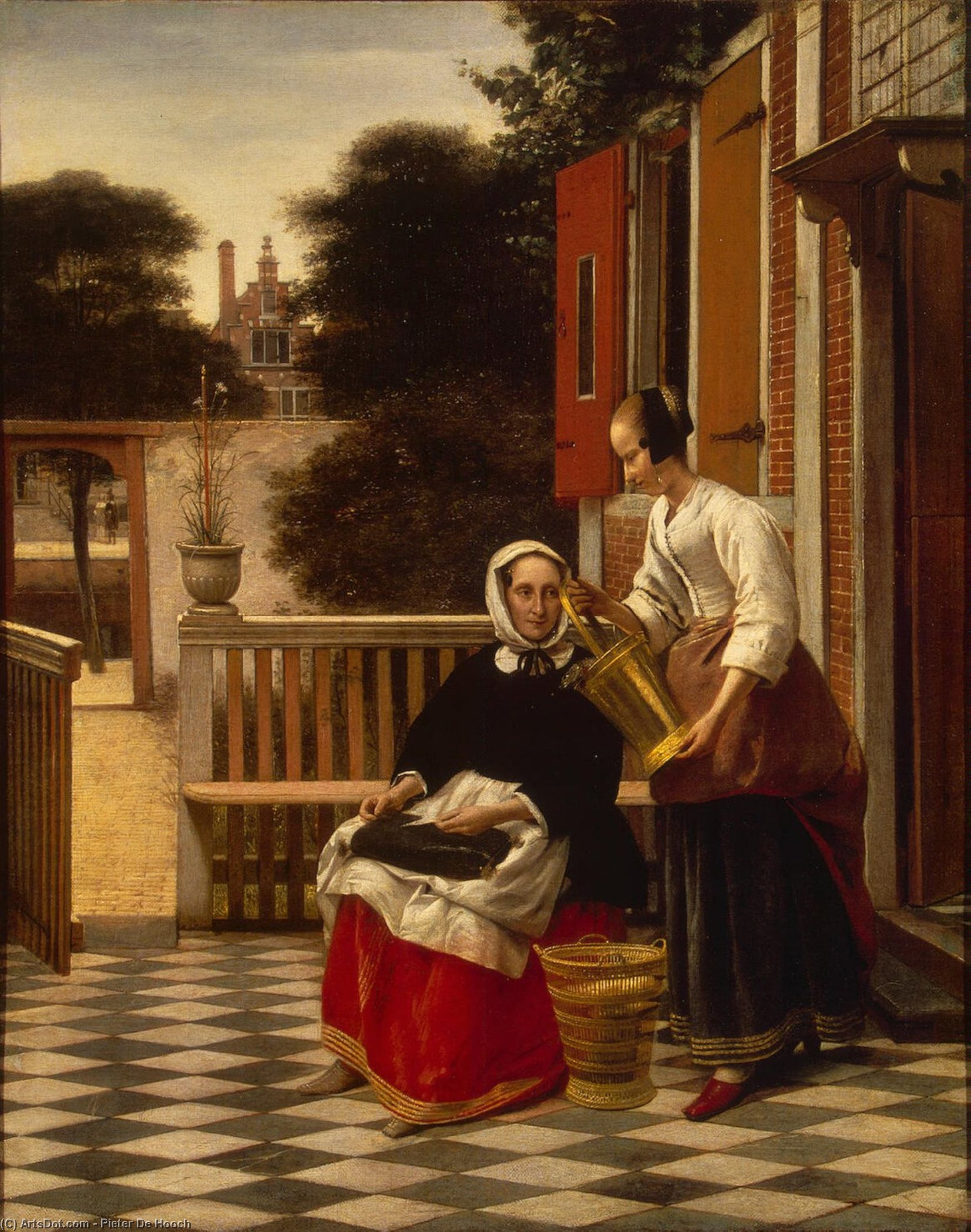
Pieter de Hooch was a Dutch painter renowned for his depictions of interiors and urban scenes during the Dutch Golden Age. His meticulous attention to detail and use of naturalistic lighting established him as a pioneer in genre painting, focusing on everyday life and capturing subtle emotions.
A Quiet Radiance in Delft: The Soul of De Hooch’s Domesticity
In the soft, diffused light of a seventeenth-century Dutch courtyard, time seems to suspend itself within Pieter de Hooch’s “Woman and Maid.” Painted around 1657, this masterpiece serves as a profound window into the Dutch Golden Age, capturing much more than a mere household chore. It is an intimate study of domestic harmony, where the boundaries between labor and leisure blur under a gentle, atmospheric glow. As one gazes upon the two figures—one likely a mistress and the other her devoted maid—there is an immediate sense of peace that transcends the centuries. The scene, currently preserved in the prestigious Hermitage Museum, invites the viewer to step into a world where the mundane is elevated to the monumental through masterful observation.
The composition is anchored by a remarkable command of space and light, a technique that places de Hooch in the same breath as his contemporary, Johannes Vermeer. The artist utilizes chiaroscuro not for dramatic tension, but to sculpt form and breathe life into the textures of the courtyard. One can almost feel the coolness of the stone, the weight of the wooden buckets, and the delicate touch of the potted plant being tended. De Hooch’s ability to manipulate light—allowing it to spill across the ground and illuminate the subtle folds of fabric—creates an immersive, three-dimensional experience. This interplay of shadow and luminosity does more than just define the physical environment; it imbues the very air of the painting with a sense of quiet sanctity.
The Art of the Everyday: Symbolism and Social Texture
Beyond its technical brilliance, “Woman and Maid” is a rich tapestry of social narrative. During this era, the Dutch middle class found great pride in the cleanliness and order of their homes, viewing domestic stability as a reflection of moral virtue. The presence of the bucket and the act of tending to greenery are not merely incidental; they symbolize the diligence and care that underpinned the prosperity of the Netherlands. There is a subtle, unspoken dialogue occurring between the two women, a shared moment of connection that suggests a deep-rooted social cohesion within the household. This focus on the "humanist spirit"—the celebration of authentic, lived experience—is what makes the piece so enduringly relatable to modern sensibilities.
For the discerning collector or interior designer, this artwork offers a unique opportunity to introduce a sense of tranquility and timelessness into a space. The muted palette of earth tones, softened by the ethereal light, allows the painting to serve as a sophisticated focal point that complements both classical and contemporary decor. It does not demand attention through loud colors or jarring subjects; instead, it commands respect through its subtle elegance and emotional depth. To possess a reproduction of such a work is to bring a piece of history’s most peaceful afternoon into one's own home, fostering an atmosphere of reflection and grace.