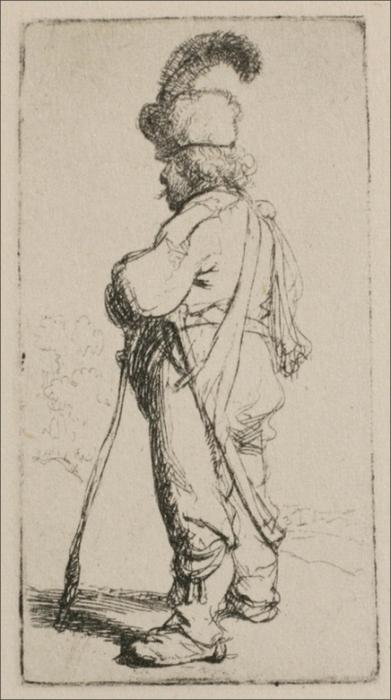
Rembrandt’s Masterful Observation: “A Polish Nobleman”
Rembrandt Harmenszoon van Rijn, a titan of Baroque art and arguably the most psychologically astute painter of his era, gifted us with countless iconic images—self-portraits that plumbed the depths of human emotion, biblical scenes brimming with dramatic fervor, and landscapes imbued with atmospheric grandeur. Yet, amidst this prolific output lies “A Polish Nobleman,” painted in 1637, a deceptively simple composition that reveals Rembrandt’s extraordinary ability to capture not just likeness but also inner life.
Composition and Technique: A Study in Light and Shadow
The artwork presents a vertically oriented portrait of a man seated on what appears to be a city street. Rembrandt eschews grand theatrical gestures, opting instead for a quiet stillness that draws the viewer’s gaze inward. The figure occupies most of the frame, positioned slightly off-center—a compositional choice that subtly directs attention towards his contemplative posture. Lines dominate the image; meticulously etched into a copper plate and subsequently printed onto paper, they delineate the man's clothing with painstaking detail – particularly his ornate hat and beard – utilizing hatching and crosshatching to build up areas of shadow and create an illusion of volume that transcends mere representation.
Historical Context: Urban Life in Amsterdam
Painted during Rembrandt’s formative years in Amsterdam, “A Polish Nobleman” reflects the burgeoning intellectual curiosity and artistic dynamism of the Dutch Golden Age. The gentleman depicted wears elaborate attire—a testament to social status and possibly ceremonial function—suggesting a milieu steeped in aristocratic tradition. Rembrandt's meticulous rendering captures not only the visual appearance but also the psychological atmosphere of urban life, mirroring the broader humanist concerns prevalent at the time.
Symbolism: Downward Gaze and Inner Reflection
The man’s downward gaze—a characteristic gesture of introspection—communicates a profound sense of melancholy. His hunched posture reinforces this impression, conveying vulnerability and suggesting an engagement with inner thoughts rather than outward observation. Rembrandt skillfully employs tonal variations to convey emotion; the subdued palette underscores the contemplative mood, inviting viewers to contemplate themes of solitude and contemplation.
The Legacy of Light: Rembrandt’s Signature Style
“A Polish Nobleman” exemplifies Rembrandt's unparalleled mastery of chiaroscuro—the dramatic interplay between light and shadow—a technique that distinguishes him from his contemporaries. The diffused natural light casts soft shadows, defining the man’s form without harsh contrasts, thereby enhancing the artwork’s emotional impact. This masterful manipulation of light not only illuminates the subject but also imbues it with psychological depth, cementing Rembrandt's place as one of history’s greatest artists and securing “A Polish Nobleman” as a cornerstone of Baroque art.