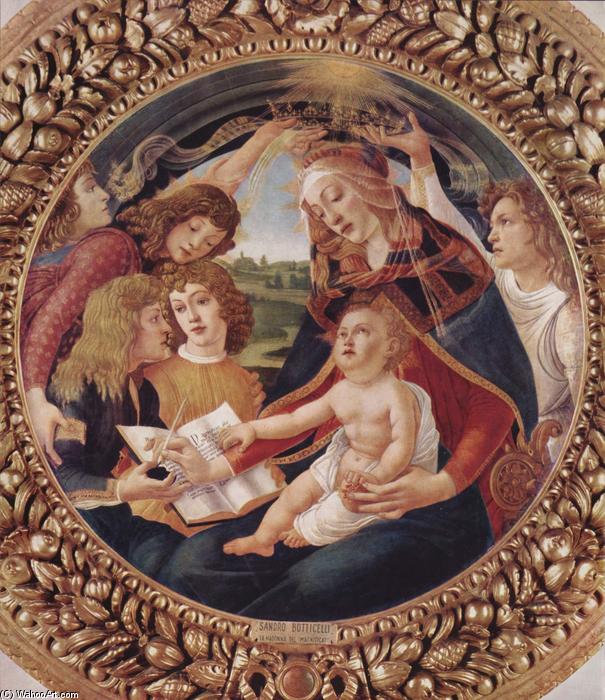
A Celestial Vision in Florentine Gold
In the heart of the Renaissance, where the intellectual fervor of Florence met the divine aspirations of the soul, Sandro Botticelli breathed life into the Madonna del Magnificat. This masterpiece, painted around 1485, is far more than a mere religious icon; it is a window into a world of ethereal grace and profound spiritual intimacy. As one gazes upon the Virgin Mary, cradling the Christ Child, there is an immediate sense of being transported to a realm where the earthly and the divine converge. The composition, uniquely circular in its format, draws the viewer into a tight, harmonious embrace with the holy figures, creating a sense of closeness that feels both personal and monumental.
The painting serves as a breathtaking testament to the Early Renaissance aesthetic, characterized by Botticelli’s unparalleled ability to marry delicate line work with a luminous, almost otherworldly palette. Unlike the heavy, muscular realism that would later define the High Renaissance, this work celebrates a softer, more poetic reality. The use of pastel hues—gentle blues, soft greens, and warm yellows—bathes the scene in a serene glow, evoking a sense of peace that lingers long after the first encounter. Every fold of the drapery and every subtle movement of the surrounding angels is rendered with a meticulous precision that speaks to the artist's mastery of light and form.
Symbolism and the Medici Legacy
Beyond its visual splendor, the Madonna del Magnificat is steeped in the complex symbolism of 15th-century Florence. The arrangement of the figures—a celestial assembly of nine souls including saints and angels—creates a balanced, rhythmic movement that guides the eye toward the central mystery of the Incarnation. The presence of these heavenly witnesses underscores the importance of the Magnificat, the hymn of praise attributed to Mary, reflecting the humanist ideals of the era which sought to find divine truth through beauty and intellect. The backdrop, while subtle, provides a sense of depth that anchors this heavenly vision within a tangible, though idealized, landscape.
The historical context of this work is inseparable from the golden age of the Medici patronage. Created during the reign of Lorenzo “Il Magnifico,” the painting reflects the cultural zenith of a city flourishing under unprecedented artistic and political stability. For the modern collector or interior designer, owning a reproduction of such a piece is not merely about decoration; it is about inviting a legacy of Florentine excellence into a space. The artwork possesses a unique emotional resonance, offering a sense of tranquility and timelessness that can transform a room into a sanctuary of contemplation.
An Eternal Inspiration for the Modern Interior
For those seeking to curate an environment of sophistication and soul, the Madonna del Magnificat offers endless inspiration. Its harmonious composition and soft, luminous tones make it a versatile centerpiece, capable of complementing both classical and contemporary settings. Whether placed in a sunlit gallery or a quiet study, the painting’s ability to evoke emotion through its delicate textures and radiant colors remains undiminished by the centuries.
To possess a high-quality reproduction of this Botticelli masterpiece is to hold a fragment of history. It is an invitation to experience the same awe that Florentine scholars and devotees felt over five hundred years ago, bringing the enduring beauty of the Renaissance into the heart of the modern home.