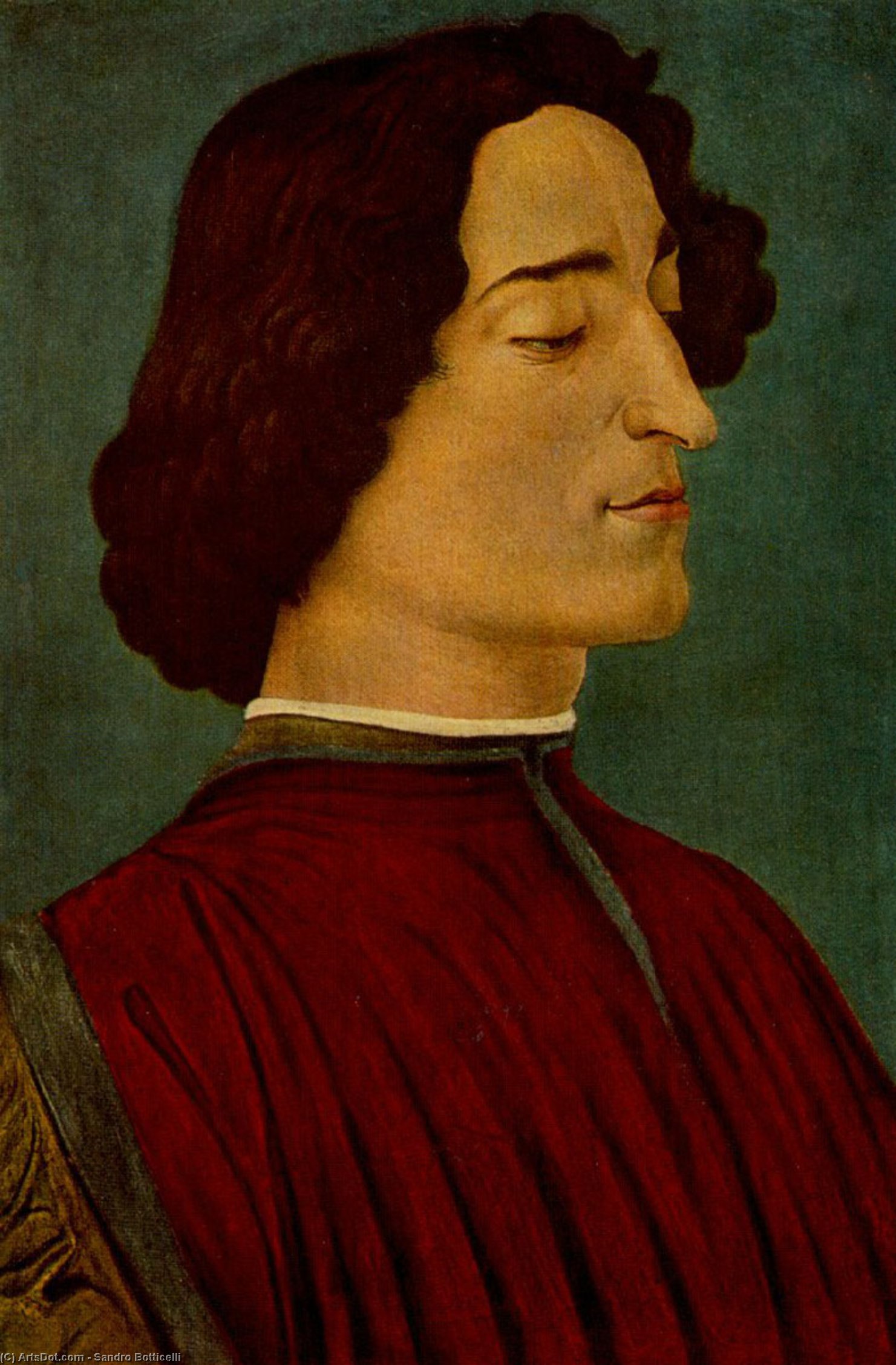
portrait - Giuliano de' Medici

Botticelli's captivating portrait of Giuliano de' Medici showcases the artist’s signature grace and detail from the Early Renaissance period. This striking image of a man in red, with long hair and a distinctive nose, offers a glimpse into Florentine nobility. Discover or own this exquisite hand-painted reproduction.


Сандро Ботичели (1445 - 1510)

Sandro Botticelli био је италијански сликар из времена раног ренесансе који је познат по својим вечним делима као што су Рођење Венеције и Пролеће, чије елегантне композиције и боје трајно су запамтиле свет.

A Portrait of Power and Mystery: Sandro Botticelli’s Giuliano de' Medici

  • Sandro Botticelli’s “Portrait – Giuliano de’ Medici” offers a captivating glimpse into the world of Renaissance Florence, specifically through the eyes of one of its most influential figures. Painted around 1480, during the height of the Medici family's power and influence, this portrait transcends a simple likeness; it embodies the ambition, intellect, and perhaps even the melancholy associated with a man poised to shape an era.
  • The subject, Giuliano de’ Medici, is depicted in a red robe – a color historically linked to wealth, status, and even royalty. The downward gaze, a characteristic of Botticelli's portraits, invites contemplation and suggests a private thought or observation. His distinctive nose, meticulously rendered, becomes a focal point, adding to the portrait’s inherent intrigue. The blue sky in the background isn't merely an atmospheric detail; it represents hope, aspiration, and perhaps even the vastness of the heavens – themes frequently explored within Renaissance art.

Botticelli’s Technique: A Synthesis of Observation and Idealization

  • Botticelli was a master of observation, yet his work always carried an element of idealization. “Giuliano de' Medici” exemplifies this balance. The artist employs *sfumato*, a technique perfected by Leonardo da Vinci, to create subtle gradations of tone and shadow, softening the edges and lending the figure a sense of ethereal beauty. Note the delicate rendering of the hair, achieved through layering thin glazes of oil paint – a hallmark of Botticelli’s meticulous approach.
  • The composition itself is carefully constructed. The use of perspective, though not entirely rigorous by Renaissance standards, directs the viewer's eye towards Giuliano, reinforcing his importance within the frame. The brushwork is smooth and controlled, reflecting Botticelli’s dedication to precision and detail. He utilized tempera on panel, a common medium for Florentine artists at the time, which allowed for vibrant colors and detailed work.

Historical Context: The Medici and the Renaissance

  • Giuliano de’ Medici (1479-1550) was the eldest son of Lorenzo il Magnifico, one of the most powerful and influential patrons of the arts during the Italian Renaissance. Florence under the Medici family was a crucible of artistic innovation, attracting some of the greatest minds of the era – including, of course, Botticelli himself. The portrait reflects this environment of intellectual and cultural flourishing.
  • Botticelli’s relationship with the Medici was complex. While he benefited greatly from their patronage, he also navigated the political intrigues and rivalries that characterized Florentine society. The commission of portraits like “Giuliano de' Medici” served not only to celebrate the family but also to solidify their position through association with artistic excellence.

Symbolism and Emotional Impact

  • The downward gaze of Giuliano de’ Medici is particularly significant. It suggests a contemplative mood, perhaps reflecting on his role as heir to the Medici legacy or contemplating the challenges that lay ahead. The red robe, a symbol of power and status, underscores his position within Florentine society.
  • Ultimately, “Portrait – Giuliano de’ Medici” is more than just a representation of an individual; it's a window into the soul of Renaissance Florence—a city brimming with ambition, artistry, and political maneuvering. This reproduction captures not only Botticelli’s technical brilliance but also the enduring mystery and power of one of history’s most influential families.