A Vision of Heavenly Grace: Botticelli’s Divine Symphony
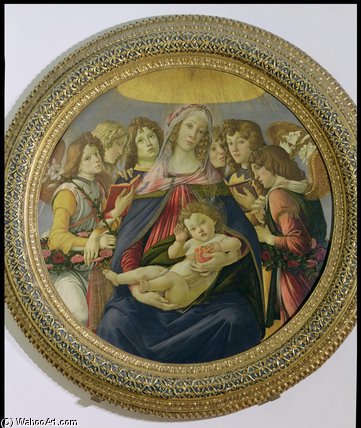
In the heart of the Florentine Renaissance, where the boundaries between the earthly and the divine seemed to dissolve under the light of humanist discovery, Sandro Botticelli crafted one of his most enchanting visions. “Virgin and Child with Six Angels” is not merely a religious icon; it is a window into a celestial realm, a masterpiece that captures the very essence of spiritual serenity. As one gazes upon the central figures of Mary and the Christ child, there is an immediate sense of being enveloped by a sacred peace. The composition, meticulously arranged with a symmetrical grace, draws the viewer into a rhythmic dance of angelic presence, where each figure contributes to a larger, harmonious whole that reflects the perceived divine order of the universe.
The painting serves as a profound testament to the era of Lorenzo de' Medici, a time when beauty was viewed as a direct reflection of God’s grace. The way Mary cradles the infant Jesus, her gaze directed with a quiet, contemplative upward tilt, suggests her role as the ultimate mediator between heaven and earth. Surrounding them, the six angels are not merely spectators but active participants in this holy moment, their delicate forms creating a sense of depth and ethereal movement. For the collector or the designer, this work offers more than just aesthetic pleasure; it provides an anchor of tranquility, making it a transformative piece for any space dedicated to reflection and elegance.
The Mastery of Line and Luminous Color
Botticelli’s technical prowess is on full display through his masterful use of tempera on canvas. This medium, characterized by the delicate mixing of pigments with egg yolk, allowed the artist to achieve a unique luminosity that seems to radiate from within the fabric itself. The palette is a sophisticated arrangement of muted reds, deep blues, and shimmering golds—colors that do not shout but rather whisper of ancient sanctity. These tones work in concert to create a soft, atmospheric glow, lending the skin of the Virgin and the angelic attendants an almost translucent quality.
The artist’s signature style—defined by flowing, lyrical lines—is evident in the drapery of the figures and the gentle contours of their faces. This linear grace, often associated with the late Gothic influence transitioning into the Early Renaissance, gives the painting its characteristic "ethereal" weightlessness. Every brushstroke serves to reinforce the sense of movement and lightness, ensuring that while the subject matter is heavy with theological significance, the visual experience remains fluid and breathtakingly beautiful.
A Timeless Legacy for the Discerning Eye
Beyond its historical importance within the Cappella San Barnaba in Siena, this artwork possesses a universal emotional resonance. It speaks to the human desire for harmony, protection, and the sublime. For interior designers seeking to infuse a room with a sense of history and soul, or for art lovers looking to possess a fragment of the Renaissance spirit, a high-quality reproduction of this work offers an unparalleled opportunity. The painting’s ability to command attention through subtlety rather than spectacle makes it a versatile centerpiece, capable of complementing both classical and contemporary settings.
To bring this Botticelli masterpiece into one's collection is to invite a sense of timelessness. It is an invitation to pause, to breathe, and to reconnect with the profound beauty that emerges when human skill meets divine inspiration. Whether placed in a quiet study or a grand salon, the “Virgin and Child with Six Angels” continues to act as a beacon of grace, reminding us of the enduring power of art to elevate the human spirit.