A Divine Encounter in Sienese Gold
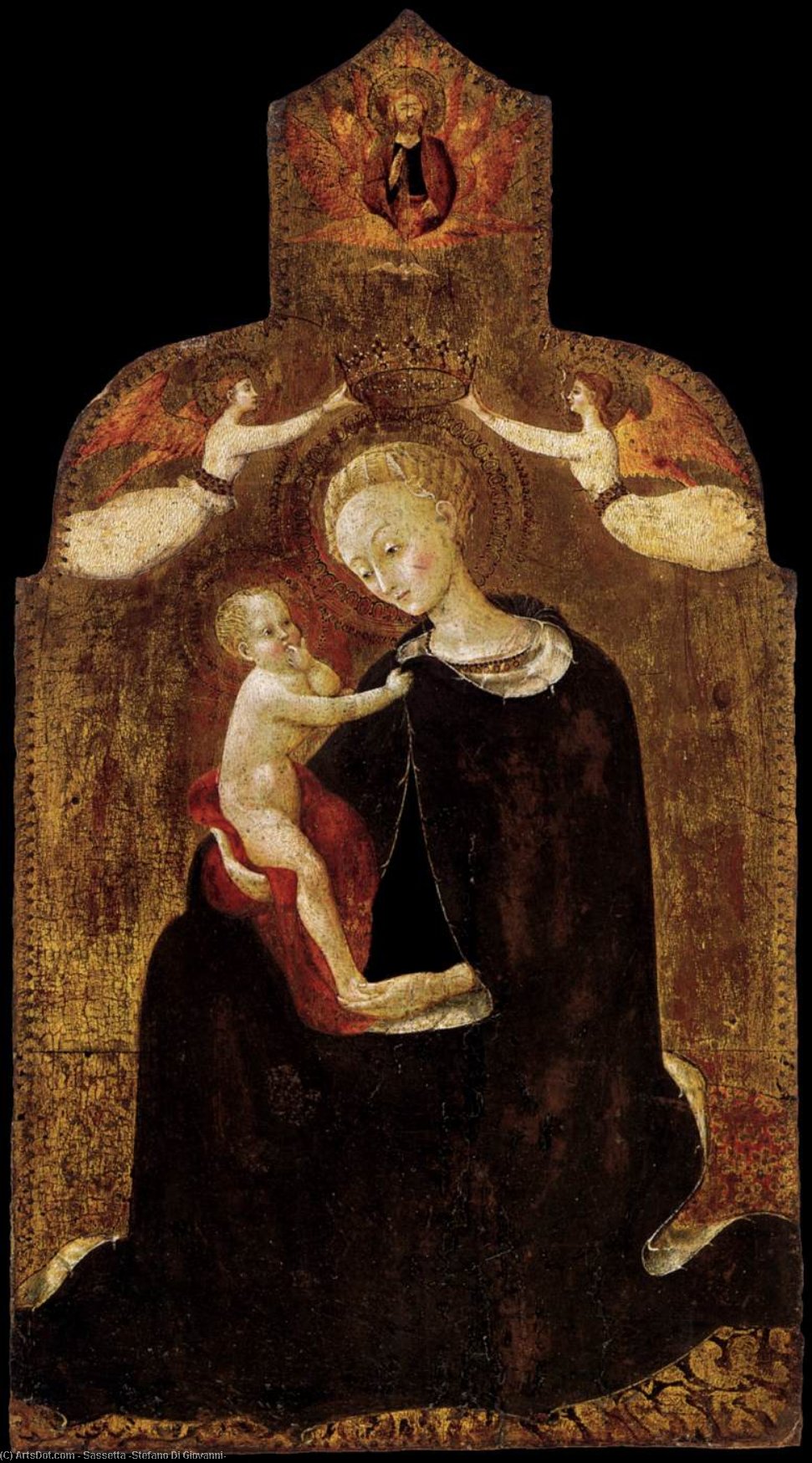
In the quiet sanctity of the early fifteenth century, few images capture the profound intimacy of the divine as gracefully as Sassetta’s Madonna of Humility. Painted around 1432, this masterpiece serves as a breathtaking window into a period where the ethereal meets the earthly. The composition centers on the Virgin Mary, not seated upon a distant, golden throne, but nestled in a posture of profound humility that defines her very essence. As she cradles the Christ Child, there is an unmistakable sense of maternal warmth that transcends the centuries, inviting the viewer into a sacred space of contemplation and peace. This is more than a mere religious icon; it is a masterclass in emotional resonance, designed to evoke a sense of protective grace within the soul of anyone who gazes upon it.
The scene unfolds with a tender, almost whispered intensity. The Virgin Mary is positioned at the heart of the work, her focus entirely consumed by the infant Jesus. As she nurses her child, she is surrounded by a celestial assembly of angels, whose presence provides a protective and serene atmosphere. One angel watches from the left, another from the right, and a third hovers above, creating a triangular harmony that guides the eye toward the central act of nurturing. This delicate arrangement captures a fleeting, holy moment—a snapshot of divine tenderness that feels both monumental and deeply personal.
The Synthesis of Gothic Grace and Renaissance Realism
Sassetta, born Stefano di Giovanni, was a virtuoso of the Sienese School, known for his unique ability to blend the delicate, flowing lines of the International Gothic style with the burgeoning realism of the early Renaissance. In this work, we see the shimmering legacy of Siena’s past through the use of a gold leaf background, which lends an ethereal luminosity to the entire composition. This golden radiance does not merely serve as a backdrop; it acts as a divine light, enveloping the figures in a celestial glow that suggests they exist outside the boundaries of ordinary time.
Yet, beneath this ornamental splendor, one can detect the subtle influence of Florentine innovation. Influenced by the groundbreaking techniques of masters like Masaccio, Sassetta began to experiment with chiaroscuro and a more nuanced approach to spatial representation. The way light falls upon the soft skin of the Madonna and the gentle folds of her drapery hints at a growing interest in the physical reality of the human form. This delicate balance between the decorative elegance of the Gothic tradition and the emerging naturalism of the Quattrocento makes the painting a pivotal moment in art history, representing a bridge between two eras.
A Timeless Inspiration for the Modern Collector
For the discerning collector or interior designer, a reproduction of the Madonna of Humility offers much more than mere decoration; it provides an anchor of tranquility and historical depth. The painting’s soft palette and luminous textures possess a unique ability to transform a space, lending an air of sophisticated serenity to any room. Whether placed in a sunlit gallery or a quiet study, the work invites slow looking and deep reflection.
The symbolism within the piece—the themes of nurturing, protection, and humble devotion—remains universally poignant. To possess such a work is to bring a fragment of the Sienese Renaissance into the contemporary home, celebrating a period where art was used to bridge the gap between human understanding and divine revelation. It is an exquisite choice for those who seek to surround themselves with art that speaks not only to the eye but to the spirit.