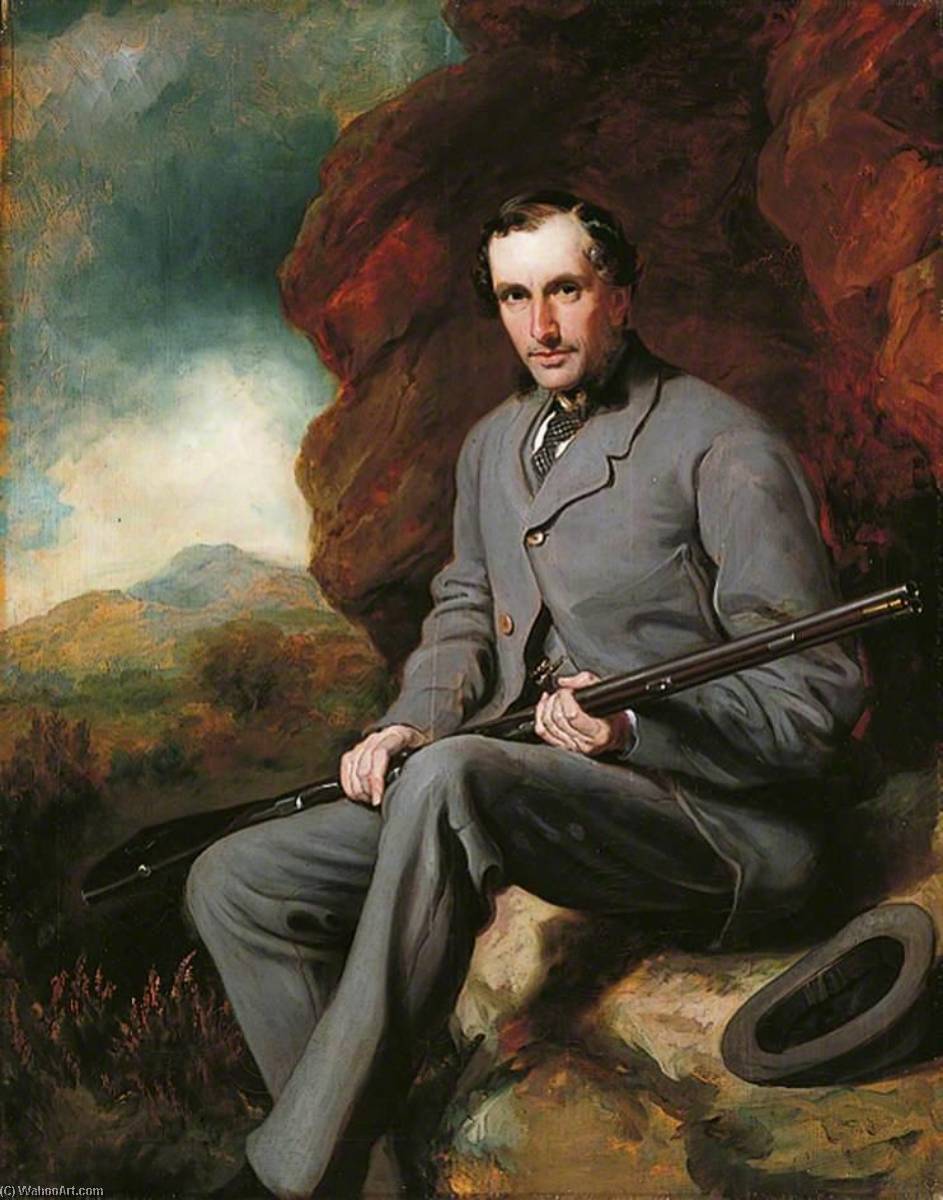
The Subject – A Man Defined by Contemplation
Sir Francis Grant’s “Hugo Francis Meynell Ingram” isn't a painting of action or dramatic gesture; it’s a study in stillness, a portrait that radiates an almost palpable sense of contained power. The subject himself, Hugo Francis Meynell Ingram (1820-1871), was a man deeply embedded within the fabric of Victorian society – a Conservative MP, a landowner, and, crucially, a prominent figure in the world of hunting. Grant captures him not as a warrior or a politician actively engaged in debate, but rather as a thoughtful observer, a gentleman presiding over his domain. The pose is deliberately understated: seated on a rugged rock, he’s not imposing, yet there's an inherent dignity in his posture and gaze.
The details of Ingram’s attire – the formal suit jacket, the meticulously tied cravat, the top hat perched casually on the ground – speak volumes about his social standing. These aren’t merely garments; they are emblems of a particular era, reflecting the strict codes of conduct and expectations associated with the landed gentry. The choice to place the top hat on the ground adds an intriguing layer of symbolism, suggesting perhaps a moment of reflection, a pause in the relentless demands of his public life.
A Realistic Style – Precision and Light
Grant’s style is firmly rooted in the academic tradition of the Royal Academy, yet he avoids mere imitation. He employs a meticulous realism, rendering every texture—the rough stone beneath Ingram's seat, the weave of his trousers, the subtle sheen of his jacket—with remarkable accuracy. However, this precision isn’t cold or sterile; it’s tempered by an astute understanding of light and shadow. The painting is bathed in a soft, diffused illumination that seems to emanate from the left side, casting gentle shadows across Ingram's face and highlighting the contours of his features.
The artist skillfully uses chiaroscuro – the dramatic contrast between light and dark – to create depth and volume. This technique not only enhances the realism but also contributes to the painting’s overall mood of quiet contemplation. Notice how the shadows subtly obscure certain aspects of Ingram's face, inviting the viewer to focus on his eyes—those are windows into a thoughtful, perhaps slightly melancholic, soul.
Historical Context – Victorian Society and Portraiture
To fully appreciate “Hugo Francis Meynell Ingram,” it’s essential to understand the context of its creation: mid-19th century Britain. This was an era defined by rapid industrialization, social change, and a burgeoning middle class. Portraiture flourished during this period, serving as both a means of commemorating individuals and documenting the prevailing social order. Artists like Grant were often commissioned by wealthy patrons to create images that reflected their status and legacy.
Grant’s work reflects this trend, but he also subtly challenges it. By focusing on Ingram's inner life—his contemplative gaze, his quiet dignity—he elevates the portrait beyond a mere representation of social standing. He suggests that true worth lies not in wealth or power, but in character and intellect.
Symbolism – The Rock, the Hat, and the Landscape
The setting itself is laden with symbolic meaning. The rugged rock upon which Ingram sits represents stability and resilience—a grounding force amidst the uncertainties of life. The rifle resting across his lap isn’t a symbol of aggression but rather a reminder of his role as a landowner and hunter, connected to the land and its traditions. The placement of the top hat on the ground is particularly intriguing; it could be interpreted as a gesture of humility or a symbolic rejection of the rigid formalities of Victorian society.
Finally, the landscape—rolling hills under a cloudy sky—provides a sense of vastness and solitude. It reinforces the feeling that Ingram is an individual set apart, lost in his own thoughts. The painting, therefore, isn’t simply a likeness; it's a carefully constructed meditation on identity, status, and the human condition.