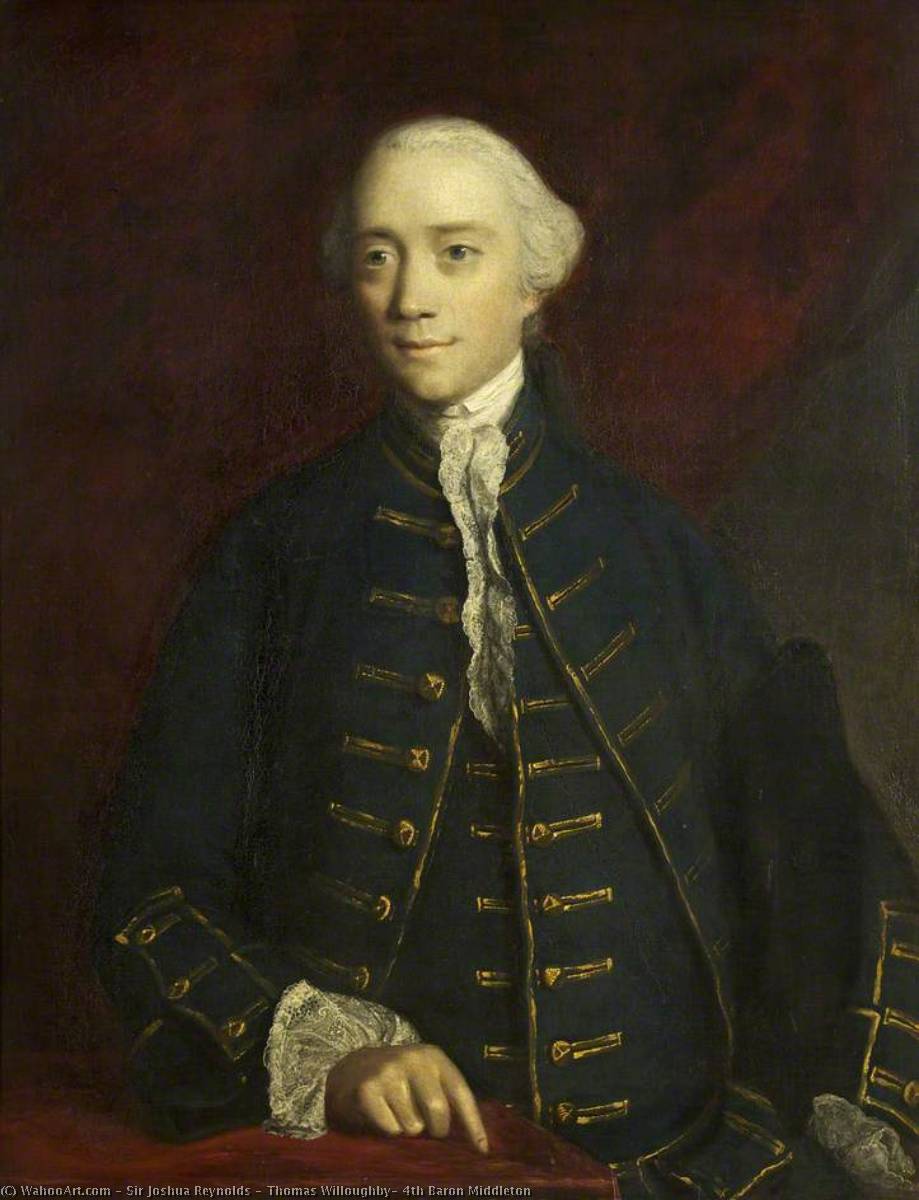
Thomas Willoughby, 4th Baron Middleton: A Portrait of Regency Dignity
Sir Joshua Reynolds’s “Thomas Willoughby, 4th Baron Middleton,” painted in 1761, is more than just a likeness; it's a meticulously crafted tableau of Georgian society and the carefully constructed persona of a landed gentleman. The painting captures a man at the height of his social standing – a figure radiating quiet authority and understated elegance within the opulent confines of his estate. Willoughby himself, a prominent member of Parliament and a key player in the political landscape of the time, is presented not as a warrior or a revolutionary, but as a symbol of stability, tradition, and refined taste—qualities highly valued during the reign of George III.
Reynolds’s masterful technique immediately draws the eye. The composition is remarkably balanced, with Willoughby occupying a central position within a richly appointed interior. The deep crimson curtains, meticulously rendered in velvet texture, create a sense of luxurious depth and hint at the vastness of his home. Note the subtle play of light across the fabrics and the polished surfaces – Reynolds’s use of chiaroscuro (the dramatic contrast between light and dark) not only models the forms but also imbues the scene with an atmosphere of quiet contemplation. The artist's attention to detail is breathtaking, from the intricate folds of Willoughby’s coat to the delicate embroidery on his waistcoat, each element contributing to a portrait that speaks volumes about wealth and status.
The Grand Style and its Patronage
This painting exemplifies Reynolds’s “Grand Style,” a technique he developed in the 1760s. Unlike earlier portraiture which often prioritized immediate likeness, the Grand Style aimed for an idealized representation of the sitter—a carefully constructed image designed to project an aura of nobility and virtue. Willoughby is not simply depicted as he was on any given day; he’s presented as the embodiment of his social role, a man worthy of admiration and respect. Reynolds skillfully employs classical motifs – the restrained pose, the dignified expression, the carefully chosen attire—to elevate Willoughby beyond the mundane and transform him into an emblem of Georgian ideals.
The commission itself speaks volumes about the power of portraiture in this era. Patrons like the Baron Middleton sought to solidify their position within society through visual representation. A flattering portrait wasn’t merely decoration; it was a strategic investment, reinforcing family lineage, demonstrating wealth and influence, and securing a place in history. Reynolds understood this dynamic perfectly, skillfully manipulating his brush to create an image that would serve both the sitter's ambitions and the patron's desire for social recognition.
Symbolism of Dress and Setting
The details within the painting are laden with symbolic meaning. Willoughby’s blue coat, a color associated with loyalty and trustworthiness, underscores his commitment to his position and responsibilities. The gold buttons on his chest—a subtle but significant detail—represent wealth and authority. The red curtains, traditionally associated with royalty and power, subtly elevate Willoughby's status, suggesting a connection to the highest echelons of society. Even the arrangement of objects within the room – the books, the writing desk, the musical instruments – speaks to Willoughby’s intellectual pursuits and refined tastes.
The setting itself is crucial. The interior, though somewhat generic in its design, evokes a sense of spaciousness and comfort—a reflection of the Baron's considerable wealth. It’s a space designed for contemplation and social interaction, a microcosm of Georgian society where power, prestige, and refinement were paramount. The painting doesn’t offer a glimpse into Willoughby’s private life; instead, it presents a carefully curated image of public persona—a man embodying the virtues expected of his station.
A Legacy of Elegance
"Thomas Willoughby, 4th Baron Middleton" remains a captivating example of Reynolds's artistic prowess and his profound understanding of the social dynamics of his time. It’s a portrait that transcends mere representation, offering a window into the world of Georgian aristocracy—a world defined by tradition, decorum, and an unwavering commitment to projecting an image of impeccable dignity. Today, this painting continues to resonate with viewers, inviting us to contemplate the complexities of power, status, and the enduring allure of idealized beauty.