The Dignified Presence of a Patriot: Sir Joshua Reynolds’ William Mason
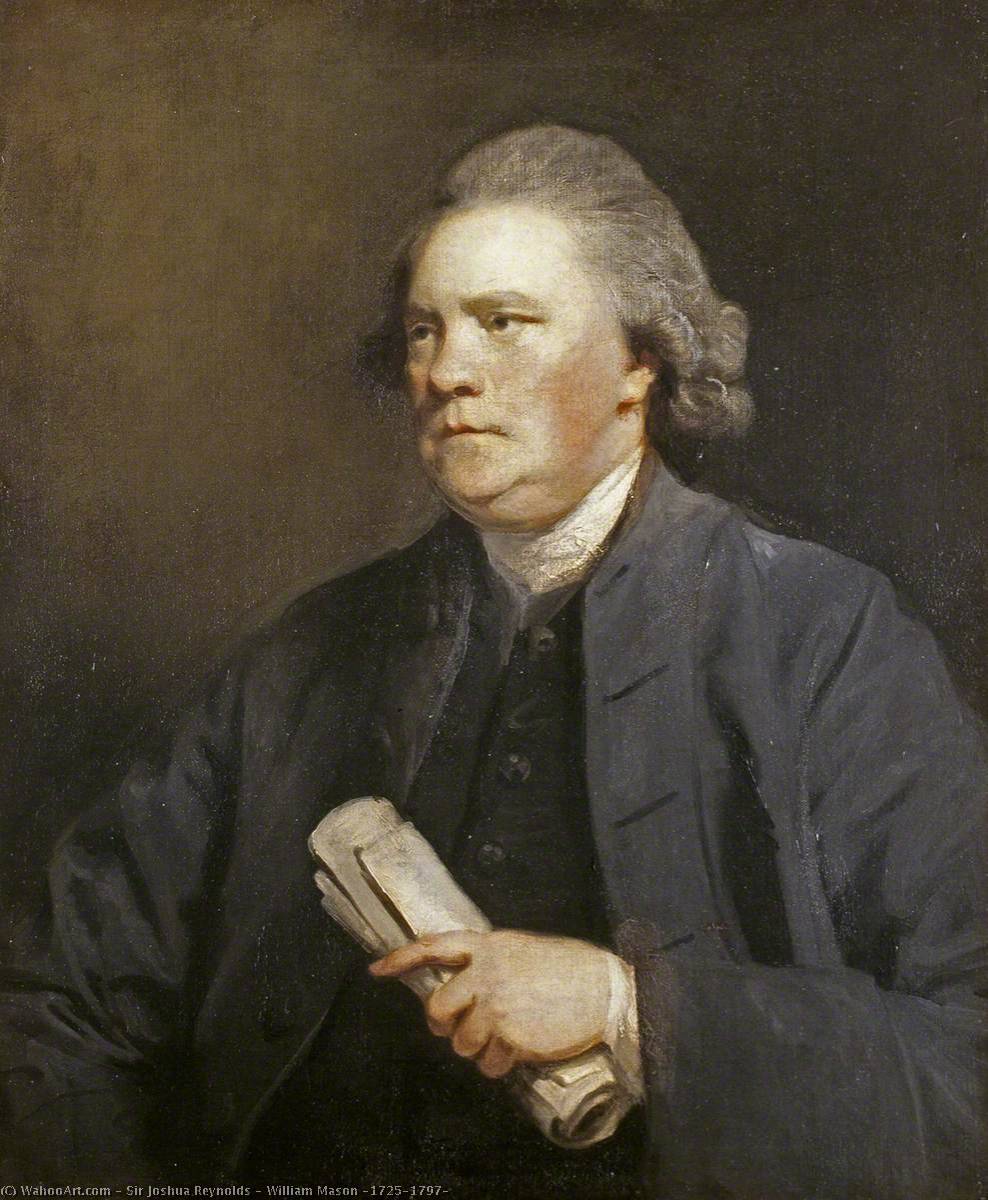
Sir Joshua Reynolds' "William Mason" is more than just a portrait; it’s a carefully constructed tableau vivant, a window into the intellectual and social landscape of 18th-century England. Painted in 1774, this remarkable work captures not merely the likeness of a man, but his character, intellect, and standing within a world defined by reason, tradition, and burgeoning civic engagement. The painting immediately commands attention with its formal composition – a central figure framed against a subtly receding background, a hallmark of the ‘Grand Style’ championed by Reynolds himself. The deliberate use of light and shadow, originating primarily from the left, imbues the scene with a sense of gravitas and contemplation, drawing the viewer into Mason's world.

Neoclassical Precision and the Language of Portraiture
Reynolds’ mastery lies in his ability to seamlessly blend meticulous observation with a profound understanding of artistic convention. The painting exemplifies Neoclassicism, a style deeply rooted in classical antiquity, emphasizing clarity, order, and restraint. Notice the precise delineation of Mason's features – the furrowed brow suggesting thoughtful deliberation, the carefully rendered lines of his face conveying wisdom and experience. The artist’s brushwork is remarkably controlled, creating a sense of texture that mimics the weave of the fabric of his coat and the subtle sheen of his skin. The use of linear perspective establishes a believable spatial depth, anchoring the figure within a defined environment.
- Technique: Reynolds employs layering techniques to build up form and create rich textures, capturing both the weight of fabric and the luminosity of skin.
- Composition: The central placement of Mason reinforces his importance and authority, while the receding background provides a sense of stability and tradition.
- Color Palette: A predominantly dark palette – deep browns, grays, and blues – contributes to the painting’s serious and contemplative mood.
A Man of Letters and Civic Duty
Beyond the purely aesthetic qualities, "William Mason" offers a glimpse into the life of a significant figure. Mason was a prominent poet and divine, deeply involved in intellectual circles and known for his friendship with Thomas Gray. The document held in his hand – a rolled parchment – subtly alludes to his scholarly pursuits and perhaps even his legal profession, hinting at a mind engaged in both artistic expression and civic responsibility. The painting speaks volumes about the values of the Enlightenment: reason, learning, and public service. It’s a portrait not just of an individual, but of an era.
Historical Context and Legacy
Painted during the mid-18th century, "William Mason" reflects the growing importance of portraiture as a means of documenting social status and commemorating individuals. Reynolds' work played a crucial role in establishing portrait painting as a respected art form in England, influencing generations of artists to come. The painting’s enduring appeal lies not only in its technical brilliance but also in its ability to evoke a sense of timelessness – a reminder of the ideals and values that shaped a pivotal moment in history. Today, reproductions of this iconic portrait continue to captivate viewers with their dignified beauty and profound insight into the character of William Mason.