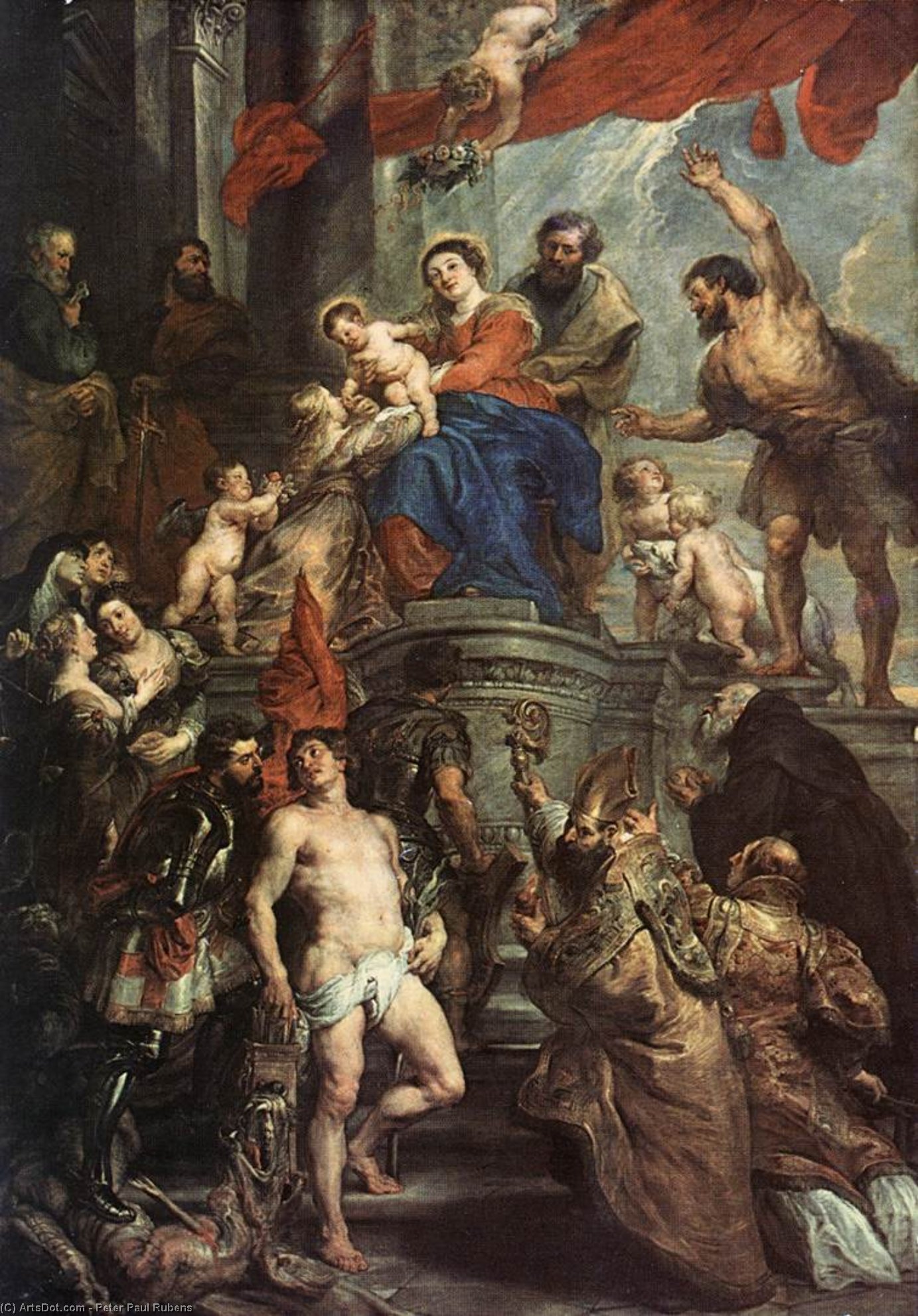
Madonna Enthroned with Child and Saints
Peter Paul Rubens’s *Madonna Enthroned with Child and Saints*, completed in 1628, stands as an unparalleled testament to Baroque artistic grandeur and spiritual fervor. Housed within The Museum Cassa di Risparmi (Prato, Italy), this monumental oil painting—measuring 564 x 408 cm—captures the essence of Renaissance piety transformed into a dynamic visual experience. Rubens’s masterful command of color, composition, and chiaroscuro elevates it beyond mere depiction to become an immersive meditation on divine grace and maternal devotion.
The painting's genesis lies in the fervent religious climate of Antwerp during Rubens’s tenure as court painter for Philip IV of Spain. Commissioned by Cardinal Federico Borromeo—a staunch advocate of Catholic reform—the altarpiece aimed to inspire piety and reaffirm faith amidst the turbulent Protestant Reformation gripping Europe. Rubens skillfully employed a pyramidal composition, anchoring the Virgin Mary at its apex and radiating outwards towards the surrounding saints, creating a sense of stability and upward movement that reflects theological ideals of ascension and divine majesty.
Rubens’s technique—characterized by loose brushstrokes and vibrant hues—was revolutionary for its time. He eschewed the meticulous detail favored by Mannerists, opting instead for expressive color palettes that conveyed emotion and dynamism. The luminous golden tones adorning Mary's robes and throne symbolize divine splendor, while contrasting shades illuminate the faces of the saints, imbuing them with palpable humanity. Furthermore, Rubens’s masterful use of *tenebrism*, a dramatic technique employing stark contrasts between light and dark—highlights key figures and creates an atmosphere of solemn contemplation.
The iconography of *Madonna Enthroned* is rich in symbolism reflecting Christian theology. Mary is depicted seated upon a throne adorned with symbols of royalty and holiness, representing her divine dignity as Queen of Heaven. The Child Jesus cradled in her lap embodies innocence and divinity—the incarnation of God incarnate—while the saints surrounding them embody virtues such as faith, humility, compassion, and justice. Each saint’s gesture and posture conveys a specific spiritual message, reinforcing the painting's overarching theme of divine grace and moral aspiration.
Beyond its religious significance, *Madonna Enthroned* embodies the artistic spirit of the Baroque era—a period marked by theatrical grandeur and emotional intensity. Rubens’s masterpiece continues to inspire awe and admiration for its breathtaking beauty and profound spiritual depth. Its enduring legacy testifies to the transformative power of art to convey complex ideas and evoke powerful emotions—a testament to Rubens's genius as one of the greatest painters of all time.
- Artist: Peter Paul Rubens
- Year: 1628
- Location: The Museum Cassa di Risparmi (Prato, Italy)
- Medium: Oil on Canvas
- Dimensions: 564 x 408 cm
Additional Research:
* Explore Rubens’s other masterpieces at
Peter Paul Rubens on ArtsDot.
* Discover the influence of Raphael and Caravaggio on Rubens's artistic vision.
* Delve into the historical context of Antwerp during the Baroque period—the religious fervor and political tensions that shaped Rubens’s oeuvre.
Related Works:
*
Virgin and Child Enthroned with Saints
*
Virgin and Child Enthroned with Saints
*
Virgin and Child Enthroned with Saints
*
Virgin and Child Enthroned with Saints
*
Virgin and Child Enthroned with Saints
Photo Description:
The painting depicts the Virgin Mary seated on a throne adorned with golden hues, cradling Jesus Christ in her lap. Surrounding them are several saints—Peter, Catherine, Lucy, and Paul—positioned in a semi-circular arrangement that emphasizes solemn contemplation. Rubens’s masterful use of *tenebrism* illuminates key figures and creates an atmosphere of spiritual grandeur. The composition conveys stability and upward movement, reflecting theological ideals of ascension and divine majesty.
Size:
564 x 408 cm
Date:
1628