A Vision of Naval Command
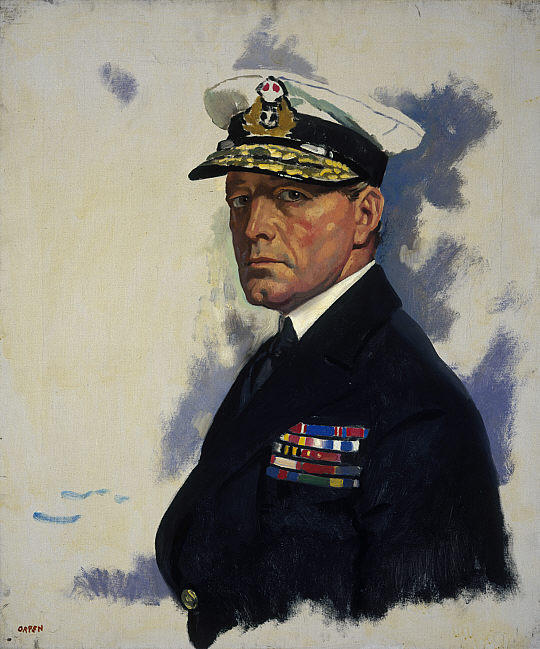
In the masterful portrait of David Beatty, 1st Earl Beatty, Sir William Newenham Montague Orpen achieves far more than a mere photographic likeness; he captures the very essence of maritime authority. The painting presents the legendary Admiral from the chest up, positioning him with a commanding presence that demands the viewer's attention. His gaze, unwavering and solemn, pierces through the canvas, reflecting the heavy mantle of responsibility carried by a commander of the Fleet. Orpen utilizes a deliberate compositional balance, placing Beatty slightly off-center to create a dynamic tension that prevents the portrait from feeling static, instead imbuing it with a sense of living, breathing history.
The attire of the subject serves as a profound testament to his rank and service. Clad in the crisp whites and deep blues of the Royal Navy, the uniform is rendered with meticulous attention to detail, yet softened by Orpen’s signature painterly touch. The gold ornamentation on his naval officer's hat and the glint of his medals provide essential focal points, catching the light to symbolize achievement and the weight of tradition. These metallic accents contrast beautifully against the more organic textures of the skin and fabric, creating a visual hierarchy that guides the eye from the face to the symbols of his station.
The Intersection of Realism and Impressionism
What elevates this work for the discerning collector is Orpen’s sophisticated blending of realism and impressionistic technique. While the facial features and the intricate details of the medals are executed with a sharp, representational precision, the background dissolves into a dreamlike atmospheric perspective. This use of soft, gestural brushstrokes creates a sense of vastness, subtly evoking the unpredictable and infinite expanse of the sea that Beatty commanded. The background is not merely empty space; it is an emotive element composed of muted blues and greys that suggest the misty horizons of naval life.
The artist’s use of impasto adds a tactile dimension to the piece, particularly where light hits the raised surfaces of the hat and decorations. This thickness of paint lends a physical presence to the artwork, making the light appear to dance across the surface. Through subtle color gradations and a soft, diffused lighting scheme, Orpen creates an aura of dignified composure. For those looking to integrate such a piece into a curated interior, the painting offers a perfect balance of structured formality and expressive movement, making it a centerpiece capable of anchoring a room with both historical gravity and artistic elegance.
A Legacy Captured in Oil
Beyond its technical brilliance, the portrait serves as a window into the Edwardian era and the turbulent waters of early 20th-century naval history. As an official war artist, Orpen possessed a unique ability to capture the psychological depth of his subjects. In Beatty, we see the intersection of individual character and national identity. The sternness of the expression speaks to a life defined by duty and the relentless pressure of command during pivotal moments like the Battle of Jutland.
For art lovers and interior designers alike, this reproduction offers an opportunity to possess a fragment of British maritime heritage. The painting’s palette—dominated by authoritative blues, pristine whites, and regal golds—is versatile enough to complement both classic traditional settings and more contemporary, sophisticated spaces. It is an investment in a narrative of courage, a study in light and shadow, and a timeless tribute to one of the most influential figures of the sea.