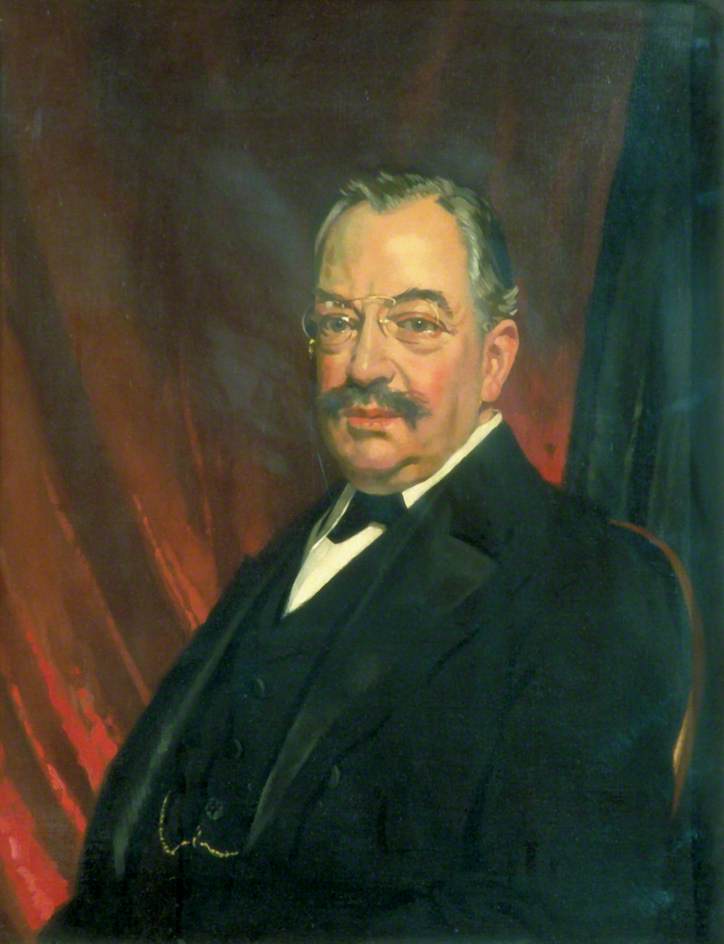
This painting depicts Marcus Samuel, 1st Viscount Bearsted, dressed in formal clothing—a black jacket, white shirt, and bow tie—before a vibrant red background. The portrait captures his confident demeanor and attention to detail.
Marcus Samuel (1853–1927), Lord Bearsted
William Newenham Montague Orpen’s “Lord Bearsted,” painted in 1922, stands as a testament to both artistic skill and the prominent figure of Marcus Samuel, a titan of British industry and philanthropy. This portrait captures Samuel at a moment of considerable success – the founder of Shell Transport and Trading Company – radiating confidence and intellect amidst an ensemble of carefully considered details.
The painting employs a rich oil paint technique, characteristic of Orpen’s oeuvre during his peak creative period. Layers of pigment create depth and luminosity, particularly noticeable in the subtle gradations of color applied to Samuel's jacket and waistcoat. Brushstrokes are visible, conveying texture and movement—a deliberate choice that lends an immediacy to the depiction.
Beyond its aesthetic qualities, “Lord Bearsted” is steeped in historical context. Painted shortly after Samuel’s ascension to the peerage as Baron Bearsted in 1903, it reflects the burgeoning influence of Jewish businessmen within Victorian society and the growing importance of maritime trade—a sector heavily impacted by Orpen's own involvement.
Symbolically, the red background serves not merely as a visual anchor but also contributes to the painting’s mood. Red is traditionally associated with power, prestige, and vitality – qualities undoubtedly attributed to Samuel during this period of expansion for Shell. The deliberate use of color underscores Orpen's intention to portray Samuel as a man of stature and ambition.
The overall impression conveyed by “Lord Bearsted” is one of dignified composure. Samuel’s gaze directs outwards, suggesting contemplation and awareness of his position within the broader landscape of British society. It’s a portrait that transcends mere likeness; it captures the essence of a man who shaped an era—a remarkable achievement for Orpen and a captivating subject for art enthusiasts seeking to appreciate both artistic mastery and biographical significance.