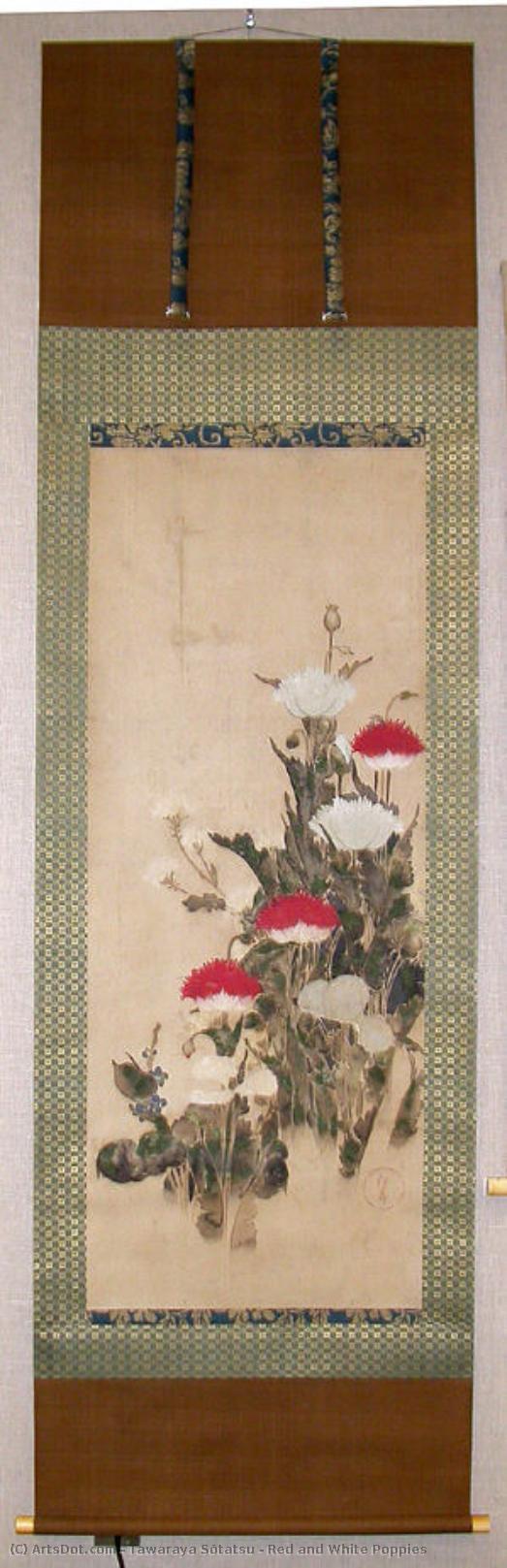
Admire 'Red & White Poppies,' a stunning Rinpa masterpiece by Tawaraya Sōtatsu. Explore this exquisite 17th-century painting's mineral pigments & elegant composition. A timeless work of art.
Discover Tawaraya Sōtatsu (c. 1570-1640), a pivotal Rinpa school painter known for bold designs, gold leaf, & iconic screens like Wind God and Thunder God. Explore his influence on Japanese art & tarashikomi technique.
Unlike many themes in the repertoire of Rinpa artists, poppies do not figure prominently in classic literature. In fact, this beloved flower, often depicted in Edo period painting, seems to have been introduced to Japan only in the 1630s as an exotic medicinal herb, the result of a growing interest in natural sciences. Here, boldly arranged in two clumps within the narrow vertical format and rendered in the heavy mineral pigments that characterize the works of Sōtatsu and his followers, this decorative rendition of the poppies nevertheless reveals a careful attention to naturalistic detail. These characteristics are notable in the work of Sōsetsu, who by 1639 had taken over Sōtatsu"s atelier, as well as the use of his Inen seal, a version of which is impressed on this work.