Kumi Sugai’s “The Summer Holiday”: A Vibrant Echo of Urban Modernity
Born in Kobe during a period of significant artistic ferment, Kumi Sugai emerged as a pivotal figure in post-war Japanese art. His journey, marked by relocation to Paris and a relentless pursuit of innovative expression, culminated in works like "The Summer Holiday," a captivating piece from the 1960s that embodies his evolution from lyrical abstraction to a bold embrace of hard-edge geometry. This painting, produced during a period of intense stylistic experimentation, offers a compelling glimpse into Sugai’s engagement with the rapidly changing urban landscape and his desire to translate its dynamism onto canvas.
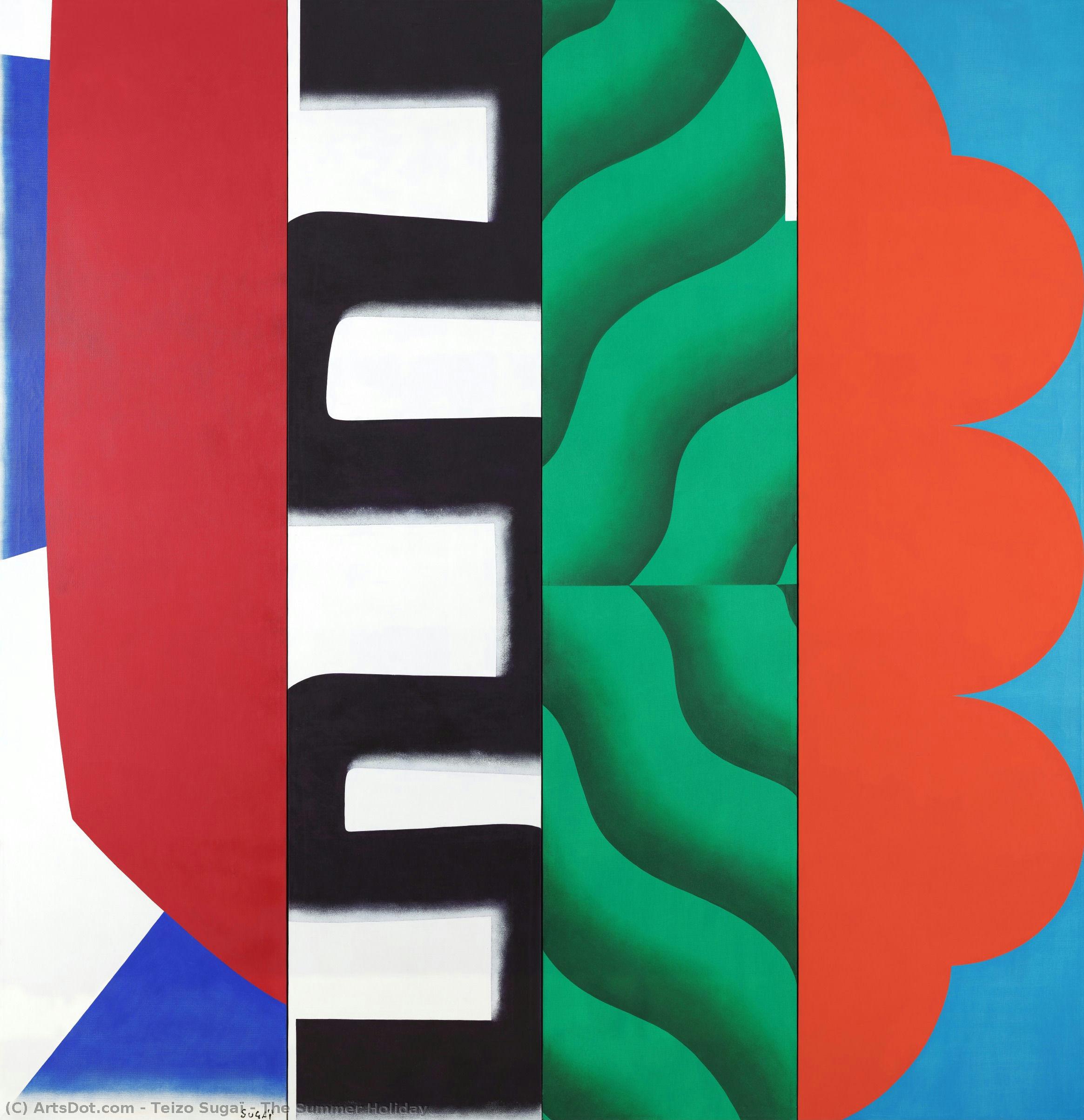
- Subject Matter: The composition depicts three distinct color blocks – vibrant red, lush green, and cool blue – arranged in a dynamic interplay that immediately draws the eye. Two human figures are subtly integrated into this abstract world, adding a layer of narrative ambiguity and inviting contemplation about their relationship to the surrounding forms.
- Color Palette: Sugai’s masterful use of color is central to the work's impact. The dominant red suggests energy and perhaps even speed – a nod to his fascination with automobiles – while the green evokes nature, albeit filtered through an urban lens. The blue provides a crucial counterpoint, offering a sense of distance and serenity.
- Technique: Executed in a hard-edge style, “The Summer Holiday” showcases Sugai’s deliberate rejection of traditional brushwork in favor of precise, geometric forms. This technique reflects the influence of American Hard-Edge painting but was uniquely adapted by Sugai to express his own vision of modern life.
Historical Context and Influences
Created in 1965, “The Summer Holiday” exists within a crucial period of artistic transition. Following World War II, Paris remained a vibrant hub for avant-garde movements, and Sugai’s time there exposed him to the work of artists like Piet Mondrian and Josef Albers, who championed geometric abstraction. However, Sugai wasn't simply replicating these styles; he was synthesizing them with his own Japanese sensibility and observations of contemporary urban life – particularly the impact of automobiles on the landscape.
The painting’s title itself—"The Summer Holiday"—suggests a fleeting moment of respite amidst this dynamic environment, perhaps reflecting Sugai's own desire to capture a sense of tranquility within his abstract explorations. The series it belongs to, “Auto Route,” further emphasizes this connection to the automobile and the evolving urban experience.
Symbolism and Emotional Impact
Beyond its formal qualities, "The Summer Holiday" resonates with deeper symbolic meanings. The repetitive curves, reminiscent of a road or highway, evoke a sense of movement and progression – mirroring the relentless pace of modern life. The figures within the composition are deliberately ambiguous, inviting viewers to project their own interpretations onto the scene.
Ultimately, Sugai’s work invites us to consider our relationship with technology, urban spaces, and the fleeting nature of experience. “The Summer Holiday” is not merely a decorative piece; it's a powerful statement about the challenges and possibilities of navigating the modern world.
Collecting Considerations
Reproductions of Kumi Sugai’s work offer an accessible way to appreciate his unique artistic vision. ArtsDot.com provides meticulously crafted hand-painted reproductions that faithfully capture the vibrancy and complexity of “The Summer Holiday.” Consider this artwork for its bold color palette, dynamic composition, and enduring relevance as a commentary on the modern condition. Its geometric precision and evocative use of form make it a compelling addition to any art collection or interior design scheme.