A Portrait of Melancholic Grace: Thomas Couture’s “Jeune Femme en Buste”
Thomas Couture's "Jeune Femme en Buste les Épaules Dénudées" (Young Woman in Bust Pose, Nude Shoulders) is a captivating study in Romantic sensibility and understated elegance. Painted around 1835-1879 – a period of significant transition within French art—this oil on canvas offers more than just a likeness; it’s an exploration of mood, vulnerability, and the quiet contemplation of youth. Initially rejected by the prestigious Prix de Rome competition six times, Couture ultimately forged his own path, establishing an independent atelier that challenged the rigid conventions of the École des Beaux-Arts, and this painting exemplifies his distinctive approach – one prioritizing emotional resonance over strict academic adherence.
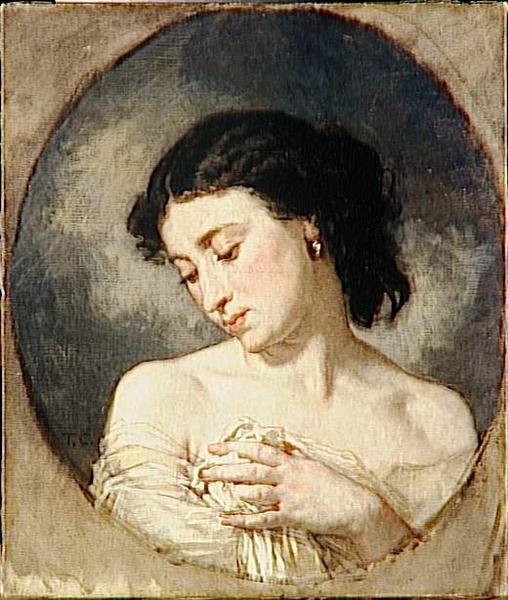
The composition immediately draws the viewer in with its central focus on the young woman’s face. Rendered with a remarkable sensitivity to light and shadow, her gaze, directed downwards, subtly conveys a sense of introspection or perhaps even wistful sadness. The loose oval framing created by the background serves to isolate her, intensifying the feeling of intimacy and drawing attention to her emotional state. Her left hand gently resting against her chest is a powerful gesture of quietude and vulnerability, reinforcing the overall melancholic atmosphere. Couture masterfully employs soft, blended lines throughout the painting – particularly in the background and around the woman’s features – creating an effect of hazy serenity that further enhances the sense of introspection.
Color, Light, and Texture: A Symphony of Subtlety
The color palette is remarkably restrained, dominated by a muted range of beige, cream, and grey. These cool tones are punctuated by delicate touches of pink on her face – suggesting youthful bloom – and darker browns and blacks in her hair and the subtle shadows that define her form. This limited chromatic vocabulary contributes to a harmonious and deeply evocative atmosphere. Couture’s use of light is equally deliberate; it's diffused and gentle, emanating from an unseen source above and slightly to the left, casting soft shadows that sculpt her features without harsh contrasts. The varied textures – the smooth rendering of her skin, the visible brushstrokes in the background, the subtly draped fabric – add a tactile quality to the painting, inviting the viewer to almost feel the softness of her garments.
Symbolism and the Romantic Spirit
Beyond its technical brilliance, “Jeune Femme en Buste” is rich in symbolic meaning. The downward gaze is a recurring motif in Romantic art, often representing contemplation, melancholy, or even a yearning for something beyond the immediate present. The bare shoulders – a deliberate choice by Couture – can be interpreted as symbols of innocence and vulnerability, further amplifying the painting’s emotional impact. The overall effect is one of quiet dignity mixed with a poignant sense of longing—a hallmark of the Romantic movement's exploration of human emotion and experience. It’s a portrait not merely of a young woman, but of an inner world.
Historical Context and Couture’s Legacy
Painted during a period of significant artistic upheaval, “Jeune Femme en Buste” reflects Couture’s own rebellion against the rigid formalism of the Académie des Beaux-Arts. He sought to create art that resonated with genuine emotion and individual expression, rejecting the idealized forms and historical narratives favored by his contemporaries. Thomas Couture was a pivotal figure bridging Romanticism and Realism—a painter who dared to challenge academic convention while simultaneously mastering its techniques. His independent atelier became a haven for artists seeking an alternative to traditional instruction, fostering a new generation of painters who prioritized emotional depth and personal vision. This painting stands as a testament to his innovative spirit and enduring artistic legacy.